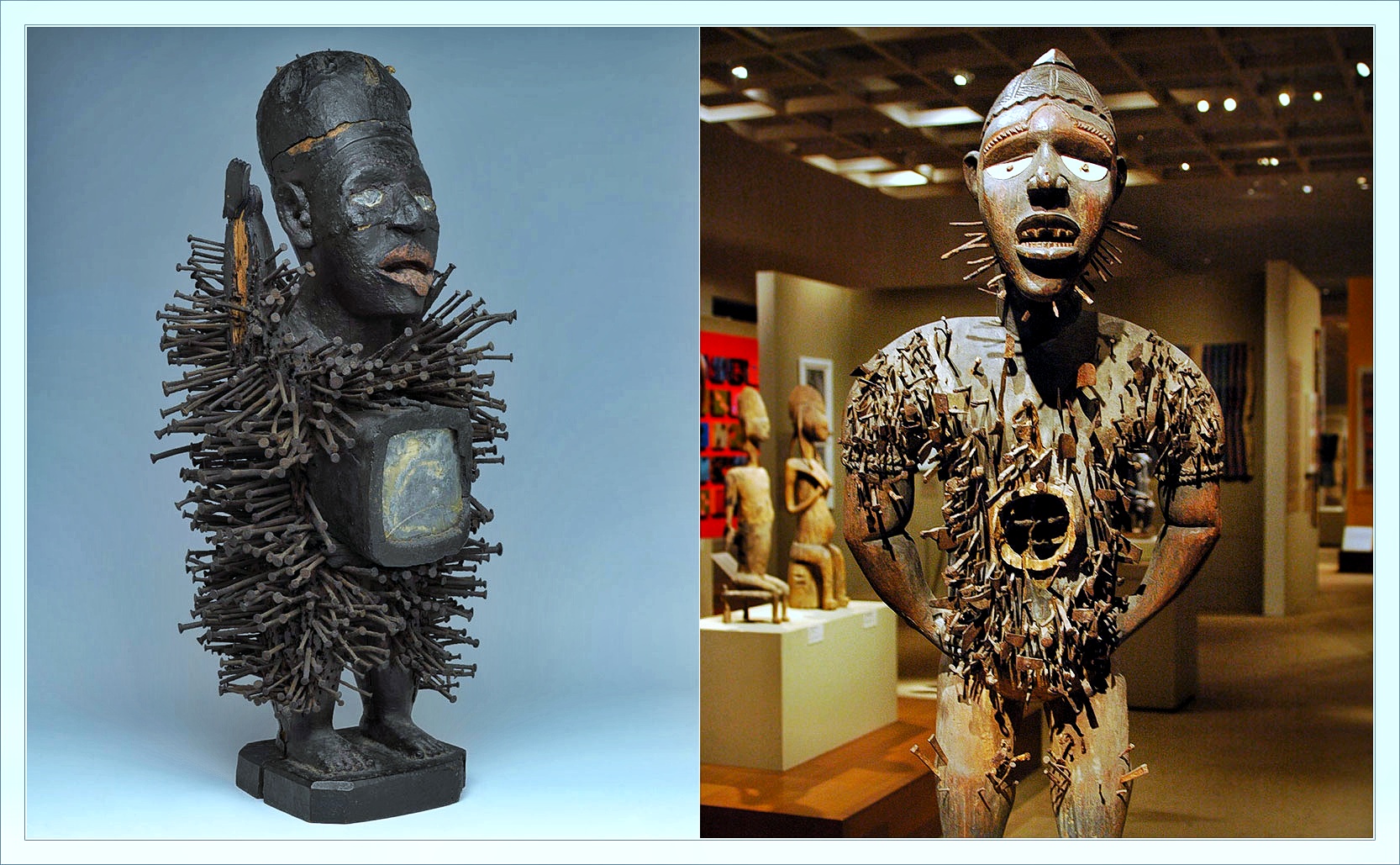
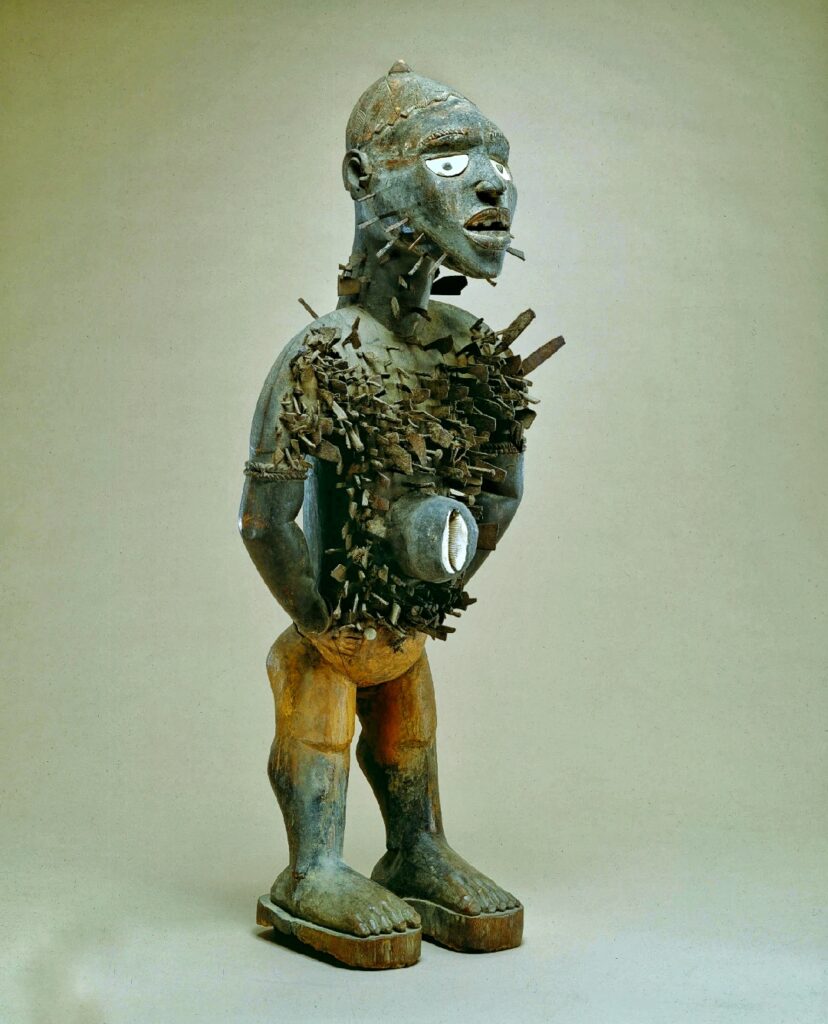
The Nkisi Nkondi is one of the most powerful and feared sacred objects ever produced on the African continent. It comes from the Kongo people, also known as the Bakongo, a Bantu ethnic group whose civilization was established across what is today the Democratic Republic of Congo, the Republic of Congo, Angola, and the Cabinda enclave. The Kingdom of Kongo itself was founded in the 14th century and grew into a highly organized state with its own legal systems, trade networks, and spiritual traditions.
The word “nkisi” in the Kikongo language translates to “sacred medicine.” The broader category of objects called minkisi (the plural of nkisi) refers to containers or figures believed to hold spiritual forces that can be activated to help or harm people. The Nkisi Nkondi is a specific and particularly aggressive type within this category. The name “nkondi” comes from the Kikongo verb “-konda,” which means “to hunt.” This was not a decorative object. It was a spiritual instrument designed to locate wrongdoers, enforce sworn agreements, and inflict punishment including death on anyone who violated the sacred rules attached to it without proper permission from the spiritual specialist who controlled it. Kongo testimony recorded in the early 20th century describes the object plainly: “The way of every nkisi is this: when you have composed it, observe its rules lest it be annoyed and punish you. It knows no mercy.”
These figures have been produced since at least the 16th century. The earliest known representation of an nkisi figure in an aggressive standing pose appears in the coat of arms of the Kingdom of Kongo, designed around 1512 and illustrated between 1528 and 1541.
Materials and Craftsmanship
The Nkisi Nkondi was not made by one person alone. It was a collaborative production between a wood carver and a spiritual specialist called a nganga. The carver produced the wooden figure, which could range in size from less than a foot tall to life-size, approximately 114 centimeters in height in documented museum examples. The wood was typically taken from a tree specifically cut for this purpose, sometimes following a ritual process directed by the nganga.
Once the wooden figure was carved, the nganga packed it with sacred substances collectively called bilongo. These materials were selected for their spiritual significance and included soil or earth taken from an important person’s grave, body parts or elements from powerful animals such as leopards, white clay called mpemba collected near cemeteries, plant matter, seeds, minerals, and in some cases gunpowder. A cavity was carved into the figure, usually in the belly or the head, to hold these substances. This cavity was then sealed shut with a piece of glass or mirror.
The materials inserted into the body of the figure after its consecration included iron nails, metal blades, pegs, shards, and other sharp objects. These were driven into the figure by the nganga on behalf of clients during rituals. The accumulation of these metal insertions over time gave the Nkisi Nkondi its most recognizable visual appearance. Some figures document dozens or even hundreds of individual insertions, each one representing a separate legal matter, oath, or petition.
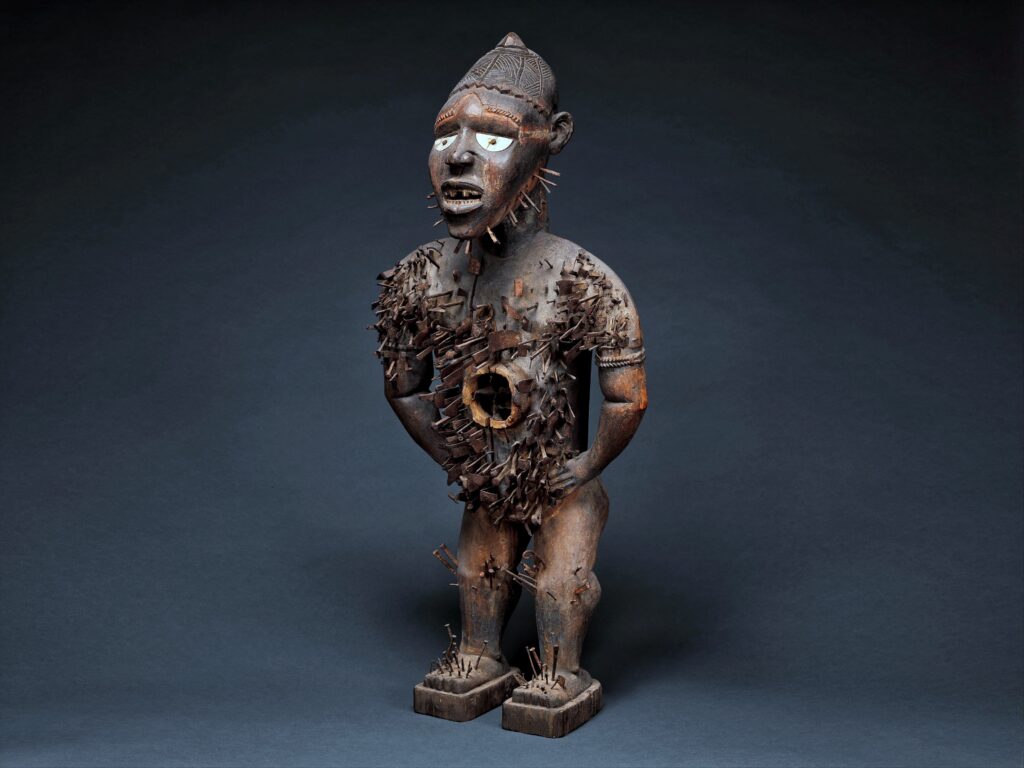
The Mangaaka type, which is the largest and most documented class of Nkisi Nkondi, was produced by a specific workshop active along the Chiloango River on the border of present-day Democratic Republic of Congo and Cabinda during the 19th century. Fifteen or more figures from this single workshop are known to exist in museum collections worldwide today.
Form and Features
The Nkisi Nkondi takes the form of a human figure, usually male, carved in a standing position. The posture is deliberately aggressive. The figure leans slightly forward, with its hands placed on its hips in a stance documented in Kongo scholarship as “vonganana,” which translates as “to come on strong.” Many figures were carved with one arm raised, sometimes holding a weapon. This pose signals readiness for confrontation.
The face of the figure is carved with an intense, direct expression. The eyes are wide and staring, and in many documented examples they are inlaid with reflective materials such as mirror glass or cowrie shells. According to Kongo belief, the reflective surface of the eyes allowed the spirit inside to look outward into the world of the living and identify enemies or wrongdoers.
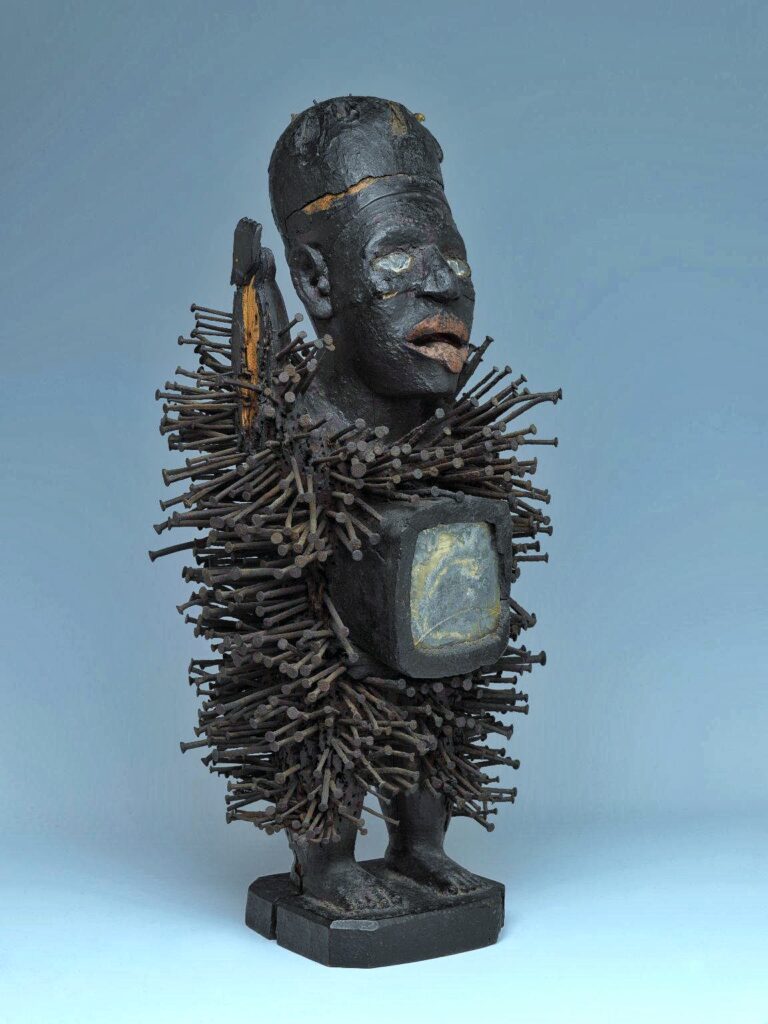
The belly of the figure contains the sealed cavity where the bilongo are stored. In the Mangaaka type, this cavity was covered with a large cowrie shell. The head is typically covered with the mpu headdress, a type of woven cap worn historically by Kongo chiefs and priests, which signals authority and high status.
The metal insertions covering the body are the defining visual feature of the Nkisi Nkondi. Each nail or blade was placed there during a specific ritual event. A small wooden peg indicated a matter that had been settled. A nail driven deeply into the figure indicated a more serious issue, such as a charge of murder or a major criminal accusation. Prior to insertion, the parties involved in a dispute would often lick the nail or blade to seal the agreement or accusation through their saliva, connecting themselves physically to the spirit inside the figure.
Function and Use
The Nkisi Nkondi served several documented functions within Kongo society, all of them related to the enforcement of social order and justice.
Its most common use was as a legal instrument. When two parties had a dispute, they would appear before the nganga and the Nkisi Nkondi. Both sides would state their positions, a nail or blade would be driven into the figure to seal the proceedings, and the spirit inside the figure was understood to be activated as a witness and enforcer. If either party later broke the terms of the agreement, the belief was that the spirit of the Nkisi Nkondi would hunt them down and bring sickness or death upon them. An oath taker could formally declare themselves vulnerable to the diseases associated with that specific nkisi if they violated their oath.
The figure was also used to identify criminals and thieves. A piece of material belonging to or connected to the accused, such as a fragment of animal hair in the case of livestock theft, could be tied to the figure so that the spirit would locate and punish the correct person.
It was additionally used to open and close trade routes, sanction social rules within a community, protect villages from outside harm, and end disputes that could not be resolved through ordinary means.
The nganga was the only person authorized to interact directly with the figure, to activate its power, and to direct it toward specific tasks. Anyone who handled or disturbed the figure without going through the nganga and without the proper ritual authorization was considered to have violated the rules of the nkisi. According to Kongo belief, this violation would result in the figure turning its power against that person.
Cultural Context
The Nkisi Nkondi existed within a complete religious and social system that shaped all aspects of life in Kongo society. The Kongo people believed in a supreme god called Nzambi, and also in a host of ancestral spirits who remained active after death and could be contacted and directed by qualified spiritual specialists.
The Kongo understanding of the world divided existence into two parallel realms: the world of the living and the world of the dead, separated by water. Death was not an ending but a transition. Ancestors continued to have power and knowledge, and the minkisi objects were the physical containers through which those powers could be brought into the world of the living.
The nganga occupied a critical position in this system. The nganga acted as a healer, a diviner, and a mediator between the living and the dead. They were trained specialists who knew how to compose minkisi, how to activate them, and how to control their power. Only the nganga could safely handle the Nkisi Nkondi in its fully activated state.
The Nkisi Nkondi functioned as the judicial system for communities that lacked written legal codes. Its authority was absolute within that system because the consequences of breaking its rules were understood to be enforced by a force that could not be bribed, escaped, or appealed to by ordinary means. This made it particularly effective as a tool for enforcing contracts, protecting community boundaries, and maintaining order.
The Portuguese arrived in Kongo territory in 1483 and began encouraging conversion to Christianity from the late 15th century onward. The ruling class of the Kingdom of Kongo formally adopted Christianity in the early 16th century. Despite this, the practice of creating and using minkisi continued, particularly in the northern Kongo regions that did not convert.
Discovery and Preservation
Europeans first encountered the Nkisi Nkondi during expeditions to the Congo region as early as the 15th century. However, extensive documentation and collection of these figures began primarily in the 19th century. The German Loango Expedition of 1873 to 1876 produced one of the earliest detailed written descriptions and illustrations of a nailed nkondi figure, identifying it as a “thief-finder.”
During the late 19th and early 20th centuries, colonial authorities from Belgium, France, and Portugal viewed the Nkisi Nkondi as an instrument of resistance against colonial control. Christian missionaries considered them evidence of paganism and had them removed from communities through coercion and in some cases by force. Many figures were destroyed in what missionaries called “iconoclastic bonfires,” intended to eliminate their influence. The figures that survived were collected by European traders, diplomats, anthropologists, and museums.
Robert Visser, a German trader and diplomat, collected large numbers of nkondi figures for German museums in Berlin and Stuttgart. Many of the major Mangaaka figures now in museum collections were removed from the Chiloango River region between 1880 and 1910.
The process of removal often involved deliberate deconsecration. In some documented cases, Kongo communities removed parts of the bilongo from the figures before allowing Europeans to take them, effectively deactivating them. A documented example is the Mangaaka figure now held at the World Museum in Liverpool, which was found to be missing its cowrie shell belly covering, its resinous beard, and its fiber skirt, all of which were integral to its spiritual function. Scholars believe these elements were intentionally removed by the original Kongo owners before the figure left the region.
Today, documented Nkisi Nkondi figures are held in collections at the Metropolitan Museum of Art in New York, the Detroit Institute of Arts, the World Museum in Liverpool, the Royal Museum for Central Africa in Tervuren, Belgium, the Fowler Museum at UCLA, the Dallas Museum of Art, and several institutions in Germany. The exact number of surviving figures is not confirmed, but scholars have identified over 15 examples from the Mangaaka workshop alone.
Why It Matters
The Nkisi Nkondi matters for several well-documented reasons that go beyond its dramatic appearance.
First, it demonstrates that pre-colonial African societies had fully developed systems of law, justice, and conflict resolution that did not depend on European legal frameworks. The Nkisi Nkondi served as a court, a judge, and an enforcement mechanism all in one, and it functioned within a community for generations.
Second, it is one of the most technically and intellectually sophisticated objects produced in the history of African art. The collaborative production process involving trained carvers and ritual specialists, the deliberate selection of materials for specific spiritual purposes, and the cumulative recording of legal events through each nail and blade make it an object that carried both artistic and documentary functions simultaneously.
Third, the history of how these figures left their communities reveals the wider story of colonial disruption of African spiritual and legal systems. The missionaries and colonial governments who removed these figures were not simply collecting art. They were dismantling functioning institutions.
Fourth, the Nkisi Nkondi had a direct and documented influence on the development of modern art. When European artists and scholars encountered these figures in the late 19th and early 20th centuries, they described them as extraordinary examples of formal innovation. The figures influenced artists working in the early 20th century who were developing what became known as modern and avant-garde movements.
Finally, the tradition of the Nkisi Nkondi did not disappear with colonization. Kongo spiritual practices traveled to the Americas through the Atlantic slave trade. Elements of nkisi tradition are documented in Hoodoo practices in the southern United States, in Palo Monte in Cuba, in Haitian Vodou, in Candomble Bantu in Brazil, and in other Afro-Atlantic spiritual systems. The Nkisi Nkondi is therefore not only an artifact of a lost world. It is an ancestor of living traditions practiced by millions of people today.