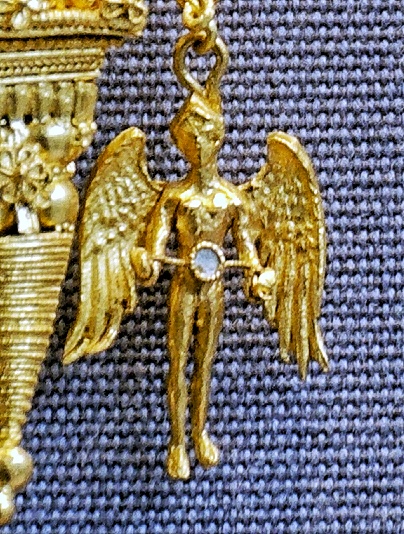
The sacred object believed to make any person irresistible is the Iynx, an ancient Greek spinning wheel used in love magic that has been documented in literary sources, archaeological artifacts, and ritual texts spanning more than two thousand years. Small enough to hold in one hand, spun on a cord between the fingers, and believed to generate an irresistible force of attraction in whoever witnessed its motion and heard its sound, the Iynx was not merely a mythological symbol. It was a physical object that people in the ancient world actually made, carried, and used in recorded ritual practice. The modern English word jinx derives directly from its name.
Origins: The Nymph Who Invented Irresistibility
The Iynx takes its name from a nymph in ancient Greek mythology who was credited with its invention. According to multiple classical sources including the scholia on the works of Theocritus and Pindar, Iynx was the daughter of Pan, the god of wild nature, and either Echo or Peitho, the goddess of persuasion. She was renowned for her ability to produce spells of attraction so powerful they could override the will of gods.
The most famous mythological account of the Iynx describes how she used her spinning wheel to make Zeus, the king of the gods, fall in love. Depending on the source, she did this either for her own desires or on behalf of the nymph Io. When Hera, Zeus’s wife and the goddess of marriage, discovered what had happened, she punished Iynx by transforming her into the wryneck bird, known in Greek as iynx torquilla. This bird, a member of the woodpecker family, was noted in the ancient world for the dramatic twisting motions of its neck during mating rituals, which were interpreted as a physical embodiment of erotic enchantment.
After the transformation, the object named after the nymph retained her powers. The spinning wheel that bore her name continued to be used as the primary instrument for generating irresistible attraction in any person who deployed it correctly.
What the Iynx Was
The Iynx was a small circular disk made from materials including gold, bronze, lead, terracotta, crystal, and wood, depending on the status and resources of the person commissioning or making it. Two or more small holes were drilled through the center of the disk. A cord of leather or thread was passed through these holes and tied at both ends to create a loop. The user held one end of the cord in each hand and wound it repeatedly in one direction until the cord was tightly twisted. When the hands were then pulled apart rhythmically and released in alternating tension, the disk spun rapidly in one direction, then the other, producing a distinctive whirring sound.
This sound was central to the object’s ritual function. Ancient practitioners believed that the sound of the spinning Iynx, combined with the spoken invocations recited during its use, activated the forces of attraction that the object was designed to direct toward a specific person. The Byzantine scholar Michael Psellos documented that practitioners devoted to Hekate used the Iynx as a primary ritual tool. The philosopher Damascius also described it in detail. The Chaldean Oracles, a collection of mystical texts from the 2nd century AD, include the instruction: “Work with the strophalos of Hekate,” using an alternative name for the same device.
In some versions of the object, a live wryneck bird was incorporated into the construction, attached to the wheel so that the bird’s body and neck movements became part of the spinning action. This was the original form, derived directly from the mythology of the nymph Iynx. In later practice, the bird was replaced by bird imagery carved or painted onto the disk itself. A terracotta wheel adorned with five wryneck birds, dated to between 350 and 300 BC, was excavated from the cemetery of the ancient site of Akanthos in Chalkidiki, Greece, and is now held at the Archaeological Museum of Thessaloniki. This artifact provides direct physical evidence of how the Iynx appeared in practice.
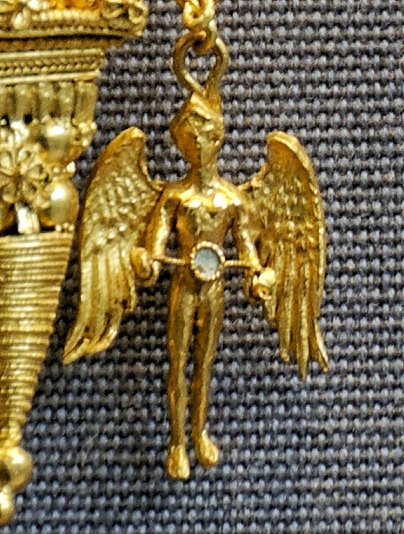
Aphrodite, Eros, and the Iynx
The mythological gift of the Iynx from Aphrodite to Jason is one of the most detailed accounts of the object’s use in ancient literature and connects it directly to the goddess of love herself.
In Pindar’s Pythian Ode 4, composed in 462 BC, Aphrodite fashions an Iynx specifically to enable Jason to make Medea fall in love with him during the Argonauts’ quest for the Golden Fleece. By using the spinning wheel with the wryneck bird attached and reciting the prescribed incantations, Jason induced in Medea an overwhelming passion that caused her to betray her father, her homeland, and everything she knew in order to help him. Pindar’s account treats this as a factual description of how the Iynx worked: spin the wheel, speak the words, direct the force toward the target, and the attraction becomes irresistible.
The poet Theocritus, writing around 270 BC, composed his second Idyll as a dramatic monologue spoken by a woman using magic to draw back an unfaithful lover. The poem’s refrain, repeated throughout the work, is addressed directly to the Iynx itself: “Spin magic wheel spin, and bring my lover home.” This refrain has been preserved in numerous translations and is one of the most cited examples of the Iynx in ancient literature. The poem treats the object as a real tool being actively used during the composition, not as a mythological reference.
Eros, the god of desire and son of Aphrodite, was depicted in ancient art holding an Iynx. A gilded copper ring dated to between 350 and 300 BC, found at Naukratis in Egypt and now held at the British Museum under catalog number 1888,0601.1, shows Eros crouching and holding an Iynx wheel on a string. The inscription associated with this object describes its purpose as being used “to attract lovers and call back faithless lovers.” This ring demonstrates that the Iynx was not only a ritual tool but a recognized symbol of the power of attraction that people wore and carried as a personal amulet.
How the Iynx Was Used
The ritual use of the Iynx followed a specific procedure that combined physical action, sound, and spoken words directed at a named target.
The practitioner would hold the cord of the Iynx between both hands, wind it to the point of tension, and then begin spinning it rhythmically. As the disk spun and produced its whirring sound, the practitioner recited the name of the person they wished to attract and the invocation to the relevant deity, which was typically Aphrodite, Eros, or Hekate depending on the tradition and context of the ritual. The combination of the sound, the motion, and the spoken name was believed to create a direct channel between the practitioner and the forces of attraction, directing them toward the target with a force that could not be refused.
Ancient magical theory supported this mechanism through the doctrine of sympathetic correspondence: the motion of the wheel pulling against itself mirrored the pulling of the target toward the practitioner. The sound mimicked the call of the wryneck bird, which was understood as a voice of erotic compulsion inherent in nature itself. The spinning motion also corresponded to what ancient practitioners called the turning of fate, using the physical action to influence the spiritual reality of the situation.
The Chaldean Oracles, drawing on Greek and Near Eastern mystical traditions, described the sound produced by spinning ritual objects as aligned with specific planetary and astral frequencies. Practitioners believed that the seven Greek vowels, pronounced correctly during the spinning of the Iynx, each corresponded to one of the seven planetary spheres and could invoke the divine forces associated with each planet. This made the Iynx not merely a love charm but a tool for accessing cosmic levels of influence, which is why ancient sources described its effects as irresistible rather than merely persuasive.
The Wryneck Bird and Its Documented Properties
The wryneck bird, iynx torquilla, was understood in the ancient world as a natural embodiment of the same force that the Iynx wheel produced artificially. The bird’s unusual behavior during mating, in which it twists its neck dramatically, rolls its eyes, and produces a distinctive pulsing cry, was interpreted as a living demonstration of erotic enchantment made visible in nature.
Ancient Greek texts noted several properties of the wryneck that were considered evidence of its connection to irresistible attraction. When threatened, it produces a hissing sound and mimics the movements of a snake, which was associated in Greek magical tradition with the binding and captivating powers of certain chthonic forces. Its cry was described as capable of drawing potential mates from considerable distances, which was taken as proof that the bird possessed natural attraction magic that the Iynx wheel could be used to channel.
The bird was associated with Aphrodite, Eros, and Hekate in different branches of the tradition. Its connection to Hekate specifically linked the Iynx to the darker dimensions of love magic, the kind that did not merely attract but compelled. Ancient sources describe this distinction. Aphrodite’s version of erotic attraction was understood as a naturally arising desire. The Iynx, particularly when connected to Hekate, was associated with a more forceful compulsion that overrode the target’s own will and replaced it with obsessive desire.
Archaeological Evidence
Physical artifacts associated with the Iynx and its traditions have been recovered from multiple archaeological contexts across the ancient Mediterranean.
The terracotta wheel with wryneck birds from Akanthos, dating to 350 to 300 BC and held at the Archaeological Museum of Thessaloniki, is one of the clearest surviving physical examples. Additional votive wheels and bird figurines have been found in ritual deposits and burial sites, particularly at sanctuaries associated with Aphrodite and at cemeteries. The presence of these objects in burial contexts confirms their connection to chthonic traditions, the forces associated with the underworld and with binding magic directed toward absent or deceased persons.
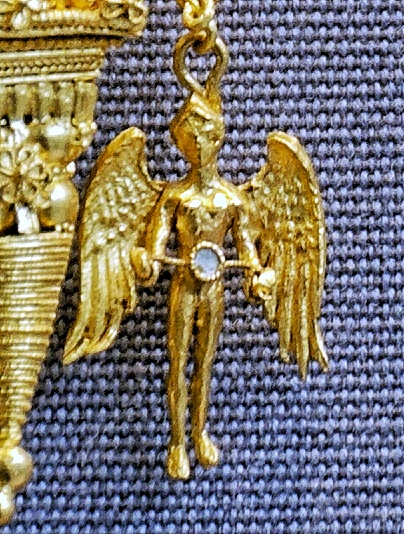
The gilded copper ring from Naukratis at the British Museum, showing Eros holding an Iynx, confirms that the object was reproduced in miniature as a personal amulet meant to be worn as a talisman of irresistibility. The explicit inscription identifying its purpose as attracting and recalling lovers makes this artifact one of the most directly documented objects of its type in any museum collection.
Archaeological contexts from Phaleron in Attica, as well as from sites in Corinth and across the broader Greek world, have yielded comparable finds. The distribution of these objects across multiple regions over several centuries confirms that the Iynx was not a local or isolated tradition but a widespread practice embedded in the everyday ritual life of the ancient Greek world.
The Greek Magical Papyri and the Iynx Tradition
The Greek Magical Papyri, a collection of magical texts compiled in Graeco-Roman Egypt from sources dating between the 2nd century BC and the 5th century AD, contain numerous spells of attraction that belong to the same tradition as the Iynx. These texts, now held primarily at the British Library, the Louvre, and other major institutions, document the specific invocations, materials, and procedures used to make a person irresistible or to direct irresistible attraction toward a specific target.
One spell within the collection is explicitly titled an “irresistible love spell of attraction.” Others describe spinning an object in combination with spoken formulas directed at specific gods to produce immediate and overwhelming desire in the named target. The pattern of spinning motion combined with divine invocation, which is the core procedure of the Iynx, appears throughout the papyri as the fundamental mechanism of attraction magic.
The papyri also document objects that functioned as amulets to make the wearer continuously irresistible, including engraved gemstones, rings with specific inscriptions, and small disks bearing the image of Aphrodite. These objects extended the Iynx tradition into portable, wearable forms that people could carry constantly rather than use in a single ritual occasion.
The Name Iynx in Modern Language
The word jinx, used in modern English to describe a curse or a person who brings bad luck, derives directly from the Greek word iynx. The transition from meaning irresistible attraction to meaning a negative influence reflects the transformation in how ancient magical traditions were perceived as they passed through the medieval period and into modern language. In its original Greek context, the iynx was not a curse. It was the opposite: an irresistible force of positive attraction directed toward a specific person. The shift in meaning occurred as the Christian tradition reframed all forms of erotic magic as negative or diabolical, gradually reversing the original significance of the word.
This etymology confirms that the cultural memory of the Iynx was sufficiently strong and widespread to leave a trace in the vocabulary of modern European languages even after the specific knowledge of the object itself had been largely forgotten.