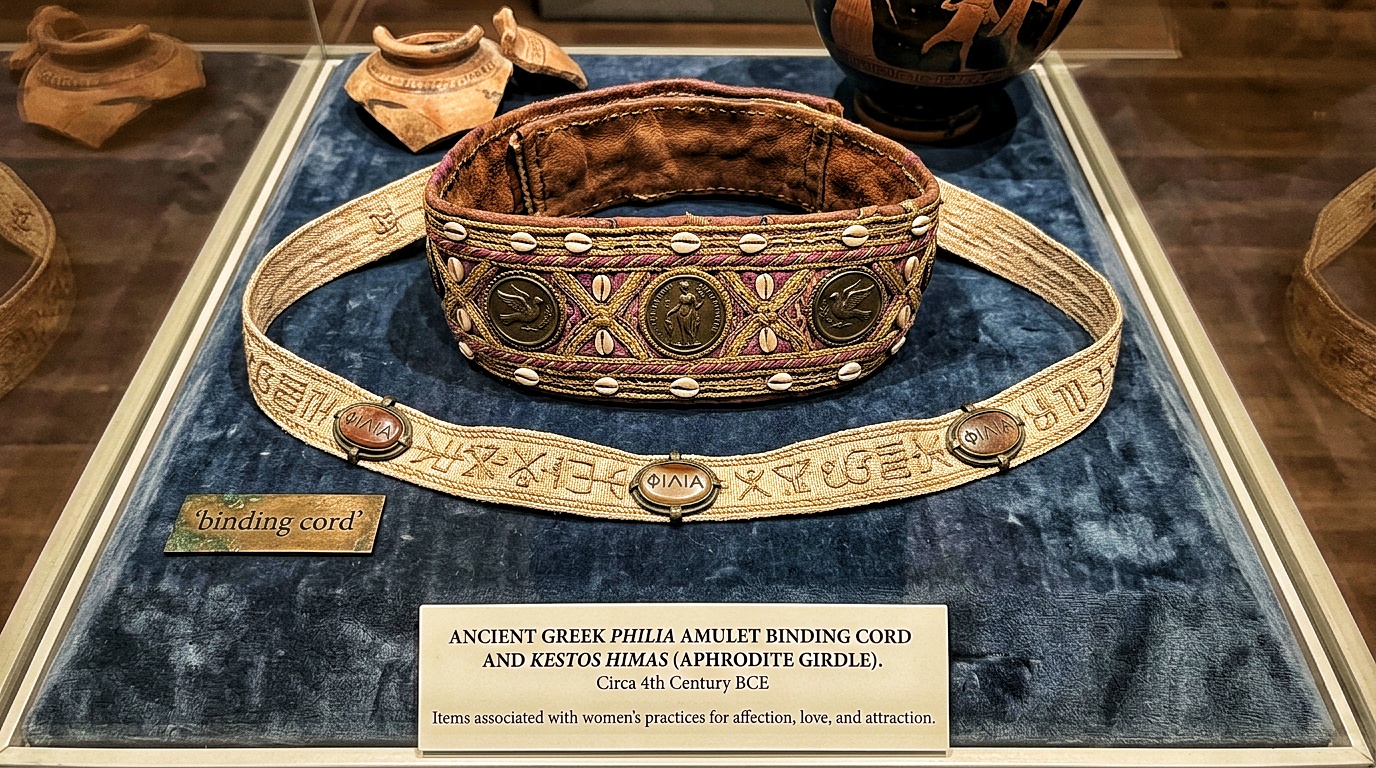
The ancient artifact women used to keep their men forever was not a weapon, not a crown, and not a religious relic in the conventional sense. It was a small, carefully crafted object worn directly against the body, inscribed with invocations to gods, tied in precise knots, anointed with specific substances, and used in private ritual to bind a husband’s affection permanently to the woman who wore it. Across the ancient Mediterranean world, from Greece to Rome to Egypt, women commissioned, purchased, and created these objects for one documented purpose: to prevent a man from straying, restore his affection when it had cooled, and make him permanently devoted to the woman who held the artifact.
Scholars have studied these objects and the traditions surrounding them extensively. The most thorough academic analysis was produced by Christopher Faraone, Professor and Chairman of Classics at the University of Chicago, whose 1999 book published by Harvard University Press established the foundational framework for understanding these practices. His research identified a category of ancient magic called philia, a Greek word meaning affection or friendship, which was practiced primarily by women and directed primarily at keeping men. The objects central to this practice included amulets, rings, knotted cords, ointments, and a mythological archetype that underpinned the entire tradition: the Kestos Himas, the magical girdle of the goddess Aphrodite.
The Kestos Himas: Where the Tradition Began
The earliest and most authoritative reference to an artifact used by women to bind male affection appears in Book 14 of the Iliad, Homer’s epic poem composed in the 8th century BC. In this passage, the goddess Hera wishes to seduce her husband Zeus and distract him from interfering in the Trojan War. She approaches Aphrodite, the goddess of love, and asks to borrow her magical girdle. Aphrodite immediately understands what Hera wants and removes the object from her own chest, handing it over with the words: “Take now and lay in thy bosom this zone, curiously-wrought, wherein all things are fashioned; I tell thee thou shalt not return with that unaccomplished, whatsoever in thy heart thou desirest.”
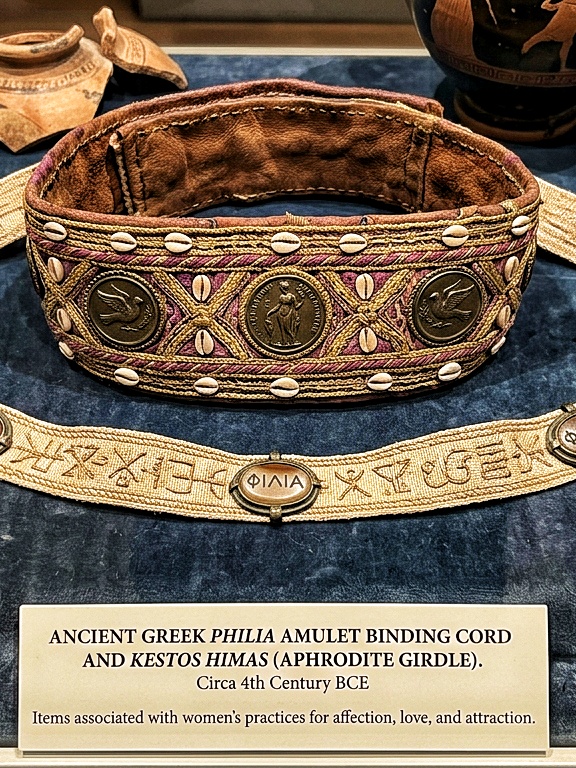
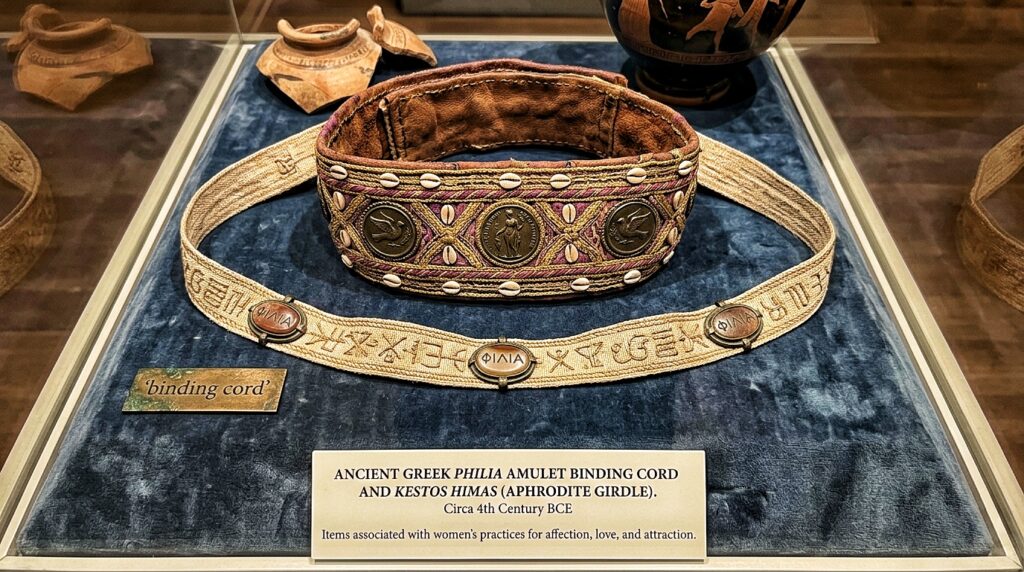
The object Homer describes is the Kestos Himas, a term combining the Greek words for embroidered strap and girdle. It was described as an intricately worked breast band or sash woven with what the text calls “all manner of allurements: therein is love, therein desire, therein dalliance, beguilement that steals the wits even of the wise.” Hera borrows it, places it against her skin, goes to Zeus, and the plan works exactly as intended. Zeus, confronted with his wife wearing the Kestos Himas, becomes overwhelmed with desire for her and forgets everything else.
Homer’s account is a divine version of what women in the ancient world actually practiced in their own lives. The goddess used a divine artifact to keep her husband devoted. Mortal women used physical objects fashioned in imitation of that same principle to accomplish the same goal with their own partners.
The Kestos Himas also appears in later classical literature. The poet Nonnus, writing in the 5th century AD, refers to Aphrodite girding herself in “the heart-bewitching cestus-belt” before intervening in divine affairs. The Roman writer Apuleius mentions Aphrodite wearing her belt around her waist in his 2nd century AD novel The Golden Ass. The courtesan Hermione, referenced in ancient sources, wore a physical girdle of flowers with a spell inscribed in gold that read: “Keep loving me for ever and do not get angry if another man holds me.” This was not mythology. This was documented practice.
Philia Magic: The Women’s Tradition
Faraone’s research established that ancient love magic divided into two sharply distinct categories along gender lines. Men predominantly used aggressive erotic spells called agoge, which were modeled on curse tablets and designed to inflame desire in a target woman through torment and compulsion. These were attack-based rituals.
Women predominantly used philia spells, which were fundamentally different in both method and intent. Philia magic aimed not to inflame but to calm, not to torment but to bind, not to attack but to preserve. Women used it to keep a husband from straying, to restore warmth to a marriage that had cooled, and to ensure a man’s continued affection and fidelity. The objects used in philia magic came directly from the tradition of healing magic rather than curse magic, which is why they differed so sharply in character from what men practiced.
The standard philia toolkit included rings, amulets, knotted cords, facial ointments, and potions. These were not random choices. Each object had a specific role in the ritual technology of keeping a man bound to the woman who possessed them.
A ring bearing specific inscriptions or gemstones associated with love and fidelity was worn or placed where the husband would encounter it. Amulets depicting Aphrodite, inscribed with binding formulas, or set with stones believed to influence emotional states were worn against the skin. Knotted cords were tied with specific numbers of knots while reciting the appropriate words, then kept in the household or worn on the body. Ointments were applied to the face or body before encountering the husband, with the belief that the substance carried the binding intention into physical contact.
The court speech Against the Stepmother for Poisoning, written by the Athenian orator Antiphon in the 5th century BC, contains one of the most revealing documentary records of this tradition. The case concerned a woman accused of murdering a man with a substance she had given him to drink. Her defense was that she had not intended to poison him at all. She had administered a philia potion, a love-binding drink, to reinvigorate a marriage she was afraid of losing. The fact that this defense was presented in a public Athenian court, and that the jury was expected to find it plausible, confirms that philia potions were a recognized and understood part of daily life in ancient Athens.
The Girdle as a Physical Object
Beyond mythology and literary references, physical objects fitting the description of philia amulets and binding artifacts have been recovered from archaeological contexts across the ancient Mediterranean.
Rings inscribed with love formulas have been found in both Greek and Roman contexts. Amulet stones depicting Aphrodite with her attributes, including her characteristic girdle, have been recovered from sites in Egypt, Greece, and Italy and are dated to periods spanning the 1st century BC through the 5th century AD. These objects were worn by both men and women, though scholarly analysis of jewelry contexts suggests that the intimate, body-worn love amulets were predominantly associated with women.
The Kestos Himas as a physical garment had real-world equivalents. The strophion, a twisted breast band worn by Greek women, was the type of garment Homer was describing when he referred to Aphrodite’s magical girdle. Ancient Greek and Roman art depicts Aphrodite wearing this garment in numerous surviving sculptures and vase paintings. The tradition of dedicating girdles to Aphrodite at the time of marriage was documented in ancient sources, with brides offering their own girdles to the goddess as part of wedding ceremonies. This ritual acknowledged the girdle as a sacred object connected to marital fidelity and the preservation of desire within the institution of marriage.
The word Kestos itself passed into Roman use as Cestus, and references to women obtaining or wearing cestus garments for amatory purposes appear in Roman literature. Sextus Julius Africanus, a 3rd century AD Roman writer, titled one of his major works Kestoi, meaning Charmed Girdles, a 24-book compilation that drew on ancient traditions of magical practice including those connected to the erotic properties attributed to Aphrodite’s girdle.
The Egyptian Parallel: Women, Spells, and Binding Objects
The tradition of women using physical artifacts to bind male affection was not limited to the Greek world. Ancient Egypt had an equally rich and in some respects older practice of love binding that paralleled the philia tradition and almost certainly influenced it given the close cultural contact between Egypt and Greece during the Hellenistic period.
The Greek Magical Papyri, a collection of magical texts compiled in Graeco-Roman Egypt from sources dating between the 2nd century BC and the 5th century AD, contains numerous spells for binding lovers and preserving affection. These texts were produced in a cultural environment that fused Egyptian, Greek, and later Roman elements, and they document practices that women in Egypt used for the same purposes as women elsewhere in the ancient world.
A particularly significant papyrus held at the Oriental Institute in Chicago describes a binding spell commissioned by a woman named Taromeway for a man named Kephalas. The spell calls upon the noble spirit of the necropolis to find this man and give him anxiety at midday and evening and all the time until he comes to Taromeway and succumbs to her. Scholars have noted that this particular spell is unusual because most erotic binding spells in ancient Egypt were used by men to pursue women. This example shows a woman commissioning the full apparatus of binding magic, including the written spell, the divine invocations, and almost certainly physical objects as part of the ritual, to secure a man’s permanent attachment to her.
The Tit amulet, also known as the Isis Knot, was a specifically female amulet associated with the goddess Isis and her ability to protect, heal, and bind relationships. It appeared in Egyptian religious and magical contexts over many centuries and was frequently connected with the preservation of domestic bonds.
Why Women Used These Artifacts
Understanding why women across the ancient world turned to philia amulets and binding objects requires understanding the social conditions in which they lived.
In ancient Greece, women occupied a legally dependent position. They could not vote, could not own property in their own names in most city-states, and had very limited recourse if a husband chose to abandon the marriage, take additional partners, or simply become cold and indifferent. A married woman’s security, social standing, material welfare, and the welfare of her children all depended on maintaining her husband’s continued attachment to the household she managed.
Faraone’s research documented that philia magic was the specific tool women used to address this vulnerability. It was not used to create desire from nothing. It was used to maintain and restore affection that already existed or had existed. The objects functioned as what he called healing magic applied to the context of a relationship, treating estrangement, infidelity, and emotional distance the same way other healing magic treated illness: by applying a specific material object, prepared in the correct manner, with the appropriate verbal formula, to restore the natural condition that had been disrupted.
Men in ancient Athens found these practices profoundly threatening, and legal records reflect this. Roman law as elaborated by the jurist Paul in the 3rd century AD included philia potions and binding objects within the category of potentially illegal magical interference. The very fact that legal structures addressed these practices confirms they were real, widespread, and taken seriously as instruments of social influence.
The Knotted Cord: The Most Documented Physical Artifact
Among all the physical objects women used in philia practice, the knotted cord is the most thoroughly documented in ancient sources and is the most direct material artifact of the tradition.
Knotted cords appear in ancient magical texts, literary descriptions, and eventually in legal records as objects women made and kept for the purpose of binding male affection. The number of knots, the material of the cord, and the words spoken during the knotting process were all specified in the magical traditions that governed their preparation. The act of tying a knot was understood as a physical enactment of binding, the word and the gesture reinforcing each other.
This tradition was not isolated to one culture. Knotted cords used for binding purposes appear in ancient Egyptian, Greek, Roman, and Near Eastern magical traditions. Their presence across independent cultural contexts suggests either broad cultural transmission or the parallel development of the same symbolic logic: that tying a physical knot while speaking the name of the person to be bound was an effective mechanism for maintaining attachment.
The 3rd century AD magical text tradition in Egypt contains specific instructions for knotted cord preparation intended to preserve the affection of a husband. Women are directed to tie specific numbers of knots in a specific sequence, speaking the husband’s name and the desired outcome at each stage, then to keep the cord in the household or wear it on the body. The cord itself became the artifact holding the intention, and its continued presence in the home was believed to sustain the binding it had established.
The Louvre Figurine: Archaeological Evidence
One of the most significant physical artifacts confirming the reality of ancient binding practices was discovered in Egypt and is now housed at the Louvre Museum in Paris. It is a clay female figurine in a kneeling position, pierced with thirteen copper needles, found inside a terracotta vase alongside a lead tablet bearing a binding spell in Greek.
The lead tablet is 28 lines long and begins with an invocation to chthonic gods including Pluto, Persephone, Hermes, and Anubis. It was designed as a binding spell directing spirits to bring the named target to the person who commissioned the ritual. This particular object represents the more aggressive agoge tradition rather than philia practice, but its physical characteristics document the material culture surrounding all forms of ancient binding magic and confirm that the objects described in texts were actually made and used in the way the texts describe.
Other physical evidence includes amulets depicting Aphrodite recovered from Greek, Roman, and Egyptian archaeological sites, inscribed rings from multiple periods and locations, and fragments of papyrus bearing love binding texts that were clearly carried as portable documents rather than stored as archives.
The Legacy of the Kestos Himas
The tradition established around the Kestos Himas and the broader philia practice did not simply vanish with the end of the ancient world. It persisted in modified forms through the medieval period in Europe, where women were documented using amulets, knotted cords, and potions for the same purpose, and where the accusations brought before inquisitorial courts frequently centered on women believed to have bound men through magical means.
The Malleus Maleficarum, the 15th century witch-hunting manual, identified women’s use of binding objects and love magic as a primary category of witchcraft. This document reflects not a new invention but a continuation and reframing of practices documented in the ancient world, now criminalized under a different legal and theological framework.
The irony documented by historians is that the same practices that ancient Greek and Roman societies tolerated as understandable female responses to social vulnerability became, under later European law, evidence of criminal association with demonic forces. The artifact and the intention remained substantially the same across more than a thousand years. What changed was who had the power to define them.
Surviving examples of philia amulets, binding rings, and inscribed objects from the ancient Mediterranean are held in museum collections across Europe and North America including the Louvre, the British Museum, the Metropolitan Museum of Art, and the Oriental Institute in Chicago.