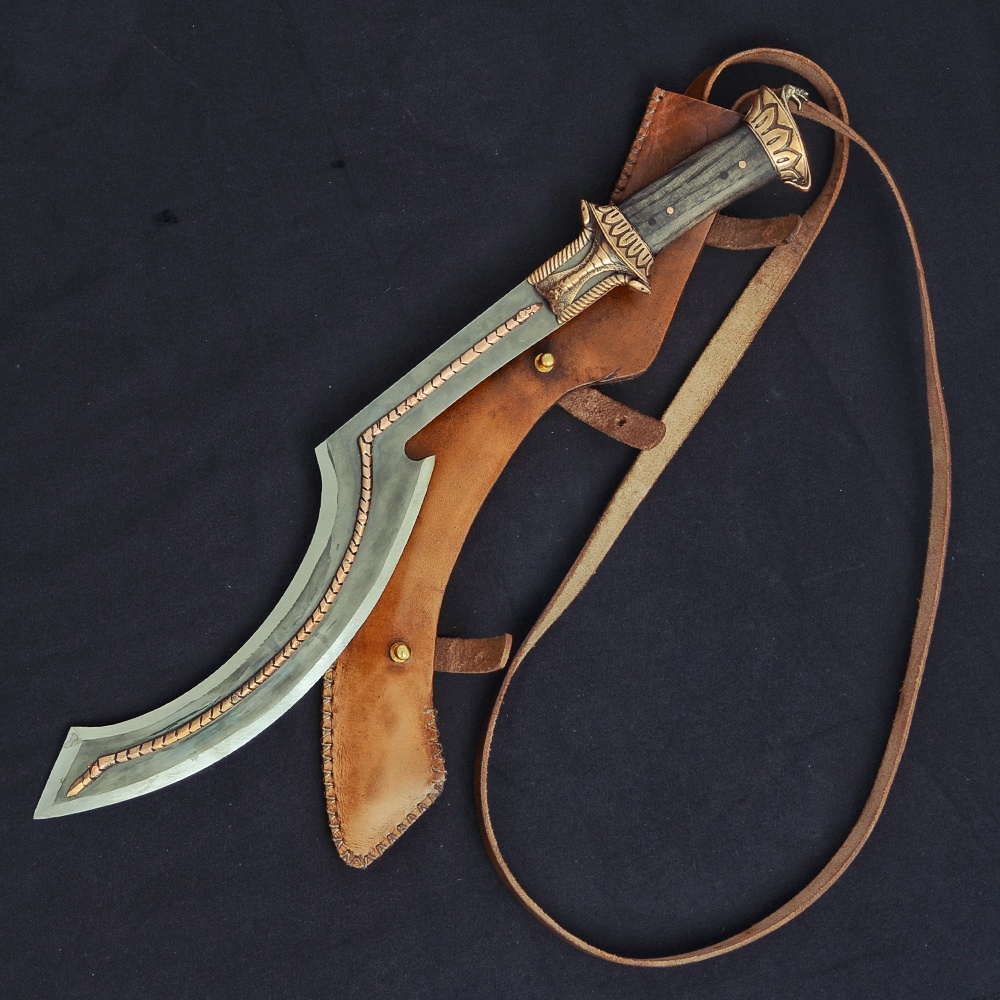
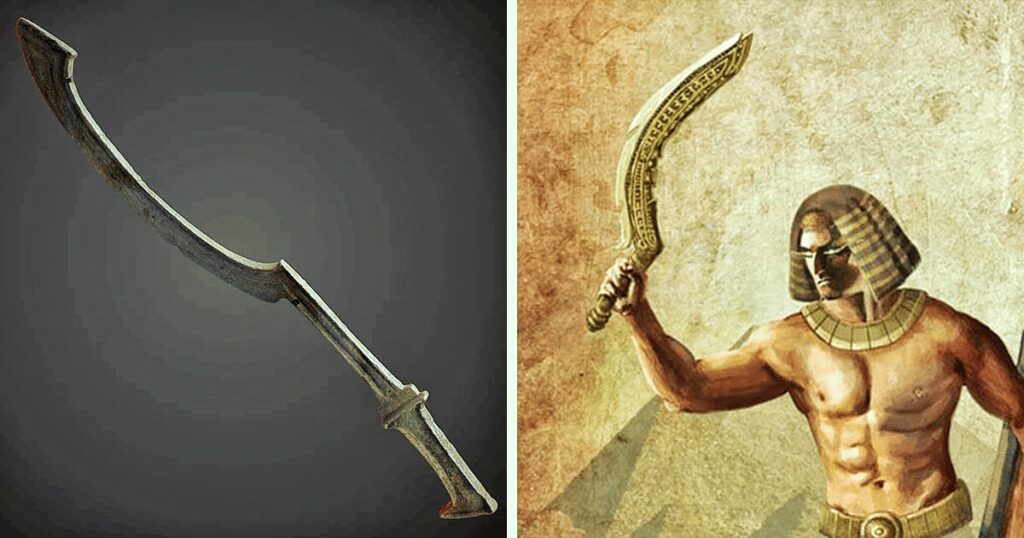
The sacred artifact kings used to destroy their enemies is the Khopesh, the curved sickle-sword of ancient Egypt that stood at the intersection of military power, divine authority, and royal ceremony for over a thousand years. From approximately 2500 BC through the end of the New Kingdom period around 1070 BC, the Khopesh was the most recognizable weapon in the Egyptian world, wielded by pharaohs on the battlefield and depicted across temple walls, royal monuments, and tomb paintings as the physical instrument through which kings imposed the will of the gods upon their enemies. No other weapon in the ancient world carried the same combined weight of practical military function and sacred royal symbolism.
Material and Craftsmanship
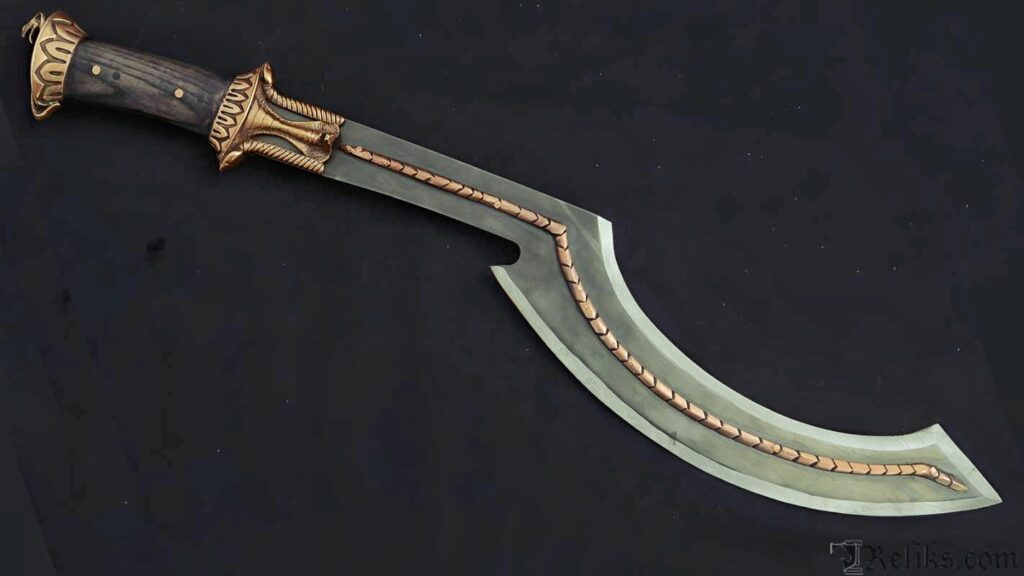
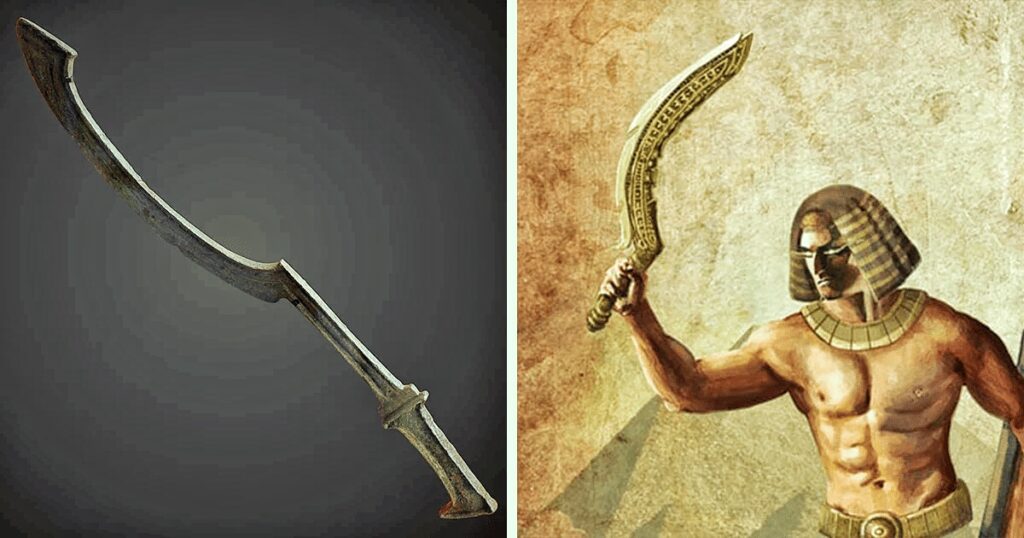
The Khopesh was produced primarily in bronze during the Middle and New Kingdom periods of ancient Egyptian history, with later examples transitioning to iron as metallurgical technology advanced. A typical Khopesh measured approximately 50 to 60 centimeters in total length and consisted of three distinct sections. The first was the hilt, measuring roughly 18 centimeters and designed for a secure one-handed grip. The second was a straight, unsharpened section of blade extending between 15 and 30 centimeters from the hilt. The third was the distinctive curved, crescent-shaped section at the end, measuring between 30 and 40 centimeters, with a sharpened edge along the outer convex curve.
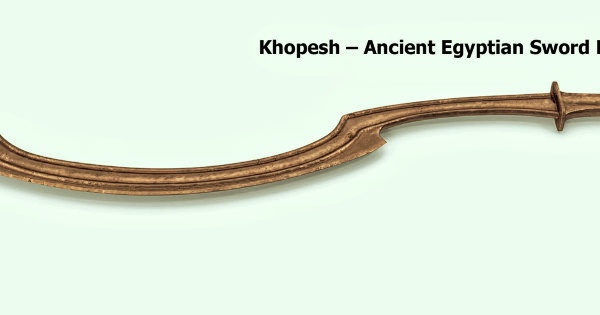
The curved section was the defining feature of the weapon and the element that gave it both its functional advantages and its symbolic identity. The sharpening of the outer convex edge rather than the inner concave edge was an unusual design decision that made the Khopesh effective for slashing and hooking attacks rather than thrusting. This placed it in a category distinct from the straight swords of other cultures, which relied primarily on penetrating thrusts.
Bronze casting quality varied depending on the purpose of a given Khopesh. Battlefield weapons were forged for durability and edge retention. Ceremonial versions, such as the two Khopesh swords found in the tomb of Tutankhamun, were crafted with deliberate ornamentation. The Tutankhamun examples, dating to approximately 1332 to 1323 BC, were made from bronze and ebony, measured 59.5 centimeters in length, and carried dull edges indicating they were never intended for combat. They are currently held at the Egyptian Museum in Cairo under catalog number JE 61588.
Form and Features
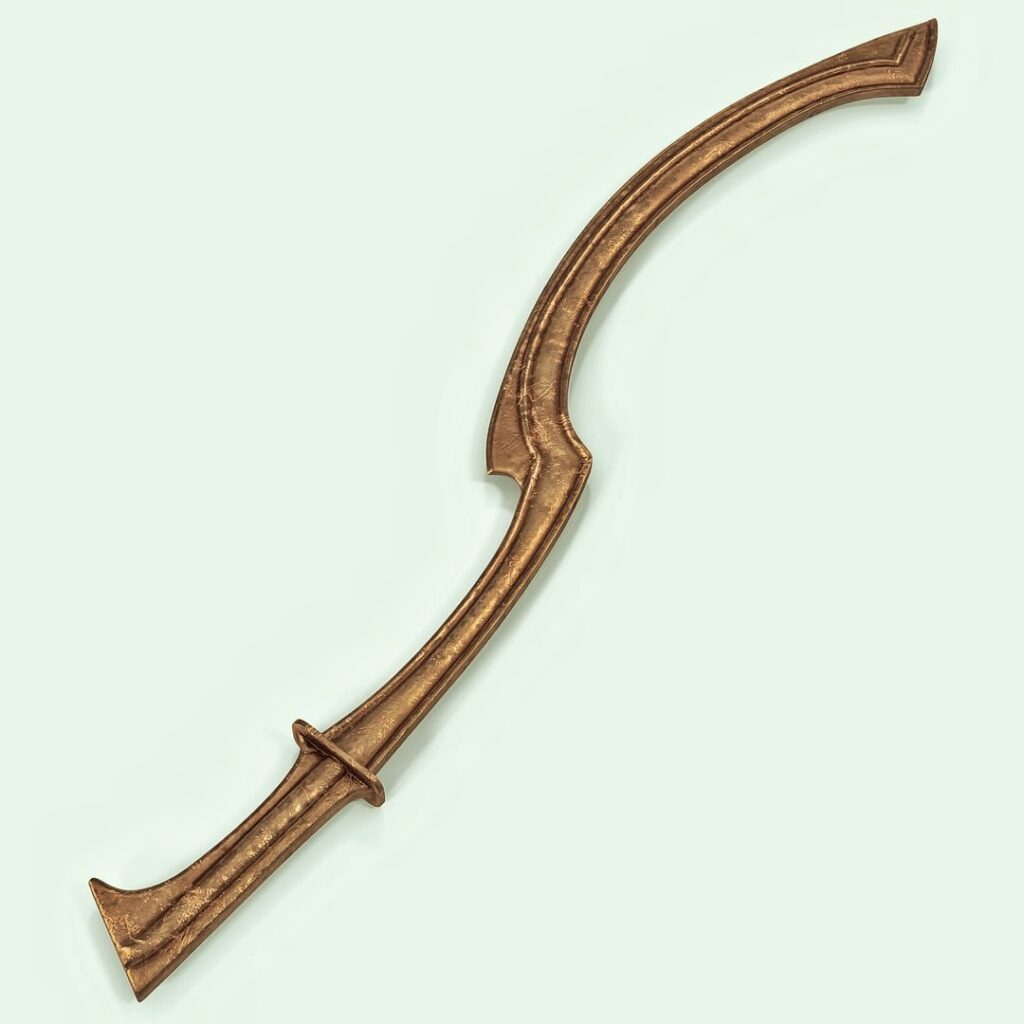
The most distinctive physical feature of the Khopesh was its sickle-like curvature, which evolved directly from the crescent-shaped battle axes that preceded it in Egyptian and Mesopotamian warfare. This evolutionary lineage meant that the Khopesh occupied an intermediate category between an axe and a sword, combining the slashing mechanics of an axe with the reach and handle design of a sword.
The inner concave curve of the weapon served multiple tactical functions. It could be hooked around an opponent’s arm to trap it, or used to rip an enemy’s shield out of position, exposing the body beneath to a follow-up strike. The outer convex edge delivered powerful slashing cuts that were particularly effective against lightly armored opponents. The weapon could also be used for thrusting when circumstances demanded it, making it a genuinely versatile close-quarters instrument.
Ceremonial versions of the Khopesh differed from battlefield weapons in several important ways. They were frequently decorated with gold inlay, engraved royal cartouches identifying the pharaoh who owned them, and elaborate geometric or symbolic patterns. Some examples bear the names of pharaohs including Ramesses II, whose name appears on a bronze Khopesh now held at the Louvre Museum in Paris. These ceremonial weapons were not tools of war. They were declarations of royal identity, religious authority, and divine mandate.
Function and Use
The Khopesh served two distinct but equally important functions within ancient Egyptian civilization: it was a battlefield weapon and a sacred instrument of royal and religious ceremony.
As a battlefield weapon, the Khopesh was carried by Egyptian soldiers during the height of the New Kingdom, a period stretching from approximately 1570 to 1070 BC when Egypt undertook its most ambitious campaigns of military expansion into Nubia to the south and the Levant to the northeast. Egyptian armies fighting against the Canaanites, the Hittites, the Libyans, and others carried the Khopesh alongside composite bows, spears, shields, and war chariots. The weapon was particularly suited to the close-quarters fighting that occurred when opposing infantry formations made contact.
Its effectiveness in battle is documented in Egyptian records of the Battle of Kadesh, fought around 1274 BC between Ramesses II and the Hittite forces under Muwatalli II. Reliefs depicting this engagement show Egyptian soldiers carrying Khopesh swords as part of their standard equipment. The battle itself ended without a decisive victor, but Egyptian accounts record it as a triumph for Ramesses, who is shown wielding his Khopesh in the associated temple carvings.
As a ceremonial and sacred instrument, the Khopesh carried meaning that extended far beyond its military utility. The gods themselves were depicted holding it. Horus and Set, the two most powerful divine forces in the Egyptian pantheon governing order and chaos respectively, both appear in Egyptian religious art carrying Khopesh swords, which reinforced the weapon’s association with cosmic power and divine authority. When a pharaoh was depicted holding a Khopesh, the image communicated not that he was a skilled soldier, but that he was the agent of divine will on earth, enforcing the principle of Ma’at, the Egyptian concept of cosmic order, against the forces of chaos represented by Egypt’s enemies.
The Merneptah Stele, a stone monument recording the military victories of Pharaoh Merneptah around 1208 BC, depicts the god Amun presenting a Khopesh directly to Merneptah as a reward for his victory over the Libyans. This iconographic detail is significant. The gift of the Khopesh from a god to a king in official royal records was not decorative. It established that the pharaoh’s military authority was divinely granted and divinely sustained. Every enemy destroyed by the Khopesh was destroyed by divine sanction.
The Khopesh was also used in specific religious ceremonies connected to death and the afterlife. It featured in the Opening of the Mouth ceremony, a vital ritual performed during mummification that was believed to restore the deceased’s ability to eat, drink, breathe, and speak in the afterlife. The presence of Khopesh swords in the tombs of kings and high-ranking officials confirmed that the weapon’s sacred properties were understood to extend beyond death into the eternal realm.
Cultural Context
The Khopesh entered Egypt from outside its borders. The weapon originated in Mesopotamia, where crescent-shaped blades appear in representations dating to at least 2500 BC. The Stele of the Vultures, a Sumerian monument from that period, depicts the king Eannatum of Lagash wielding what is understood to be an early form of the sickle-sword. From Mesopotamia, the weapon spread through Syria and the Canaanite city-states before being introduced to Egypt during the Second Intermediate Period, when the Hyksos, a people of West Asian origin, ruled Lower Egypt and brought new military technologies with them including composite bows, chariots, and curved swords.
The Egyptians, after defeating and expelling the Hyksos around 1550 BC, adopted the most effective elements of their enemies’ military technology, including the curved sword. By the New Kingdom, the Khopesh had been fully incorporated into Egyptian military and ceremonial culture to such a degree that it became inseparable from Egyptian royal identity, despite its foreign origin.
The weapon’s iconic status within Egyptian culture rested on the concept of the smiting pose, one of the most repeated images in all of ancient Egyptian art. In this pose, the pharaoh grasps a captive enemy by the hair with one hand while raising a Khopesh overhead with the other, prepared to deliver a killing blow. This image was carved on temple pylons, painted on tomb walls, engraved on ceremonial objects, and depicted in relief across royal monuments spanning more than a thousand years of Egyptian history. It communicated a specific and precisely calibrated message: the king was not merely a military leader. He was the cosmic force that maintained order by destroying chaos in its human form.
Pharaohs who are specifically documented wielding the Khopesh in military and ceremonial contexts include Seti I of the 19th Dynasty, whose image appears in a plaster relief on the exterior of the Hypostyle Hall at Karnak, showing him in a battle chariot with a raised Khopesh trampling Libyan enemies. Ramesses IV is depicted in an ostracon dated to his reign between 1153 and 1147 BC wielding a Khopesh to smite his enemies. This ostracon is currently held at the Museum of Fine Arts in Boston.
Discovery and Preservation
Archaeological evidence for the Khopesh survives across multiple categories including physical weapons recovered from tombs and excavations, carved and painted depictions on monuments and temple walls, and written references in royal inscriptions and administrative records.
Physical examples of the Khopesh are held in major museum collections around the world. The two ceremonial Khopesh swords from the tomb of Tutankhamun are preserved at the Egyptian Museum in Cairo. A bronze Khopesh bearing the name of Ramesses II is housed at the Louvre in Paris. The Liberty Biblical Museum holds a bronze Khopesh found near Jerusalem, dated to approximately 1500 BC, which represents a battlefield rather than ceremonial example and shows clear evidence of use.
Monumental depictions of the Khopesh are preserved at multiple Egyptian archaeological sites. The Hypostyle Hall at Karnak contains reliefs of Seti I dated to the 19th Dynasty, approximately 1294 to 1279 BC. The Abu Simbel temple complex, commissioned by Ramesses II in the 13th century BC, contains large-scale carvings depicting the pharaoh in the smiting pose with a Khopesh raised above captive enemies. These monuments are among the best-preserved examples of royal art in the ancient world.
The Merneptah Stele, also called the Israel Stele because it contains the earliest known written reference to Israel, is held at the Egyptian Museum in Cairo and remains one of the most important documentary records of the Khopesh’s sacred associations with royal military victory.
The Khopesh fell out of widespread use around 1300 to 1200 BC as the Bronze Age collapse disrupted metal supply networks across the eastern Mediterranean and the rise of iron weaponry changed the dynamics of infantry combat. Heavier armor became more common and the slashing mechanics of the Khopesh became less effective against it compared to straight, thrusting swords capable of penetrating gaps in plate protection.
Why It Matters
The Khopesh represents one of the most thoroughly documented sacred artifacts of royal military power in the entire ancient world. Its significance is not speculative. It is documented across physical objects, monumental inscriptions, royal records, religious texts, and tomb paintings spanning more than a thousand years of continuous use.
What sets the Khopesh apart from other ancient weapons is the completeness of its dual function. Many weapons served either military or ceremonial purposes. The Khopesh served both simultaneously and at the highest levels of both. On the battlefield, it was carried by the soldiers of one of history’s most powerful empires. In ceremonial life, it was placed in the hands of gods and kings in the most sacred contexts of Egyptian religion. In death, it accompanied kings and warriors into the afterlife as a guarantee of continued protection and power beyond the physical world.
The Khopesh also documents something important about how ancient Egypt understood the relationship between political authority and divine sanction. The repeated depiction of gods presenting the Khopesh to kings, and kings using the Khopesh to destroy enemies in the name of cosmic order, established that military power in ancient Egypt was never merely human. It was theological. The king did not destroy enemies because he was stronger than them. He destroyed them because the gods required it, and the Khopesh was the instrument through which divine requirement became physical fact.
Surviving examples of the Khopesh, currently held in Cairo, Paris, Boston, and other institutions around the world, remain among the most recognizable physical artifacts of ancient Egyptian civilization. Each one is a preserved record of a moment in history when the line between weapon and sacred object did not exist.