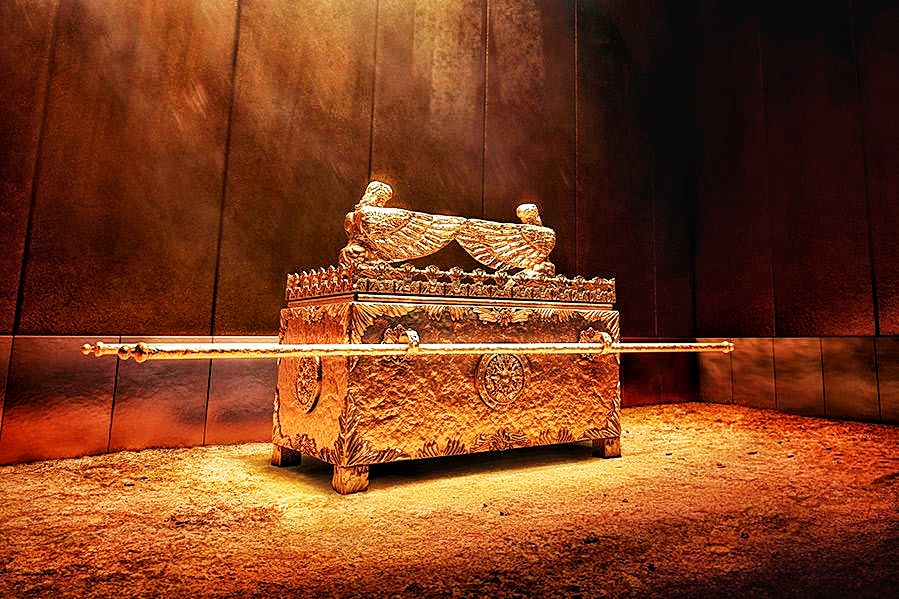
The Ark of the Covenant is one of the most talked about religious artifacts in all of human history. It appears in the Bible more than any other physical object. Armies carried it into war. A man died simply for touching it to stop it from falling. Kings trembled before it. And then, around 2,600 years ago, the Ark of the Covenant disappeared without a trace.
No one has found it since.
What the Ark of the Covenant Was
The Ark of the Covenant was a gold-covered wooden chest built by the Israelites to house the two stone tablets on which God gave Moses the Ten Commandments. Its name comes directly from Hebrew words meaning “chest of the covenant,” a reference to the sacred agreement between God and the Israelite people.
To those who carried it, the Ark of the Covenant was not simply a container. It was believed to be the physical throne and dwelling place of God on earth. It was the most sacred object in the Israelite world, and strict rules governed who could approach it, touch it, or even look at it.
Breaking those rules was believed to result in immediate death.
How the Ark of the Covenant Was Constructed
The instructions for building the Ark of the Covenant came from God directly to Moses, and they were extremely precise.
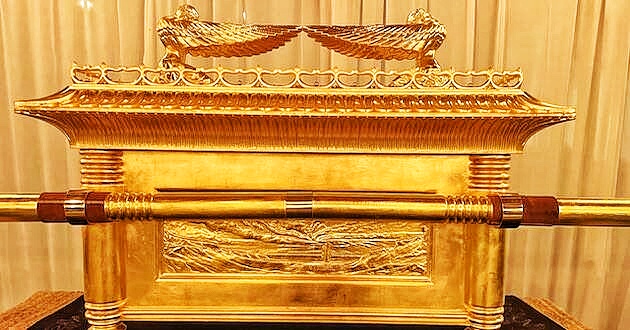
The chest was to be built from acacia wood, a tough and durable timber found across the Sinai region. The entire structure, both inside and outside, was to be covered in pure gold. In modern measurements, the finished chest would have stood roughly 1.1 meters long and about 0.7 meters wide and tall.
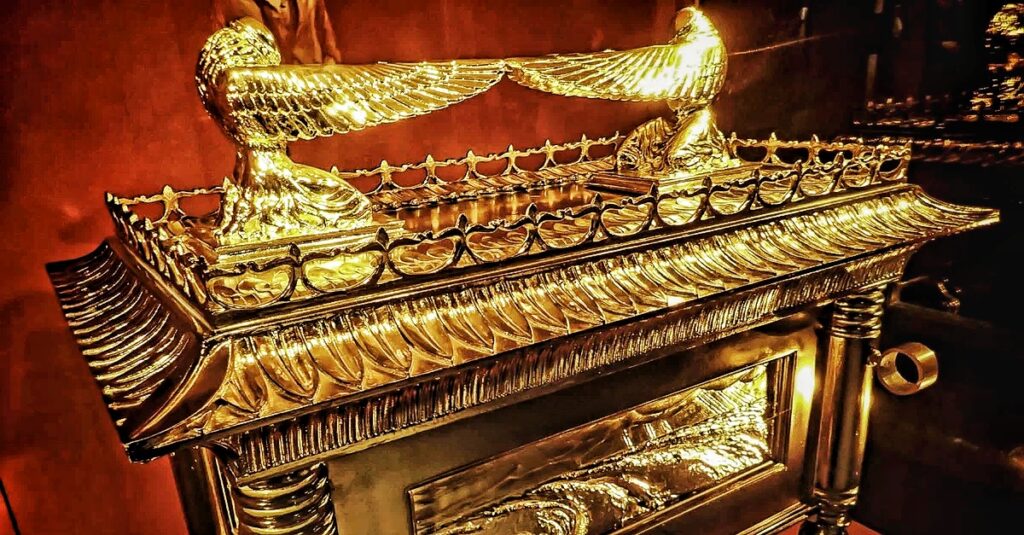
Four gold rings were fixed to the bottom corners of the chest. Two long poles coated in gold were threaded through these rings for carrying. The priests assigned to transport the Ark of the Covenant were never allowed to grip the chest itself. The poles ensured human hands never made contact with it directly.
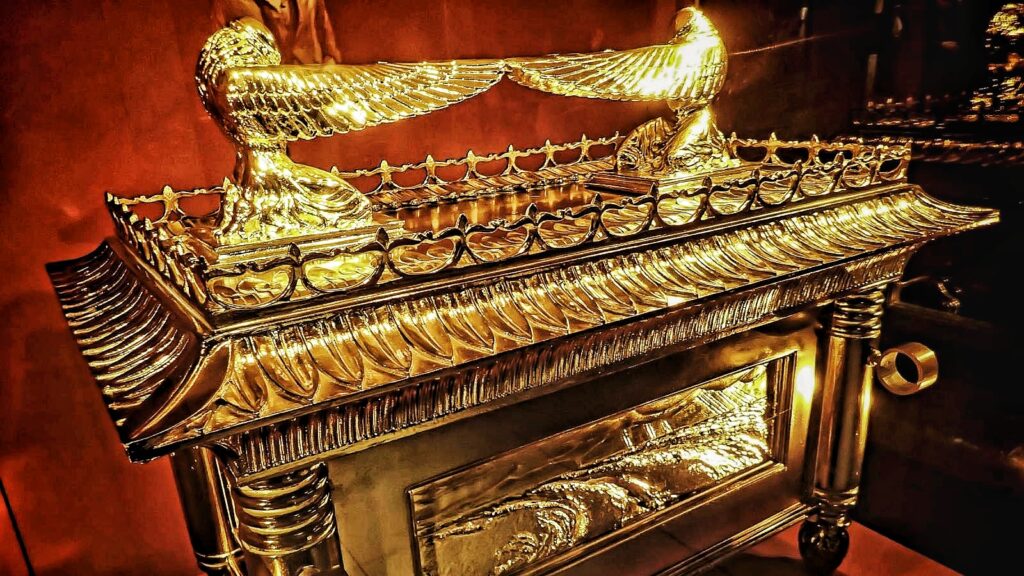
On the lid, which was called the Mercy Seat, two golden angel figures known as cherubim were sculpted facing each other with their wings spread upward. The gap between the two angels was considered the earthly seat of God’s presence.
What the Ark of the Covenant Contained
Biblical accounts record three items stored inside the Ark of the Covenant.
The first and most significant were the two stone tablets bearing the Ten Commandments given to Moses on Mount Sinai. These formed the legal and spiritual foundation of Israelite society.
The second item was a golden jar containing manna, the food that God had provided for the Israelites during their 40 years wandering in the wilderness after leaving Egypt. It was kept as a permanent reminder of that period.
The third item was the staff of Aaron, the brother of Moses. This staff had reportedly sprouted blossoms and produced almonds in a single night, which was taken as proof of Aaron’s divine appointment as head of the priestly line.
By the time the Ark of the Covenant was permanently housed in Solomon’s Temple centuries later, only the two stone tablets remained. What became of the jar and the staff is never explained.
The Ark of the Covenant in Battle
The Ark of the Covenant was not kept locked away. It was taken to war.
When the Israelites crossed the Jordan River into Canaan, priests carried the Ark at the front of the procession. The moment the priests stepped into the river, the waters reportedly stopped flowing, piling up upstream while the people crossed on dry ground.
At the city of Jericho, the Ark of the Covenant was carried around the city walls once a day for six days. On the seventh day it was carried around seven times. When the priests blew their trumpets, the walls fell flat and the city was taken.
In a later period, the Israelites brought the Ark of the Covenant to a battlefield against the Philistines, hoping its presence would guarantee victory. It did not work that time. The Philistines won the battle and captured the Ark.
What happened next became one of the most dramatic episodes connected to the Ark of the Covenant. The Philistines placed it in the temple of their god Dagon. The next morning, the statue of Dagon was found face down on the ground before the Ark. They set the statue upright. The following morning it was found face down again, this time with its head and hands broken off.
The cities that held the Ark of the Covenant then suffered outbreaks of disease and a plague of rats. After seven months, the Philistines sent the Ark back to the Israelites on a cart, along with golden offerings as a peace gesture.
The Ark of the Covenant Arrives in Jerusalem
King David eventually brought the Ark of the Covenant to Jerusalem, his newly established capital. The journey was festive, with music and celebration. But it was also marked by tragedy.
At one point during the transport, the oxen pulling the cart stumbled. A man named Uzzah reached out and grabbed the Ark of the Covenant to steady it. He died on the spot, which the Bible records as punishment for touching it. After that, David left the Ark in the care of a man named Obed-Edom for three months before completing the journey to Jerusalem.
His son Solomon later built the First Temple in Jerusalem specifically to house the Ark of the Covenant. A special inner chamber called the Holy of Holies was constructed for it. Only the high priest was permitted to enter this room, and only once a year, on the Day of Atonement.
Where the Ark of the Covenant Disappeared
The last clear mention of the Ark of the Covenant in the Bible places it in Solomon’s Temple. After that, the record goes quiet.
In 587 BC, the Babylonian king Nebuchadnezzar destroyed Jerusalem and burned Solomon’s Temple to the ground. Every valuable item in the temple was either taken to Babylon or destroyed. The Ark of the Covenant is conspicuously absent from all the lists of looted items. This silence has fueled centuries of speculation.
Several theories have been put forward over the years.
The Ethiopia Theory. The most well-known claim is that the Ark of the Covenant rests today in a small chapel in Axum, Ethiopia, called the Church of Our Lady Mary of Zion. Ethiopian Orthodox Christians have maintained for centuries that the Ark was brought to Ethiopia by Menelik, the son of King Solomon and the Queen of Sheba. A monk called the Guardian of the Ark claims to live there permanently to watch over it. No outsider has ever been allowed to see or verify the object inside.
The Hidden Before the Invasion Theory. Some researchers believe the Ark of the Covenant was hidden by priests before the Babylonians arrived, possibly in a cave beneath or near Jerusalem. The Book of Maccabees records a tradition that the prophet Jeremiah hid the Ark in a cave on Mount Nebo before the city fell. However, the same text says Jeremiah told the people the location would remain unknown until God chose to reveal it.
The Egypt Theory. A smaller group of researchers has argued that the Ark of the Covenant was taken to Egypt years before the Babylonian invasion, possibly when an Egyptian pharaoh raided Jerusalem during the reign of King Rehoboam, Solomon’s son. This theory points to temple records from the Egyptian city of Karnak that list items taken from a city identified as Jerusalem.
The Destroyed Theory. Some historians take the straightforward position that the Ark of the Covenant was simply destroyed along with the rest of Solomon’s Temple when Babylon burned it down. They argue that the silence in Babylonian records simply reflects the fact that it was not worth listing because it no longer existed.
Why the Ark of the Covenant Still Matters
The Ark of the Covenant holds significance across three of the world’s major religions. In Judaism, it represents the direct covenant between God and the Jewish people. In Christianity, it is seen as a symbol pointing to Jesus, with the Mercy Seat representing the place where atonement for sin was made. In Islam, the Ark is also mentioned in the Quran, where it is called a sign of authority given to the Israelite kings.
Beyond religion, the Ark of the Covenant has captured the imagination of the wider world. It has been the subject of major archaeological searches, documentaries, and one of the most famous adventure films ever made.
The reason is simple. If the Ark of the Covenant still exists somewhere, it would be the single most significant archaeological find in human history, a physical object tied directly to the origins of three world religions and to events that shaped the ancient world.
For now, its location remains one of the greatest unsolved questions ever asked.