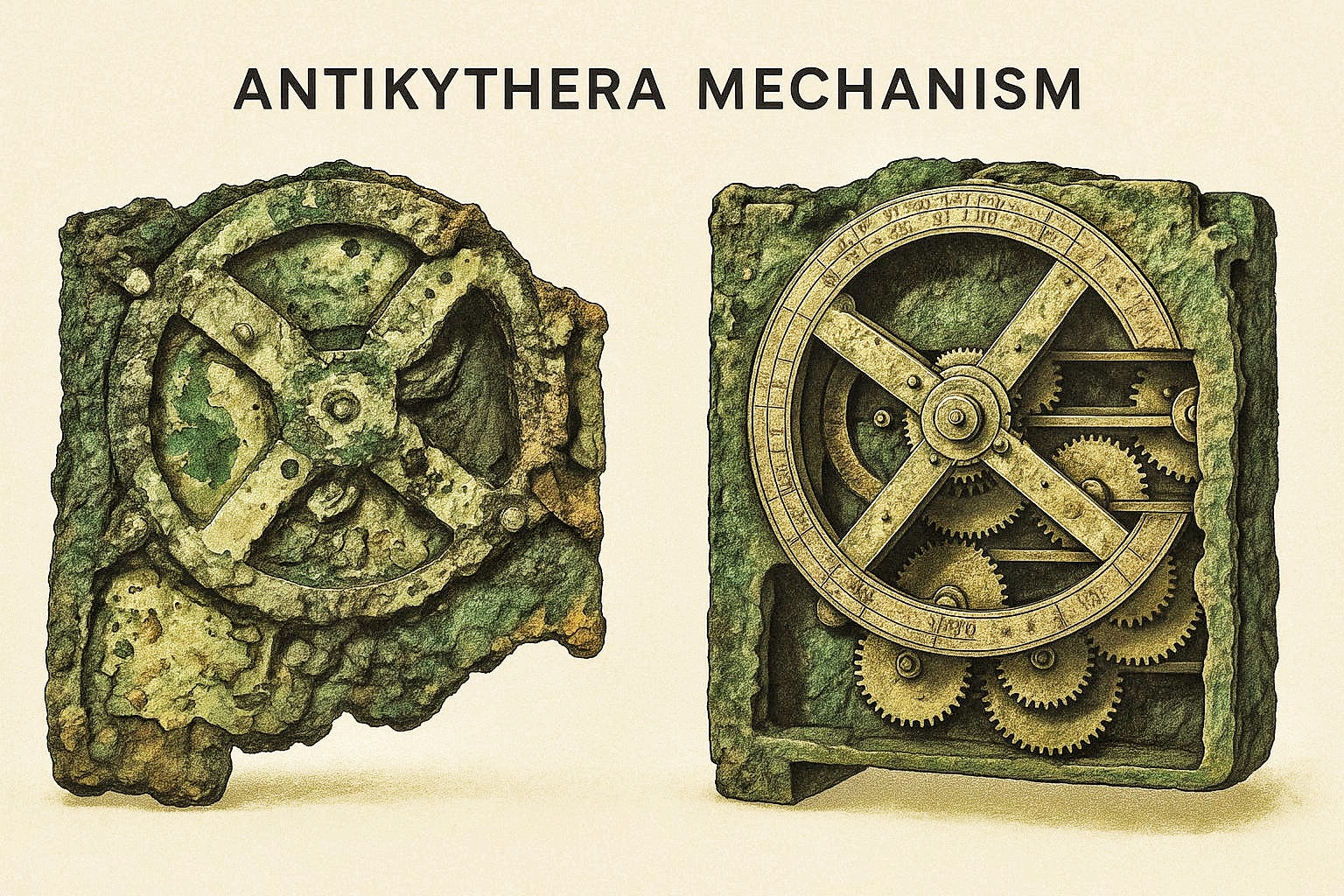
Imagine pulling a lump of corroded bronze from the bottom of the sea and discovering it is the most advanced piece of technology the ancient world ever produced. That is exactly what happened when the Antikythera Mechanism was found over a century ago. This ancient Greek device, widely regarded as the world’s first analog computer, continues to shock scientists, historians, and engineers to this day. Nothing else from its era comes close to its complexity, and it still holds secrets no one has fully unlocked.
The Shipwreck That Changed History
In the year 1900, a group of Greek sponge divers was forced off course by a storm near a small island called Antikythera in the Aegean Sea. While sheltering from the weather, they dove into the surrounding waters and stumbled upon the ruins of an ancient cargo ship sitting about 45 meters below the surface.
The wreck was loaded with treasures. Excavations brought up coins, jewelry, glassware, a seven-foot bronze statue of Hercules, and three life-sized marble horses. Among all those remarkable finds, one object looked completely unremarkable. It was a corroded, greenish lump of bronze roughly the size of a shoebox, wrapped in what appeared to be rotting wood. Nobody paid it much attention at first.
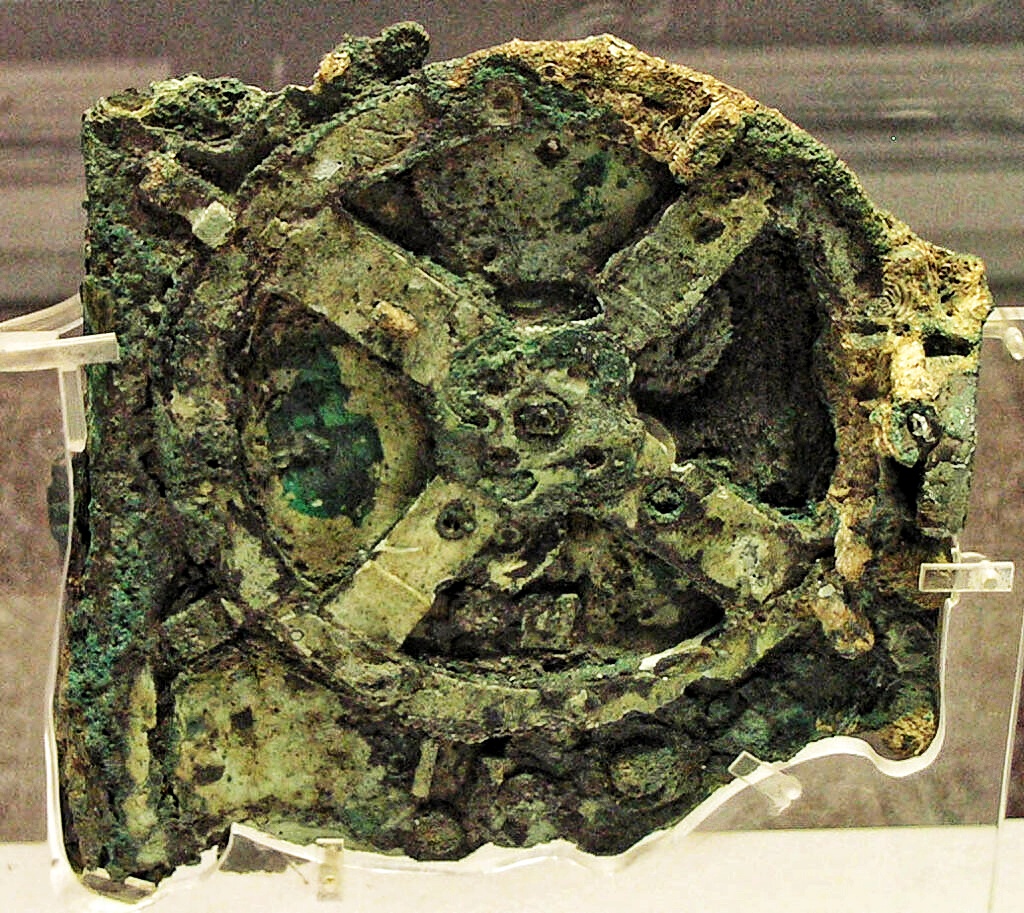
That changed in 1902 when a Greek archaeologist named Valerios Stais noticed the object had cracked open while drying, revealing tiny bronze gears and Greek inscriptions inside. What he saw looked like the inner workings of a precision clock. The problem was that, according to everything historians knew at the time, precision clockwork had no business existing in the ancient world. The discovery made no sense at all.
What Is the Antikythera Mechanism
The Antikythera Mechanism is an ancient Greek bronze device dated to roughly 100 BC, give or take a few decades. It is considered the world’s first known analog computer and the first known geared mechanism in all of recorded history.
The device was originally housed in a wooden case about the size of a shoebox. On its side was a hand crank used to set it to a specific date. The front and back faces were covered in Greek inscriptions, and the entire machine contained around 30 to 40 interlocking bronze gears, some as thin as 1 millimeter.
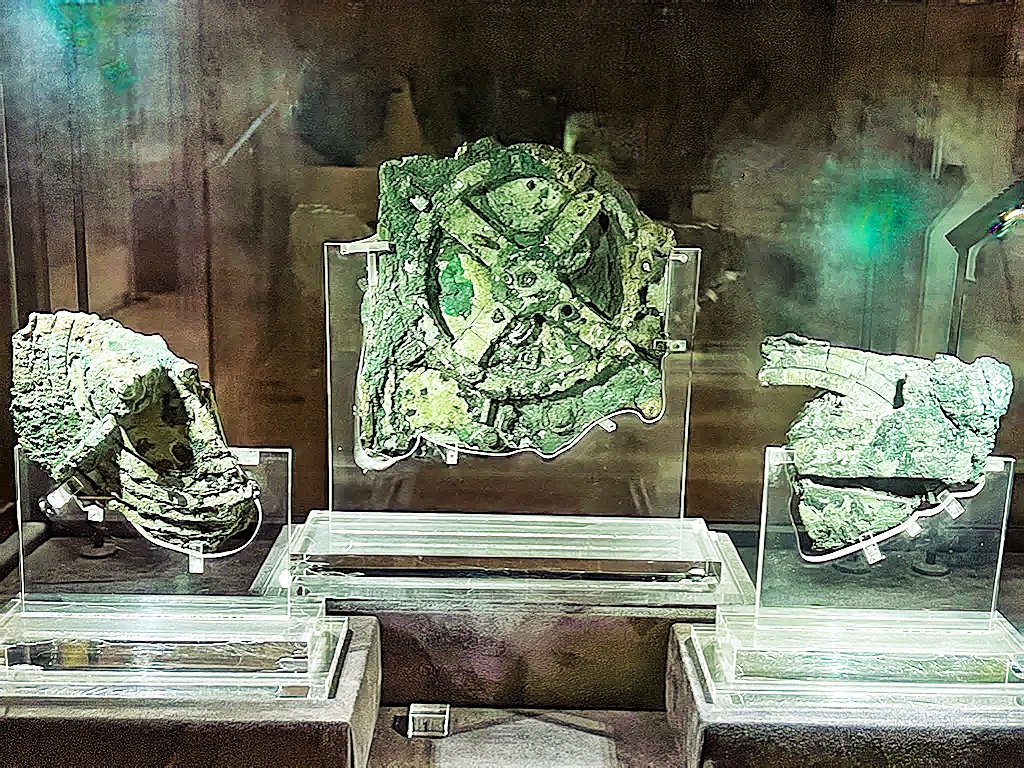
Today, only a third of the original device survives. What remains has been broken into 82 fragments, all of which are kept at the National Archaeological Museum in Athens, Greece.
What the Antikythera Mechanism Was Built to Do
This device was not a decoration or a simple tool. It was a working calculator built to track and predict movements in the sky.
When a person turned the hand crank on the side, it set all the gears inside spinning. Each gear was connected to the next, passing calculations forward through the machine until the final result appeared on one of the dials on the front or back.
The Antikythera Mechanism could do all of the following:
Track the position of the Sun and Moon. The front face had a large dial with pointers showing where the Sun and Moon were positioned in the zodiac at any given time.
Show the phase of the Moon. A small ball covered in silver on one half sat on the front face. As the gears turned, the ball rotated to show whether the Moon was full, new, or somewhere in between.
Predict solar and lunar eclipses. One of the dials on the back was dedicated to eclipse prediction. It used a complex set of gear calculations based on known astronomical cycles to show when an eclipse was likely to occur.
Track all five known planets. The device displayed the positions of Mercury, Venus, Mars, Jupiter, and Saturn. These five were the only planets the ancient Greeks knew of at the time.
Follow multiple calendar systems. The mechanism tracked both the Egyptian calendar and a Greek lunar calendar at the same time. It also had a dial connected to a four-year cycle that tracked the timing of the ancient Olympic Games and other major athletic events.
The Genius Inside the Gears
What makes the Antikythera Mechanism truly remarkable is not just what it could do, but how it did it.
The Moon does not travel around the Earth at a steady speed. It moves faster when it is closer and slower when it is farther away. The ancient Greeks did not fully understand why this happened, but they had observed it and tried to account for it in their calculations.
The engineers who built this device solved the problem using something called a pin-and-slot mechanism. Two gears were connected by a pin that sat inside a small slot. As one gear turned, the pin moved through the slot, causing the second gear to speed up and slow down in a way that closely matched how the Moon actually moved in the sky. This kind of engineering was not seen again until well into the modern era.
The gears themselves were cut by hand using files, drills, and other basic tools. Yet they were accurate to within a few tenths of a millimeter. Some gears had unusual numbers of teeth, such as 53, 127, or 223, because those specific numbers were needed to produce the correct astronomical ratios in the calculations.
How Scientists Finally Cracked the Code
For decades after its discovery, nobody could fully understand the Antikythera Mechanism. Early researchers lacked the tools to see inside it without causing further damage.
Progress began in the 1950s when a researcher named Derek de Solla Price became fascinated with the device. After years of study, he took the first proper X-rays of the mechanism in the early 1970s with the help of a Greek radiographer. His 1974 paper titled “Gears from the Greeks” argued that each gear represented the movement of a specific celestial body. Most of the academic world largely ignored his findings at the time.
Real breakthroughs came in 2005 when a research team used advanced X-ray scanning technology to see deep inside the fragments without opening them. This revealed hidden inscriptions and gear arrangements that had never been seen before.
In 2021, a team at University College London led by researcher Tony Freeth published what is considered the most complete reconstruction of the device ever produced. Their model was the first to account for all the surviving physical evidence and all the inscriptions found on the mechanism. Freeth described it as a device that could predict the positions of the Sun, Moon, and planets on any specific day, whether in the past or the future.
Questions That Still Remain
Even with all this research, the Antikythera Mechanism still holds unanswered questions.
Nobody knows for certain who built it. Some researchers believe it may have come from the island of Rhodes, which was a known center of astronomy and engineering in the ancient world. Others have suggested a connection to the famous astronomer Hipparchus. A few ancient texts, including writings by the Roman statesman Cicero, mention similar devices built by Archimedes, but no definitive proof connects any of those names to this specific machine.
Nobody knows why it was on the ship. Was it cargo being sold? A personal instrument belonging to a wealthy passenger? A gift meant for a powerful ruler? The answer has never been found.
There is also the question of how well it actually worked. A 2025 study by two engineers created a detailed digital simulation of the mechanism and found that the gears likely jammed frequently, sometimes after only a few months of use. Other researchers argue that the current condition of the bronze, which has been distorted by 2,000 years underwater, makes it impossible to draw firm conclusions about how precisely it functioned in its original state.
Why the Antikythera Mechanism Matters
The level of skill required to build the Antikythera Mechanism was not matched again until medieval European engineers began constructing large mechanical clocks in the 14th century. That is a gap of more than 1,000 years.
This tells us something important. The ancient world was far more sophisticated than most people imagine. Somewhere in Greece, more than two millennia ago, engineers and astronomers were working together to build a pocket-sized machine capable of modeling the entire solar system. They did it by hand, using nothing but bronze, basic tools, and brilliant mathematical thinking.
The Antikythera Mechanism is not just an artifact. It is proof that human ingenuity has always been extraordinary, and that much of what the ancient world achieved has been lost to time. The fact that this one device survived at the bottom of the sea for 2,000 years almost feels like it was meant to be found.
Where to See It Today
The surviving fragments of the Antikythera Mechanism are on permanent display at the National Archaeological Museum in Athens, Greece. Full working replicas, built by modern engineers after years of study, are also available at the museum so visitors can see how the original device would have looked and operated when it was new.