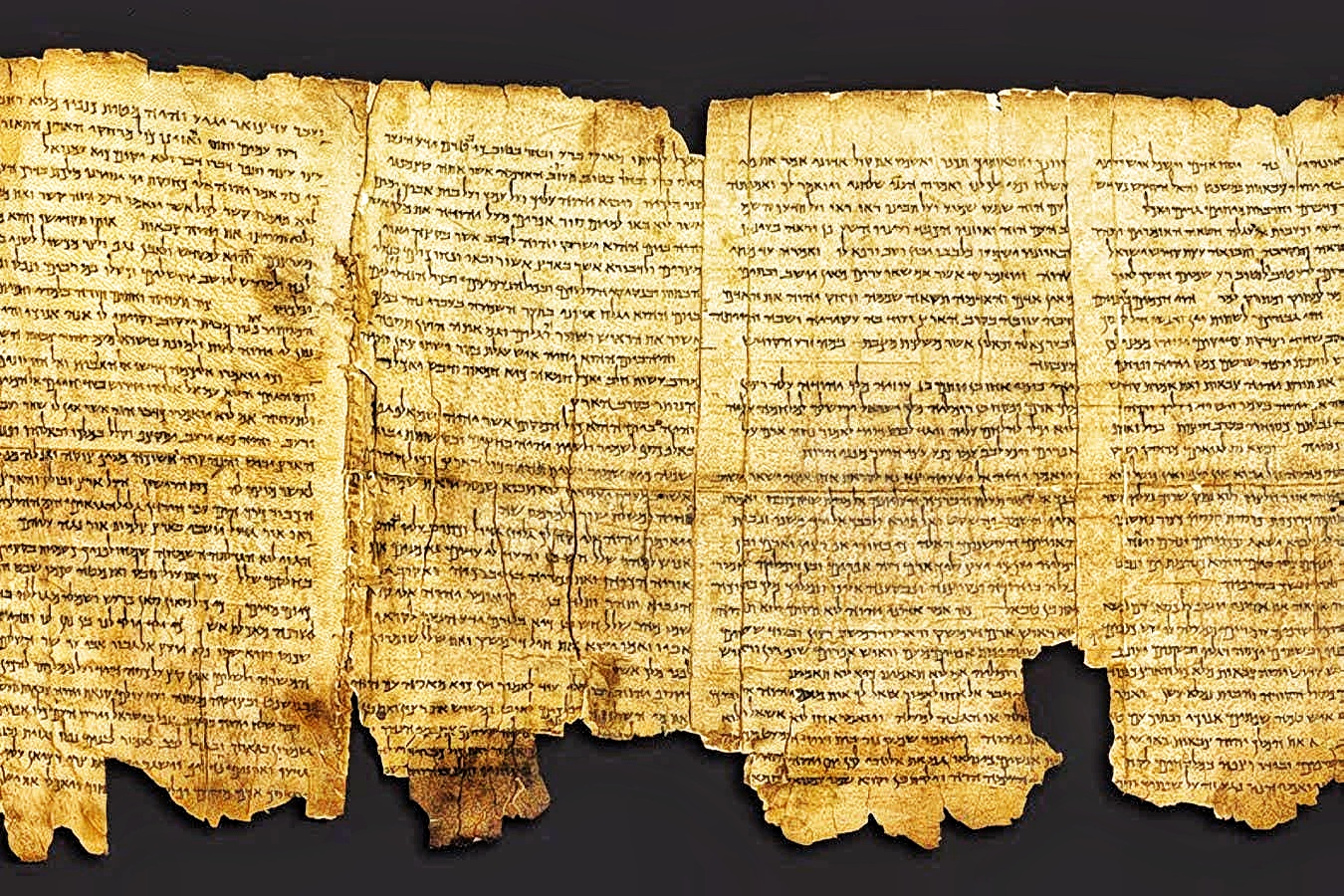
In 1947, a young Bedouin shepherd threw a rock into a cave along the northwestern shore of the Dead Sea and heard the sound of breaking pottery. What he found inside that cave turned out to be one of the most significant archaeological discoveries of the twentieth century. The manuscripts he stumbled upon, now known as the Dead Sea Scrolls, contained some of the oldest surviving copies of the Hebrew Bible ever recorded, along with texts that opened new understanding of the origins of both Judaism and Christianity.
What the Dead Sea Scrolls Are
The Dead Sea Scrolls are ancient manuscripts written mostly in Hebrew, with sections in Aramaic and Greek. They were found on the northwestern shore of the Dead Sea, in a series of caves near the ruins of an ancient settlement called Qumran in the Judean Desert. In total, over 900 manuscripts were recovered from 11 separate caves in the area.
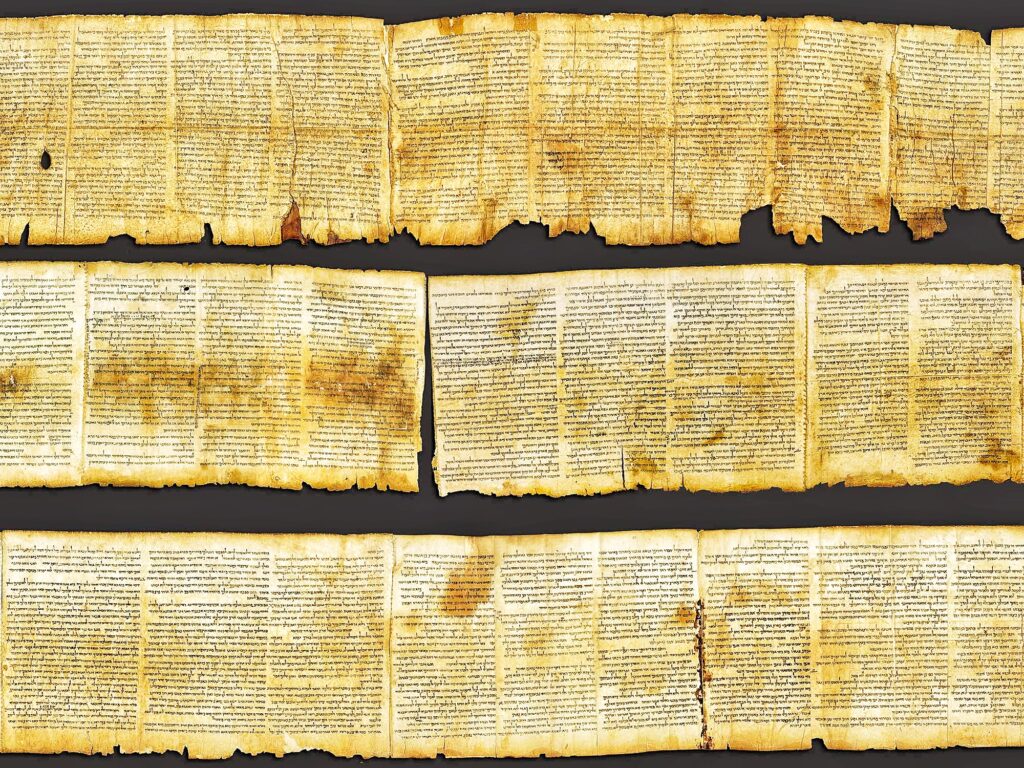
The manuscripts were written on leather, papyrus, and in one exceptional case, copper. They range from tiny fragments the size of a fingernail to large, well-preserved scrolls several meters long. The majority survived only as badly deteriorated scraps. A small number, fewer than a dozen, were recovered in near-complete condition.
How the Dead Sea Scrolls Were Found
A shepherd from the Ta’amireh Bedouin tribe was searching for a stray goat along the cliffs bordering the northwestern edge of the Dead Sea when he noticed a narrow opening in the rocky hillside. He threw a stone into the dark opening and heard the sound of clay breaking inside. When he and his companions investigated, they found clay jars containing tightly wrapped ancient scrolls.
The shepherds brought the scrolls to an antiquities dealer in Bethlehem named Kando for evaluation. Seven scrolls were retrieved from that first cave. Kando eventually sold four of them to the Archbishop of the Syrian Orthodox Monastery of St. Mark in Jerusalem. The remaining three were purchased by Israeli archaeologist Eliezer Lipa Sukenik on behalf of the Hebrew University of Jerusalem.
When news of the find spread, both professional archaeologists and local Bedouin treasure hunters began searching the surrounding caves. Over the following years, fragments and manuscripts were recovered from ten additional caves, bringing the total to over 900 manuscripts representing thousands of fragments.
The four scrolls that had been taken to the United States by the Archbishop were eventually purchased in 1954 by Yigael Yadin, Sukenik’s son and also an archaeologist, who brought them back to Israel. All seven original scrolls are today housed at the Israel Museum in Jerusalem in a purpose-built wing called the Shrine of the Book.
What the Dead Sea Scrolls Contain
The contents of the Dead Sea Scrolls fall into three broad categories.
The first and most significant category is biblical texts. The scrolls contain copies of books from the Hebrew Bible that are roughly 1,000 years older than any previously known manuscript versions. Every book of the Old Testament is represented among the scrolls except the Book of Esther, though some researchers believe a fragment of Esther may have recently been identified.
The second category covers apocryphal and pseudepigraphal writings. These are religious texts that were widely read and respected in Jewish communities of the period but were ultimately not included in the official biblical canon. Among these are the Book of Enoch, the Book of Jubilees, and the Temple Scroll, which describes an idealized version of the Jerusalem Temple and its rituals in extraordinary detail.
The third category consists of community writings. These texts describe the beliefs, rules, and daily practices of the group that produced and preserved the scrolls. The most famous of these is the Community Rule, a document that lays out the regulations governing membership, conduct, worship, and discipline within the group.
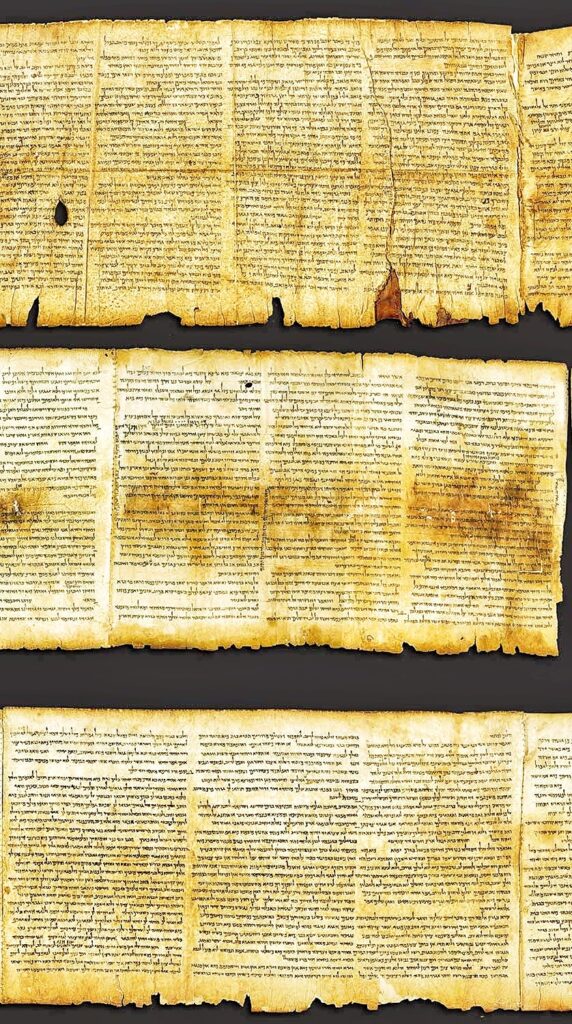
One of the most remarkable individual items found was the Great Isaiah Scroll. It contains the entire 66 chapters of the Book of Isaiah and was copied more than 100 years before the birth of Jesus. Before this scroll surfaced, no complete copy of Isaiah existed anywhere close to that age. Comparing it to later versions of the same text revealed that the content had been transmitted with extraordinary accuracy across the centuries.
Another standout find was the Copper Scroll, the only scroll in the entire collection written on metal rather than organic material. It contains a list of 64 locations across Judea where large quantities of gold, silver, and sacred objects were supposedly buried. None of the treasures described in the Copper Scroll have ever been found.
Who Wrote the Dead Sea Scrolls
The identity of the people behind the Dead Sea Scrolls has been one of the most debated questions in biblical scholarship since the discovery. The most widely accepted position is that the scrolls belonged to a Jewish sect known as the Essenes, a group that lived in a communal, deeply disciplined religious community at Qumran.
Before the Dead Sea Scrolls were found, knowledge of the Essenes came almost entirely from Greek and Roman writers, including the historian Josephus and the philosopher Philo of Alexandria. The scrolls provided, for the first time, documents written by the group itself describing their own beliefs and way of life.
According to those community texts, the group at Qumran rejected the Jerusalem Temple establishment and its priesthood, whom they considered corrupt and illegitimate. They lived apart from mainstream Jewish society, held property communally, followed a strict daily schedule of prayer, ritual bathing, and scripture study, and believed they were living in the final days before a great divine intervention in human history.
Not all scholars agree that the Essenes wrote the scrolls. Some researchers have argued that the scrolls were not produced at Qumran at all but were brought there from Jerusalem libraries, possibly to protect them from the advancing Roman army during the Jewish-Roman War that began in 66 AD. Others suggest the scrolls represent the library of a more diverse Jewish population rather than a single sectarian group.
When and Why the Scrolls Were Hidden
The Dead Sea Scrolls were placed in the caves around the time of the First Jewish-Roman War, which lasted from 66 AD to 73 AD. During this conflict, Roman forces systematically destroyed Jewish towns and settlements throughout Judea, culminating in the siege and destruction of Jerusalem and its Temple in 70 AD.
The community at Qumran was almost certainly aware of the approaching Roman forces. The most likely explanation for why the scrolls were hidden in the caves is that the community was attempting to preserve them from destruction. The jars used to store some of the scrolls were sealed in a way specifically designed for long-term preservation.
Qumran itself was destroyed by the Romans around 68 AD. The people who hid the scrolls never came back for them. The caves kept them sealed for nearly 1,900 years until that shepherd threw his stone in 1947.
What the Dead Sea Scrolls Changed
Before the Dead Sea Scrolls were found, the oldest known manuscripts of the Hebrew Bible dated to around the 10th century AD, a period known as the Masoretic tradition. The scrolls pushed that record back by approximately 1,000 years, giving scholars a direct window into what these texts looked like long before the medieval copying traditions that produced all previously known manuscripts.
The comparison between the Dead Sea Scroll versions and later manuscripts revealed two important things. First, the core content of many biblical books had been copied with remarkable consistency over a very long period of time. Second, some books showed meaningful variations between the scroll versions and the later manuscripts, indicating that multiple textual traditions existed in the ancient world before one version became standardized.
The scrolls also provided detailed evidence of Jewish religious life and belief in the period immediately before and during the time of Jesus, a period that is directly relevant to the origins of Christianity. Concepts that had previously been thought to be distinctly Christian, including communal meals, ritual washing, a strong emphasis on light versus darkness, and the expectation of a coming messianic figure, appeared clearly in the Qumran community texts predating Christianity. This confirmed that these ideas were already present in Jewish thought of the period and gave scholars a richer picture of the world in which early Christianity developed.
Where the Dead Sea Scrolls Are Today
The majority of the Dead Sea Scrolls are held at the Israel Antiquities Authority in Jerusalem, with the most significant pieces on display at the Israel Museum’s Shrine of the Book. The scrolls are kept under tightly controlled conditions, with specific levels of temperature, humidity, and light, to prevent further deterioration.
In 2012, the Israel Antiquities Authority partnered with Google to create high-resolution digital scans of the scrolls, making them available online for scholars and the public worldwide. The project has continued to expand, with new fragments being identified and catalogued regularly.
Some fragments remain in private collections and in institutions outside Israel, which has led to ongoing legal and ethical disputes over ownership and repatriation. In recent years, several fragments that had been sold to institutions in the United States were found to be forgeries, and a number of genuine fragments were confirmed to have been illegally removed from Israeli territory after 1947.