For nearly 1,400 years, the written language of ancient Egypt was completely unreadable. Thousands of texts carved into temple walls, painted onto papyrus, and etched into stone coffins sat in total silence. Nobody alive could read them. Then, in 1799, a French soldier digging in the Egyptian soil accidentally hit a large black slab. That slab was the Rosetta Stone, and it turned out to be the single most important key to understanding one of the greatest civilizations in human history.
What the Rosetta Stone Actually Is
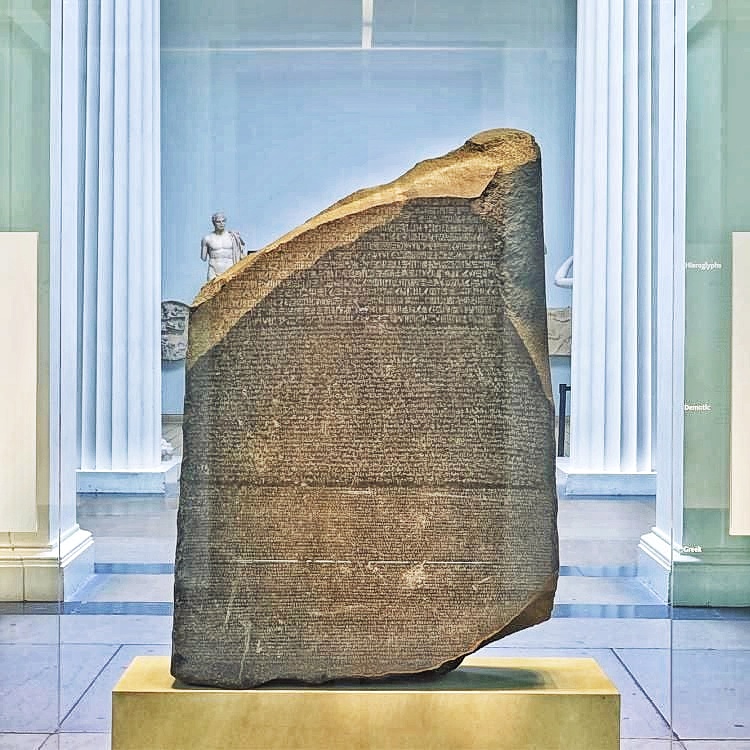
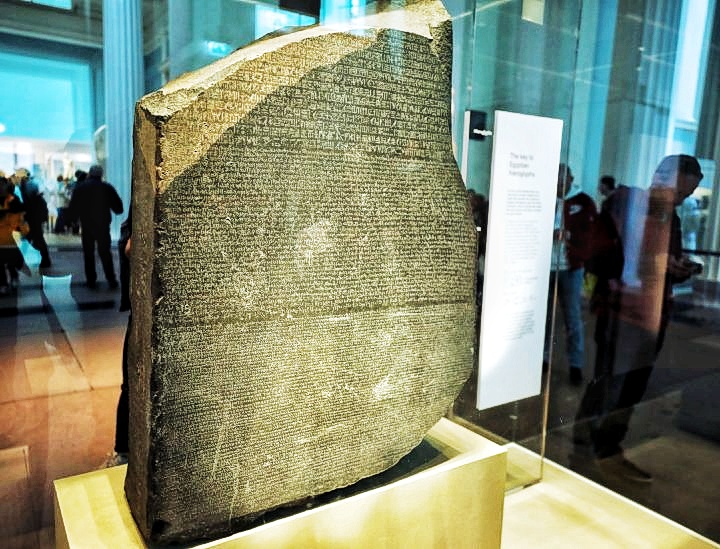
The Rosetta Stone is a large slab of granodiorite, a dark grey rock similar to granite, measuring 114 centimeters tall and 72 centimeters wide. It weighs approximately 760 kilograms.
What makes the Rosetta Stone significant is not its size or its appearance. It is the text carved into its surface. The stone contains the same written decree in three different scripts: ancient Egyptian hieroglyphs at the top, Demotic script in the middle, and ancient Greek at the bottom. All three versions say the same thing.
The decree itself was issued in 196 BC by Egyptian priests during the reign of King Ptolemy V Epiphanes. It lists the good deeds of the king, including tax relief, donations to temples, and the release of prisoners, and instructs that statues of the king be placed in every temple across Egypt. Priests were to tend to those statues three times a day.
The Rosetta Stone was not a one-of-a-kind object when it was first made. Similar stelae carrying the same decree were placed in temples throughout Egypt. The Rosetta Stone is simply the one that survived long enough to be found.
How the Rosetta Stone Was Found
In 1798, Napoleon Bonaparte launched a military campaign into Egypt. Along with his army, he brought a team of around 150 scholars, scientists, artists, and engineers tasked with studying and documenting Egyptian history, geography, and culture.
On July 15, 1799, French soldiers were digging the foundations for an extension to Fort Julien near the town of Rashid, known at the time by the French as Rosetta, in the Nile Delta region of northern Egypt. A French officer named Pierre-François Bouchard noticed that a large black stone being removed from an old wall had inscriptions on it in multiple scripts. He recognised its potential importance and had it sent to Cairo for examination by the scholars accompanying the campaign.
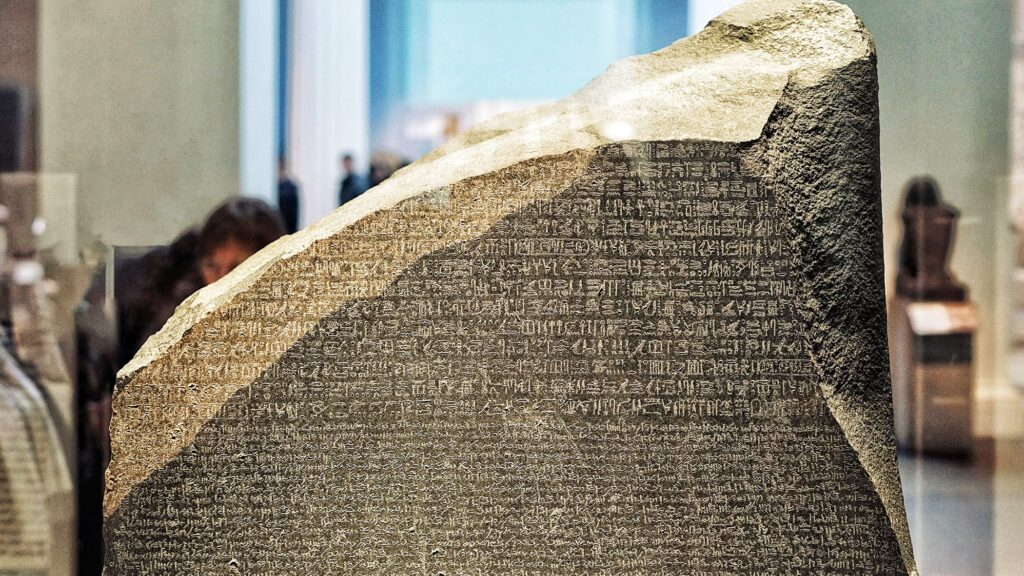
The stone was announced to Napoleon’s Institut d’Egypte in Cairo shortly afterward. French scholars immediately noted that it contained three scripts and suggested the three versions likely said the same thing, which, if true, meant the known Greek text could potentially be used to crack the unknown Egyptian ones.
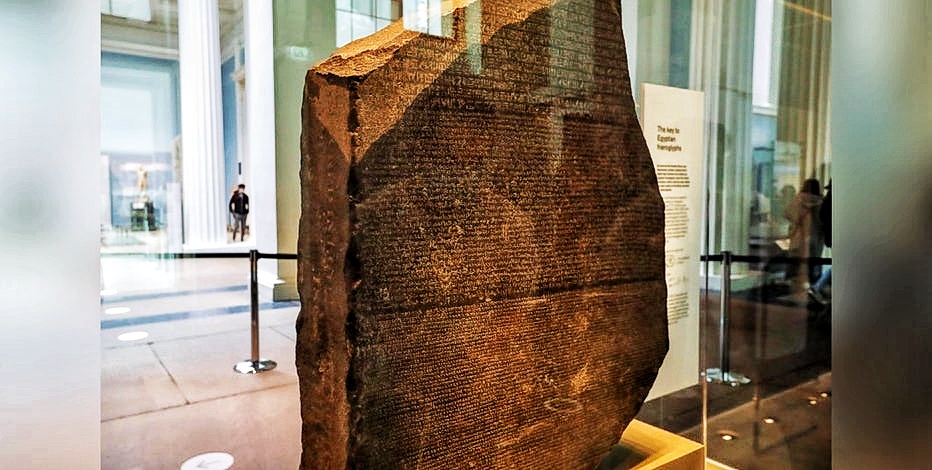
When French forces surrendered to the British in 1801, the terms of surrender included handing over antiquities collected during the campaign. The Rosetta Stone was transferred to British custody and arrived in England in February 1802. It has been on display at the British Museum in London ever since, where it is registered under the number BM EA 24.
Why Hieroglyphs Had Become Unreadable
To understand why the Rosetta Stone mattered so much, it helps to know how hieroglyphs were lost in the first place.
Hieroglyphic writing had been used in Egypt for over 3,000 years. But as Egypt came under Greek and then Roman rule, the use of hieroglyphs gradually narrowed to a small group of temple priests. By the 4th century AD, almost no one outside that shrinking priesthood could read or write them.
The last known hieroglyphic inscription was carved on August 24, 394 AD at the temple of Philae, in southern Egypt. After that, as the priesthoods died out and Egypt converted to Christianity, the knowledge of how to read hieroglyphs effectively went extinct. The last known text in Demotic, the everyday cursive script used alongside hieroglyphs, was written at the same location just a few decades later in 452 AD.
For the next 1,400 years, hieroglyphs remained completely unreadable. Scholars who encountered them assumed the symbols were purely pictographic, meaning each picture directly represented an object or idea, like a modern icon. This assumption turned out to be wrong, and it was the main reason the language resisted all attempts at translation for so long.
The Race to Read the Rosetta Stone
Once copies of the Rosetta Stone’s inscriptions were circulated among scholars across Europe, a race to decipher the hieroglyphic text began. Two men in particular drove the most significant progress.
Thomas Young was a British physicist and polymath who began studying the Rosetta Stone in 1814, not out of a deep passion for Egypt, but because the puzzle genuinely interested him. Working from the Greek text, Young identified the phonetic characters used to spell out the name Ptolemy within the oval loops, known as cartouches, that appeared in the hieroglyphic section. He also figured out the direction in which hieroglyphic signs were meant to be read by observing which way the bird and animal figures faced. His work laid important groundwork but he stopped short of a full breakthrough.
Jean-François Champollion was a French scholar who had been fascinated by Egypt and hieroglyphs since childhood. A child prodigy, he had already mastered Arabic, Hebrew, Latin, Syriac, and Coptic before the age of 20. Coptic, the late stage of the ancient Egyptian language written in Greek letters, turned out to be the crucial advantage. Unlike Young, who treated the puzzle largely as an intellectual exercise, Champollion wanted to understand the culture, not just crack the code.
Building on Young’s work and his own deep knowledge of Coptic, Champollion pushed further. He identified the phonetic characters for the name Cleopatra from another inscription. He then confirmed that hieroglyphs were not purely pictographic symbols. They functioned as a mixed system, with some signs representing sounds, some representing entire words, and some acting as classifiers that gave context to nearby signs.
On September 14, 1822, Champollion completed his phonetic alphabet for hieroglyphs. Thirteen days later, on September 27, 1822, he presented his findings publicly at the Académie des Inscriptions et Belles-Lettres in Paris. Thomas Young was in the audience. That presentation is considered the moment the ancient Egyptian language was officially deciphered, and the date is marked as the founding moment of the field of Egyptology.
It is worth noting that Champollion never actually saw the Rosetta Stone in person. He worked from copies and reproductions throughout his entire research.
What the Rosetta Stone Made Possible
The decipherment of hieroglyphs through the Rosetta Stone opened access to thousands of years of written Egyptian records that had been completely locked away.
Scholars were suddenly able to read temple inscriptions, royal decrees, religious texts, medical documents, and personal letters that had sat untouched for centuries. The detailed religious and ceremonial text known as the Book of the Dead became readable. The complex recipes used by ancient Egyptian embalmers to mummify the dead were decoded. Histories of individual pharaohs, records of battles, accounts of daily life for ordinary people all became accessible for the first time.
Before the Rosetta Stone, almost everything known about ancient Egypt came from Greek and Roman writers who had observed the civilization from the outside. After it, Egypt could speak for itself through its own records.
The Ongoing Debate Over Where the Rosetta Stone Belongs
The Rosetta Stone has been at the British Museum since 1802, and Egypt has repeatedly requested its return. Egyptian officials, including former antiquities minister Zahi Hawass, have formally called on the British Museum to repatriate the stone, arguing that it was taken during a colonial military occupation and belongs to Egypt as part of its cultural heritage.
Two painted inscriptions on the sides of the stone document its colonial history plainly. One reads “Captured in Egypt by the British Army 1801” and the other reads “Presented by King George III.”
The British Museum has so far declined to return it, citing its status as a world heritage object and the terms of the British Museum Act, which restricts the deaccessioning of objects from its collection. The debate remains active and unresolved.
Where the Rosetta Stone Stands in History
The Rosetta Stone is consistently listed among the most visited objects in the British Museum and one of the most recognised artifacts on earth. Its name has entered everyday language. When something serves as the key to unlocking a difficult problem, it is routinely called a “Rosetta Stone,” a reference that shows up in science, technology, business, and linguistics.
The language learning software company Rosetta Stone took its name directly from the artifact for the same reason.
What a group of French soldiers pulled out of an old Egyptian wall in 1799 turned out to be one of the most consequential objects ever found. Not because of what it said, which was a fairly routine royal decree, but because of what it made possible. It gave researchers the tools to read 3,000 years of recorded human experience that had been sitting in silence.