https://wikiflo.com/japanese-samurai-armor-o-yoroi/
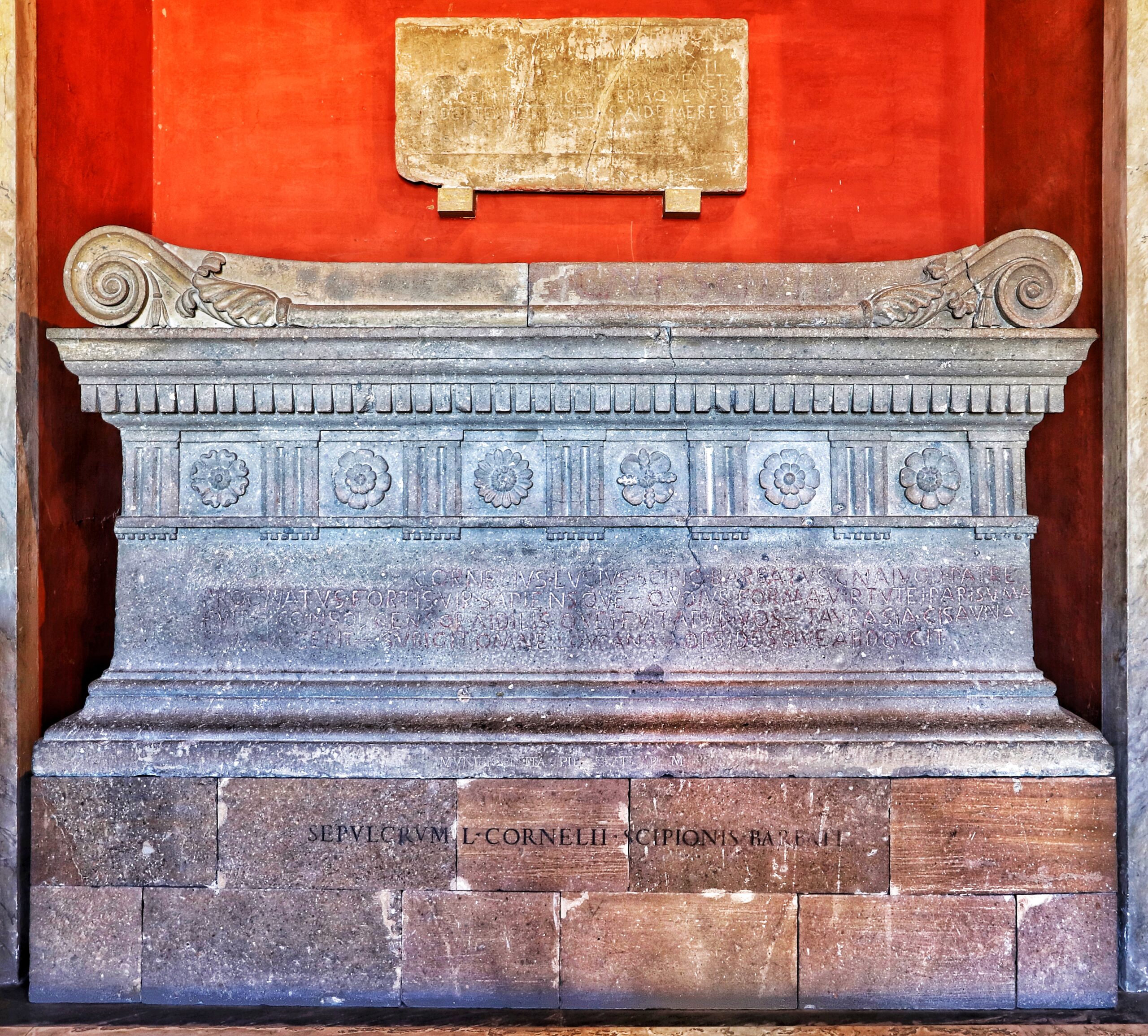
A funerary inscription carved in Old Latin Saturnian verse on the front face of a solid peperino tuff sarcophagus constitutes one of the oldest surviving Latin inscriptions to record a named individual’s civic and military career, dated to the early 3rd century BCE and associated with the burial of Lucius Cornelius Scipio Barbatus, Roman consul of 298 BCE, who died around 270 BCE. The sarcophagus and its inscription were recovered intact from the Tomb of the Scipios, a subterranean rock-cut family hypogeum located along the Via Appia just outside the Porta Capena on the southern edge of Rome, during the tomb’s second and most productive rediscovery in May 1780, when the Sassi brothers, who owned a vineyard above the site, broke into the underground chambers while enlarging their wine cellar.
The discovery was reported to Pope Pius VI, who ordered the excavation continued and subsequently transferred the sarcophagus and associated objects to the Vatican. A gold signet ring engraved with a winged Victory, found on the finger bone of the deceased within the sarcophagus, was also recovered at this time. Pope Pius VI later gave the skeletal remains of Barbatus to Venetian senator Angelo Quirini, who reinterred them in an elaborate sepulcher at his villa near Padua. The intact sarcophagus is now displayed in the Vestibolo Quadrato of the Museo Pio Clementino within the Vatican Museums complex. The name of the deceased is incised separately on the lid and catalogued in the Corpus Inscriptionum Latinarum as CIL VI, 1284. The funerary epitaph on the front face of the sarcophagus is catalogued as CIL VI, 1285. A plaster cast of the sarcophagus stands in its original position at the end of the main corridor of the Tomb of the Scipios, which remains accessible to the public at Via di Porta San Sebastiano 9 and 12, Rome.
Material and Craftsmanship Lucius Cornelius Scipio Barbatus: History and Legacy
The sarcophagus is carved from peperino, a local volcanic tuff quarried from deposits in the Alban Hills southeast of Rome. Peperino, also described in Roman sources as lapis Albanus, was a widely used building and carving material in early Republican Rome due to its availability, workability, and durability relative to softer tufa varieties. Its coarse dark gray-brown texture distinguished it visually from the white marble that later became the preferred material of elite Roman monument-makers in the middle and late Republic. The choice of peperino for the Barbatus sarcophagus reflects the material conventions of early 3rd-century Roman aristocratic funerary production before Greek marble imports had become standard practice among the senatorial class.
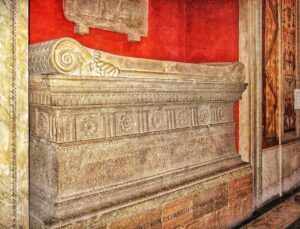
The sarcophagus was carved from a single block of peperino, making it a monolithic construction rather than a built or assembled structure. The lid is modeled in the form of a cushion or bolster, a decorative convention found on Roman and Etruscan sarcophagi of the period. The exterior of the main body is decorated with a Doric-style frieze above the inscribed epitaph, featuring alternating triglyphs, the vertical three-grooved elements characteristic of the Doric architectural order, and rosettes carved in the metope spaces between them. Ionic volute scrolls appear at the corners of the lid. The combination of Doric and Ionic decorative elements on a single monument reflects the eclectic adaptation of Greek architectural vocabulary in early Republican Roman funerary art, applied to a medium and scale suited to underground burial rather than public architecture.
The letters of the inscription were originally filled with red paint, making the text legible against the darker surface of the stone. Traces of this original coloring survive to a limited degree. Some of the decorative detail on the sarcophagus exterior was restored following the object’s transfer to the Vatican, making it necessary to distinguish between original carved surfaces and later restoration when analyzing the monument in detail.
Form and Features
The sarcophagus presents its principal inscribed face as the visible front, intended to face the viewer standing at the entrance of the tomb corridor where the monument was originally placed. The epitaph occupies the lower portion of this face, beneath the Doric decorative frieze. Above the surviving text, a roughly hewn area of the stone surface shows evidence of erasure, where earlier carved text was deliberately removed in antiquity. This erasure represents one of the most discussed features of the monument in modern scholarship.
The epitaph text as it survives reads in Old Latin Saturnian verse as follows: CORNELIVS LVCIVS SCIPIO BARBATVS GNAIVOD PATRE PROGNATVS FORTIS VIR SAPIENSQVE QVOIVS FORMA VIRTVTEI PARISVMA FVIT CONSOL CENSOR AIDILIS QVEI FVIT APVD VOS TAVRASIA CISAVNA SAMNIO CEPIT SVBIGIT OMNE LOVCANA OPSIDESQVE ABDOVCIT. Translated into modern English, the text reads: “Cornelius Lucius Scipio Barbatus, sprung from Gnaeus his father, a man strong and wise, whose appearance was most in keeping with his virtue, who was consul, censor, and aedile among you. He captured Taurasia and Cisauna in Samnium. He subdued all of Lucania and led off hostages.”
The language of the epitaph represents an early stage of Latin, predating by several generations the standardized orthography and grammar of Classical Latin. Old Latin forms present in the text include GNAIVOD for Classical Latin Gnaeo, PROGNATVS for prognatus, QVOIVS for cuius, CONSOL for consul, AIDILIS for aedilis, LOVCANA for Lucana, and OPSIDESQVE for obsidesque. According to linguist Danny Bate, the word DVONORO, meaning “of good men,” present in related Scipio family inscriptions demonstrates a sound change by which the initial du in Old Latin evolved into the b of Classical Latin bonus, illustrating a documented phonological transformation visible in these early inscriptions.
Function and Use
The epitaph served the funerary and commemorative functions standard to elite Roman aristocratic burial practice in the early and middle Republic. At its most immediate level, the text identified the deceased by name, patronymic, and cognomen, establishing his place within the Cornelius Scipio family lineage. The Saturnian verse form, the oldest attested Latin metrical system adapted from earlier Italic oral traditions, elevated the inscription from a straightforward identification label to a literary composition, signaling that the patron’s memory deserved poetic commemoration rather than plain prose notation.
The enumeration of offices held, specifically consul, censor, and aedile, addressed a Roman aristocratic audience for whom a man’s cursus honorum, the sequence of magistracies held across a public career, constituted the primary measure of civic worth. The military achievements cited, the capture of Taurasia and Cisauna in Samnium and the subjugation of Lucania, supplemented the civic record with evidence of military distinction, linking the deceased’s personal reputation to the expansion of Roman power in central and southern Italy during the Third Samnite War. Together, the two categories of achievement, civic office and military conquest, constituted the standard components of Roman aristocratic self-presentation in funerary contexts.
The physical position of the sarcophagus at the end of the main corridor of the Tomb of the Scipios, aligned with what appears to have been a window opening at the far end before the main entrance was reconfigured, placed Barbatus’s monument as the first and most prominent object visible to anyone entering the tomb. This positioning established the founder’s burial as the visual and commemorative anchor of the entire complex, subordinating all subsequent family burials to his founding presence.
Cultural Context
Lucius Cornelius Scipio Barbatus was born around 337 BCE into one of the patrician families of the Roman Republic. Lucius Cornelius Scipio Barbatus served as consul in 298 BCE. He held the consulship in 298 BCE alongside Gnaeus Fulvius Maximus Centumatus during the Third Samnite War, a prolonged conflict in which Rome sought to establish dominance over the Samnite peoples of central Italy and their various allies including the Etruscans, Umbrians, and Gauls. As consul, Barbatus commanded the Roman army that engaged Etruscan forces near Volterra, winning a strategic victory that effectively removed Etruria from the coalition threatening Rome. He subsequently served as a lieutenant general under the consuls of 297 BCE during further campaigns into Samnium, and his campaigns in Lucania are recorded both in the epitaph and in ancient historical sources. He later served as censor in 280 BCE and died around 270 BCE. Lucius Cornelius Scipio Barbatus left a lasting mark on Roman history.
The Tomb of the Lucius Cornelius Scipio Barbatus was founded, according to the analysis of archaeologist Filippo Coarelli, around the time of the opening of the Via Appia in 312 BCE, the road that ran from Rome to Brindisi along which the tomb was positioned. Coarelli’s study, published as Il sepolcro degli Scipioni a Roma by Fratelli Palombi in 1988, identified the tomb as a deliberate statement of Scipio family prominence placed on Rome’s most prestigious suburban road, visible to all travelers entering or leaving the city from the south. The tomb’s design followed Etruscan precursors in its use of a rock-cut subterranean hypogeum, reflecting the cultural influences operating on early Roman aristocratic burial practice before specifically Roman funerary architectural conventions had fully developed. The tomb of Lucius Cornelius Scipio Barbatus stands as a monument to Roman heritage.
The epitaph belongs to the broader collection known as the elogia Scipionum, a group of funerary inscriptions recovered from the tomb that collectively document multiple generations of the Scipio family. According to historian Harriet Flower, writing in Ancestor Masks and Aristocratic Power in Roman Culture published by Oxford University Press in 1996, the Scipios engaged in a documented practice of constructing and revising family history through their funerary inscriptions, at times substituting the cognomen Scipio into inscriptions of branches that had died out, and at times erasing earlier text that proved inconvenient for the family’s evolving public genealogy.
The erasure above the surviving epitaph text on the Lucius Cornelius Scipio Barbatus sarcophagus has been the subject of substantial scholarly analysis. The traditional interpretation held that an earlier, shorter epitaph had been replaced by the surviving longer text at a later date. A more recent analysis, summarized in scholarly literature and referenced by Flower, argues instead that the surviving text is itself original, but that the first portion of the epitaph, estimated at the equivalent of two Saturnian verse lines based on the dimensions and character of the erasure, was deliberately removed by a male family member during the middle Republic, before the tomb was sealed in the late Republic. The analysis argues that the erasure comprises lines of the same character size and length as the extant text, which would be inconsistent with a separately composed earlier text, and that whatever was erased was considered either controversial or genealogically inconvenient by the family member who ordered the deletion.
Discovery and Preservation
The Tomb of the Scipios was first encountered in 1614 during unauthorized entry into the underground chambers, which led to the recovery and immediate sale of the sarcophagus lid inscription of Lucius Cornelius Scipio, son of Barbatus and consul of 259 BCE. According to Rodolfo Lanciani’s Ruins and Excavations of Ancient Rome, published in 1897, this inscription was broken out of its slab and sold to a stonecutter near the Ponte Rotto in Rome, where it was seen on September 25, 1614 by a scholar named Grimaldi. It was subsequently purchased for twenty scudi by a collector named Agostini and eventually sold to the Barberini family, who set it into the wall of the spiral staircase of their palace. Following this initial entry, the tomb’s location faded from public knowledge again for over 160 years. The sarcophagus of Lucius Cornelius Scipio Barbatus was rediscovered in 1780.
The second and more consequential rediscovery occurred in May 1780, when the Sassi brothers, while extending the underground cellar of their wine facility on a farm between the Via Appia and Via Latina, broke into the hypogeum. On receiving news of the discovery, Pope Pius VI ordered the excavations continued under supervision and had the sarcophagus of Barbatus, the only sarcophagus in the tomb to survive fully intact, along with the tomb’s other objects of value transferred to the Vatican. The tomb was subsequently published by Francesco Piranesi in Monumenti degli Scipioni in 1785, though Lanciani noted that the accuracy of the drawings in that work was limited. The tomb’s location was purchased by the city of Rome in 1880 on the suggestion of Lanciani himself, following a period during which a Roma family had reportedly been living within the tomb’s chambers. Restoration work was undertaken by the Comune di Roma in 1926, during which masonry inserted in 1616 and 1780 was removed. Additional conservation interventions were carried out between 2009 and 2011, addressing structural decay in the tuff and studying the decorative program of the facade. The tomb was reopened to visitors following conservation in 2008 and remains accessible by appointment as an archaeological site.
The sarcophagus has been permanently held at the Vatican Museums since its transfer under Pius VI. The epitaph inscription CIL VI, 1285 was published and analyzed definitively by German historian Theodor Mommsen as part of his compilation of the Corpus Inscriptionum Latinarum in the 19th century, establishing the scholarly catalog reference that remains standard in epigraphic literature.
Why It Matters
The Epitaph of Lucius Cornelius Scipio Barbatus preserves one of the oldest surviving Latin inscriptions to document a named Roman individual’s complete public career in verse form, providing primary epigraphic evidence for the offices and military campaigns of a consul operating during the Third Samnite War at the moment of Rome’s consolidation of control over most of peninsular Italy. The inscription is a primary source for the early development of written Latin, with its Old Latin orthography and Saturnian verse meter representing a documented stage of the Latin language preceding Classical Latin by several centuries and illustrating phonological and grammatical features that later underwent systematic change. According to Harriet Flower, the Barbatus epitaph and the broader elogia Scipionum collectively demonstrate how Roman patrician families used funerary inscriptions not merely as commemorative texts but as instruments for actively constructing, revising, and defending their family’s historical identity across generations, a practice documented in the deliberate erasure of portions of this epitaph by a later family member. The monument’s continuous institutional history, from its original placement at the founding of the Tomb of the Lucius Cornelius Scipio Barbatus through its transfer to the Vatican in 1780, illustrates the fate of Republican Roman funerary monuments under early modern collecting practices and documents a specific case in which papal authority directly shaped the preservation and relocation of pre-Christian Roman aristocratic heritage.
The epitaph of Lucius Cornelius Scipio Barbatus remains one of Rome’s most treasured artifacts.