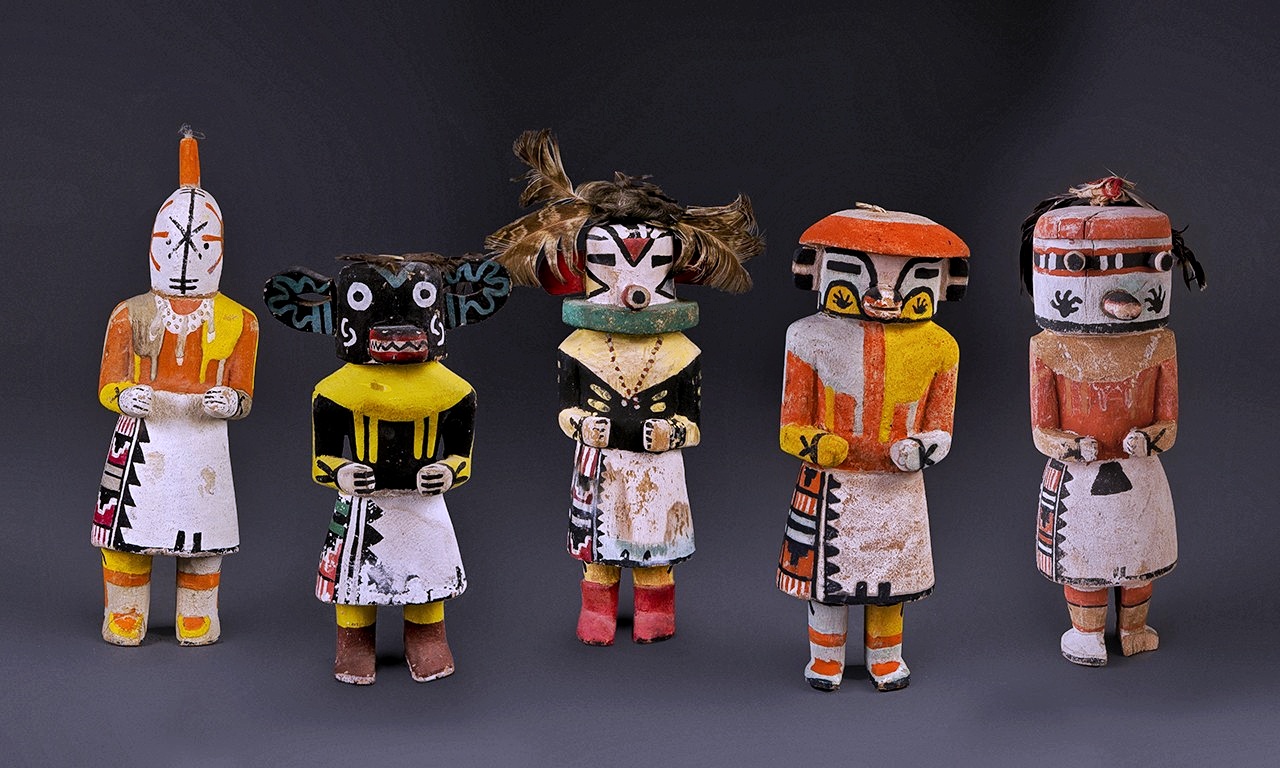
Hopi Kachina Dolls are carved cottonwood root figures ranging from 8 to 36 inches in height, created by Hopi men on the mesas of northeastern Arizona, represent over 250 distinct katsina spirit beings central to Hopi religious practice. The earliest documented specimen was collected by U.S. Army surgeon Dr. Palmer in 1857, though the tradition predates European contact by centuries. These objects, called tihu in Hopi language, functioned primarily as educational tools distributed to young girls during ceremonial dances to teach them to recognize the various katsina spirits who reside with the Hopi from winter solstice through the Niman ceremony in July. A single cottonwood root traditionally provided the carving material, smoothed with sandstone and coated with kaolin clay slip before painting with mineral and vegetal pigments. The tradition evolved through four documented stylistic periods: Early Traditional from 1850 to 1910 featuring static, cylindrical forms; Late Traditional from 1910 to 1930 showing more realistic proportions; Early Action from 1930 to 1945 with arms beginning to separate from bodies; and Late Action from 1945 onward characterized by dynamic poses, multi-piece construction, and carved rather than attached feathers following the 1970 Endangered Species Act. Commercial demand transformed these sacred educational objects into collectible art, with prices increasing from approximately $0.75 per doll in 1850 to contemporary masterworks commanding $500 to $10,000. The Museum of Northern Arizona, Heard Museum, and Field Museum hold major collections, while the Hopi Tribe has periodically attempted to limit commercial production and requested repatriation of ceremonially significant examples from public institutions.
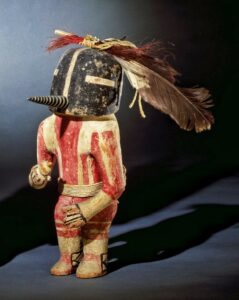
Hopi Kachina Dolls Material and Craftsmanship
Carvers select roots from Fremont cottonwood, scientific name Populus fremontii, harvested from riparian zones along washes and dry riverbeds. The roots lack grain irregularities and knots found in trunk wood, allowing detailed carving while accepting paint readily. The Hopi term paako, meaning “water wood,” references the tree’s water-seeking properties and symbolic connection to the katsina spirits’ rain-bringing function.
Early Traditional Period carvers employed stone knives and scrapers, transitioning to metal knives acquired through trade during the late 19th century. Contemporary carvers use pocket knives, specialized carving knives, chisels, gouges, Dremel rotary tools, and power sanders, though debates persist regarding whether mechanized tools compromise traditional authenticity.
The carving process begins with bark and outer layer removal, followed by rough-shaping to establish body proportions. Early forms were carved from single root pieces with arms attached to sides and minimal anatomical detail. Late Traditional Period work introduced more realistic human proportions while maintaining single-piece construction. Action Period carvers separated arms from bodies using dowels and glue, enabling dynamic poses impossible with single-block carving.
Surface preparation involved sandstone rubbing to smooth surfaces, followed by kaolin clay slip application as primer. Contemporary practice may employ commercial wood fillers and gesso to seal cottonwood’s natural porosity before painting.
Pigments evolved from ground minerals including ochres, charcoal, and kaolin mixed with water or natural binders, through commercial watercolors and tempera during the mid-20th century, to contemporary acrylics valued for durability and color intensity. Brushes transitioned from yucca fiber bundles to commercial sable and synthetic types.
Accessories include ruffs fashioned from green boughs, yarn, fabric, or carved wood; miniature ceremonial implements placed in hands; and jewelry either painted or constructed from tin and blue beads representing silver and turquoise. Feathers from eagles and other birds attached to headdresses until the 1970 federal legislation banning trade in protected bird parts prompted carvers to carve feather representations directly into wood.
Form and Features
Four traditional forms exist based on complexity and recipient age. Putsqatihu, flat boards with minimal shaping and basic painted decoration, are given to infants. Putstihu taywa’yla feature flat bodies with three-dimensional carved faces for toddlers. Muringputihu display cylindrical bodies with fully carved heads but minimal limb articulation. Tithu, the full-bodied figures recognizable as “kachina dolls,” are distributed to girls aged two and older, particularly during the Bean Dance in February and Home Dance in July.
Early Traditional Period figures stood rigidly vertical with arms attached to sides, cylindrical bodies, and minimal facial detail. Heights ranged from 8 to 12 inches. Painted decoration was minimal, focusing on essential identifying characteristics of specific katsina spirits.
Late Traditional Period work from 1910 to 1930 introduced more realistic proportions with defined shoulders, waists, and anatomical features. Carvers paid greater attention to accurate costume and mask details. Heights increased to 15 inches on average.
Early Action Period from 1930 to 1945 featured arms beginning to separate from bodies, though still relatively close to torso. Some figures adopted slight bending at waist or knees. Painting became more detailed and colorful.
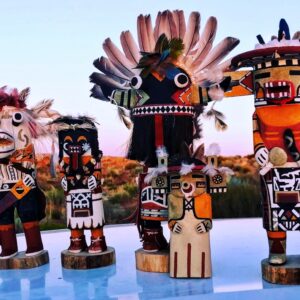
Late Action Period from 1945 onward displayed fully dynamic poses with extended arms, turned heads, and action stances suggesting dancing or ceremonial performance. Multi-piece construction allowed complex compositions. Heights reached 24 to 36 inches for elaborate examples. Surface detail approached miniature sculpture quality.
Each figure represents a specific katsina spirit identifiable through distinctive mask designs, body paint patterns, costume elements, and ceremonial implements. The Crow Mother katsina displays crow wings on the head. The Hano Clown wears horizontal black and white stripes. The Eagle katsina shows feathered costume and wings. Over 250 distinct types exist, each with specific identifying characteristics transmitted through the dolls’ educational function.
Function and Use
The dolls functioned as teaching tools within Hopi families. During ceremonies where masked dancers embodied katsina spirits, carved representations were distributed to young girls who took them home, hung them on pueblo walls, and studied them to learn distinguishing features of different spirits. Boys received miniature versions of ceremonial implements including bows, rattles, and prayer sticks rather than dolls.
This educational purpose distinguished the objects from toys. Girls were instructed not to play with the dolls but to observe them as reference materials. The figures documented the complex pantheon of katsina spirits essential to Hopi cosmology and agricultural ceremonies.
When Euro-American collectors began acquiring examples during the late 19th century, Hopi responses varied. Some carvers recognized commercial opportunities and began producing figures specifically for sale, often simplifying sacred details or creating composite types combining elements from multiple katsinas to avoid inappropriate revelation of religious information. Other community members opposed any commercial production as inappropriate commodification of sacred objects.
The introduction of cash economy and declining agricultural viability on reservation lands made kachina carving an important income source for some Hopi families during the 20th century. Master carvers including Jimmie Kewanwytewa, Cecil Calnimptewa, and Alvin James Makya developed reputations beyond the reservation, their works sought by collectors and museums.
The 1990 Native American Graves Protection and Repatriation Act created obligations for museums to consult with tribes regarding culturally sensitive items. The Hopi Tribe identified certain kachina dolls, particularly those depicting specific sacred figures or used in actual ceremonies rather than created for sale, as objects requiring restricted access or repatriation. Institutions including the Heard Museum implemented policies limiting display and photography of certain examples.
Cultural Context
The Hopi people have inhabited the high desert mesas of northeastern Arizona for over 1,000 years, cultivating corn, beans, and squash through dryland farming techniques dependent on seasonal rainfall and snowmelt. The katsina religion centers on these agricultural cycles, with katsina spirits arriving at winter solstice to bring moisture and departing after the July Home Dance when corn reaches maturity.
The katsina tradition appears to have originated in the Rio Grande Pueblo region around 1300 CE, spreading westward to Hopi villages during subsequent centuries. Archaeological evidence including kiva murals and rock art documents katsina imagery by the 14th century. The tradition provided social cohesion during periods of environmental stress including droughts and resource scarcity.
Spanish colonial authorities attempted to suppress Pueblo religious practices following their 17th-century entrada into New Mexico. The 1680 Pueblo Revolt temporarily expelled Spanish control, but their return in 1692 initiated renewed pressure against indigenous religious expression. Hopi villages in Arizona remained relatively isolated from Spanish and later Mexican authority, allowing greater continuity in ceremonial practices.
U.S. government policies during the late 19th and early 20th centuries sought to assimilate Native Americans through boarding schools, missionary activity, and suppression of traditional religious practices. Bureau of Indian Affairs agents and Christian missionaries condemned kachina ceremonies as pagan superstition. Despite these pressures, Hopi communities maintained ceremonial cycles, though certain aspects became less public or modified to avoid official interference.
The emergence of kachina dolls as collectible art during the early 20th century coincided with broader interest in Southwest Native American cultures. The Santa Fe and Taos art colonies, Fred Harvey Company tourist promotion, and anthropological documentation by scholars including Jesse Walter Fewkes created markets for Native American crafts. Kachina dolls became symbols of “authentic” Native American spirituality for non-Native collectors, though this romanticization often ignored living Hopi perspectives.
Discovery and Preservation
Dr. Palmer’s 1857 collection represents the earliest documented acquisition of kachina dolls by non-Hopi individuals. Subsequent collectors including Thomas Keam, who operated a trading post near Hopi villages from 1875 to 1902, acquired substantial numbers of examples that entered museum collections including the Smithsonian Institution and Peabody Museum.
Anthropologist Jesse Walter Fewkes conducted systematic documentation of Hopi ceremonies during the 1890s, publishing detailed descriptions and illustrations of kachina dances. His work, while scientifically valuable, generated controversy for revealing sacred information to outsiders. Fewkes acquired numerous kachina dolls for the Bureau of American Ethnology, now part of the Smithsonian’s collections.
The Museum of Northern Arizona in Flagstaff, established in 1928, developed close relationships with Hopi communities and amassed significant collections through purchases and donations. The museum initiated the Hopi Craftsman Show in 1930, providing venue for Hopi artists to sell work directly to collectors while establishing quality standards and documenting carver names.
The Heard Museum in Phoenix, founded in 1929, built extensive collections through founder Dwight and Maie Heard’s acquisitions and subsequent donations. The institution has pioneered consultation policies with Hopi representatives regarding appropriate display and access to sensitive materials.
Major private collections assembled during the 20th century by Barry Goldwater, Senator from Arizona, and other collectors have subsequently entered museum holdings or appeared at auction. A 1991 Sotheby’s sale of Goldwater’s collection generated over $3 million, establishing substantial market values that incentivized continued production while raising concerns about commercialization of sacred imagery.
Contemporary preservation challenges include distinguishing between dolls created for ceremonial distribution to Hopi girls and those made specifically for commercial sale. NAGPRA consultations have established that the former category may warrant repatriation or access restrictions, while commercially produced examples remain within museums’ collection mandates.
Why It Matters
Hopi kachina dolls document educational practices transmitting religious knowledge across generations within matrilineal Hopi society where girls received instruction through material objects encoding complex theological and ceremonial information. The tradition’s evolution from simple teaching tools to elaborate collectible sculptures demonstrates how economic pressures and cross-cultural contact transform indigenous artistic practices while communities negotiate between cultural preservation and economic opportunity. The objects raise fundamental questions about appropriate display and study of religious materials from living cultures, as institutional collecting practices established during eras of coercive assimilation policies continue affecting contemporary museum ethics and tribal consultation protocols. The carving tradition provides economic sustenance for Hopi families while creating tensions regarding commodification of sacred imagery and appropriate boundaries between cultural heritage accessible to outsiders and restricted knowledge reserved for community members. The dolls exemplify how material culture simultaneously documents historical religious practices and participates in ongoing negotiations over cultural authority, intellectual property, and the contested boundaries between art, craft, and sacred object in cross-cultural contexts.
https://wikiflo.com/epic-of-gilgamesh-tablets/
[…] What Are Hopi Kachina Dolls and Why Are They Shockingly Worth $10,000 […]