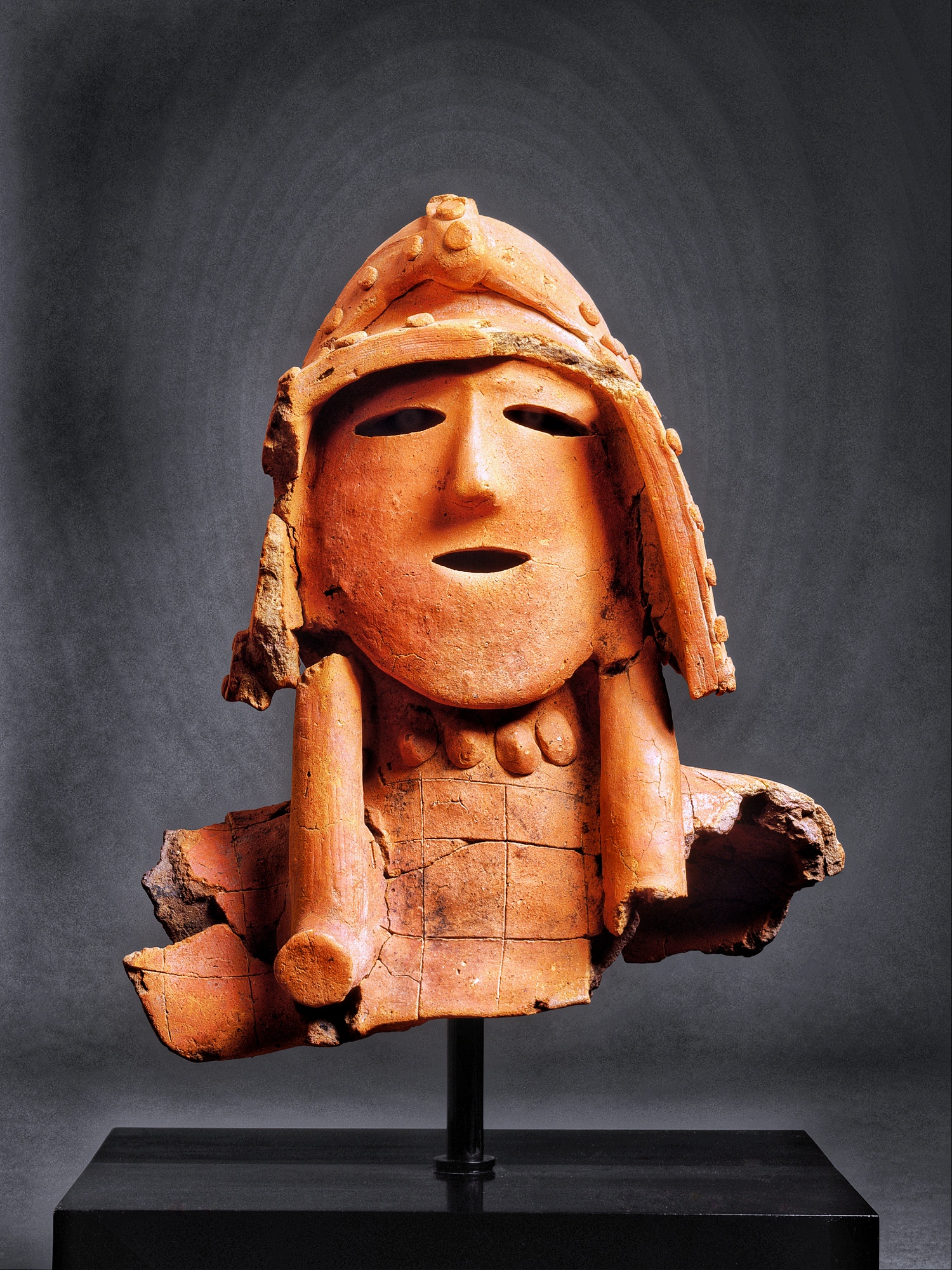
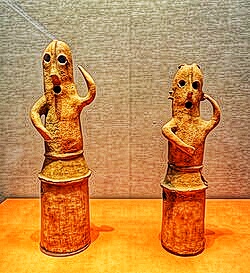
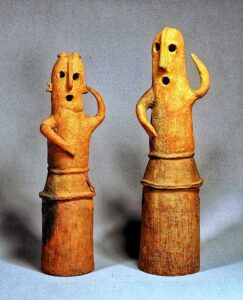
Kofun Period Haniwa Figures are unglazed hollow terracotta funerary sculptures produced between approximately 250 CE and 700 CE for placement on and around the earthen burial mounds of Japan’s ruling elite constitute the body of objects designated haniwa, a Japanese term written with two characters meaning “clay” and “ring” or “circle,” referencing the arrangements in which the figures were positioned upon tomb surfaces. Individual figures range in height from approximately 30 centimeters to 150 centimeters, with the average anthropomorphic example standing approximately 90 centimeters tall. The tallest documented anthropomorphic example, designated “Haniwa Man with a Beard” and held at the Tokyo National Museum, stands 173 centimeters tall following restoration from excavated fragments. The form encompasses two broad categories: cylindrical enkei-haniwa, which served as border markers on tomb mounds, and representational keisho-haniwa, which depict human figures, animals, houses, weapons, shields, boats, and household objects. All haniwa were produced using the wazumi technique, a method of building hollow forms from coiled clay rings fired at low temperatures between approximately 700 and 900 degrees Celsius in open kilns without glazing. Major institutional holdings include the Tokyo National Museum, the Kyushu National Museum, the Museum of the Sakitama Ancient Burial Mounds in Saitama, the Metropolitan Museum of Art in New York (accession numbers from the Harry G. C. Packard Collection and the Michael C. Rockefeller Memorial Collection), the Brooklyn Museum, the Los Angeles County Museum of Art, the Asian Art Museum of San Francisco (Avery Brundage Collection, catalog number B60S204), the Seattle Art Museum, and Chiddingstone Castle in Kent, United Kingdom. The Daisenryo Kofun in Sakai, Osaka Prefecture, the largest keyhole-shaped burial mound in the world at 486 meters in length, is estimated to have originally held more than 20,000 individual haniwa arranged across its surface. Individual haniwa figures have sold at international auction for between $2,000 and $45,000 depending on form, condition, provenance, and documentation of legal excavation.
Kofun Period Haniwa Figures Material and Craftsmanship
Haniwa were produced from locally available secondary clay, a sedimentary clay type found throughout the Kanto and Kinki regions of Japan where the majority of documented kofun are concentrated. This clay was selected for its plasticity, relatively low firing temperature requirements, and availability in quantities sufficient for the large-scale production demanded by major tomb construction projects. The clay was prepared by hand, removing coarse inclusions and working the material to a uniform consistency before forming commenced.
The wazumi coiling method required the artisan to build each figure upward from a flat base using successive horizontal rings of rolled clay. Each ring was pressed and smoothed to the one below it, bonding the layers into continuous walls. The technique produced hollow interiors that served both structural and acoustic purposes, reducing the weight of large figures and preventing explosion during firing by allowing moisture trapped in the clay body to escape through the hollow core. Cylindrical enkei-haniwa were formed as straight hollow tubes open at both ends. Representational keisho-haniwa were built from the same coiled base but developed upward into three-dimensional figurative forms through the addition of separately modeled components including heads, arms, ears, horns, and surface details applied while the clay remained leather-hard.
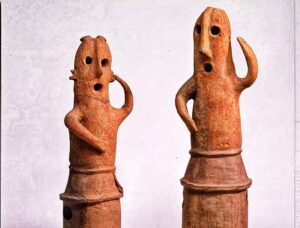
Surface detailing was accomplished by incision, applique, and spatula modeling. Eyes, mouths, and jewelry were typically rendered through triangular or comma-shaped perforations cut through the clay wall, allowing light to penetrate the hollow interior and creating visual definition without requiring additional applied material. Clothing details, armor, headdresses, and decorative bands were formed by pressing clay into the surface or attaching separately prepared elements. Some figures retain traces of red iron oxide paint applied after firing, indicating that polychrome surface treatments were employed in certain regional traditions, particularly in the Kanto region of present-day central Honshu.
Firing took place in outdoor kilns or simple pit structures at temperatures between approximately 700 and 900 degrees Celsius. This relatively low firing range produced porous, unvitrified ceramic bodies with a characteristic reddish-brown to buff coloration resulting from oxidation of iron compounds within the local clay. The porous surface absorbed and retained pigment when paint was applied post-firing. The absence of glazing across the entire haniwa tradition distinguishes these objects from the more technically advanced Sue ware ceramics that were produced in Japan during the same period using Korean-derived anagama climbing kilns at higher temperatures exceeding 1000 degrees Celsius.
Form and Features
Haniwa fall into two primary formal categories that developed sequentially across the Kofun period. The enkei-haniwa, the earlier and simpler form, consists of a plain hollow cylinder between 30 and 60 centimeters tall, open at both ends, with no representational features. These cylinders were inserted into the surface soil of burial mounds at regular intervals to form boundary lines delineating sacred zones, drainage channels, or the edges of the mound’s various terraces. The cylinder form persisted throughout the entire Kofun period alongside more elaborate representational types.
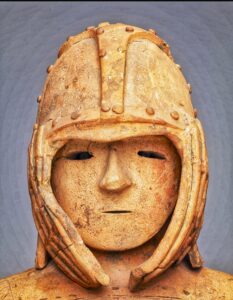
The keisho-haniwa category expanded progressively during the 4th, 5th, and 6th centuries to encompass an increasingly wide range of subjects. The earliest representational forms depicted houses, sunshades, and storehouses rendered in miniature architectural detail, complete with thatched roof ridges, raised floors, and entry ladders. Weapon and armor haniwa including shields, quivers, and helmets appeared in the middle Kofun period and were typically arranged in clusters adjacent to warrior figures. Animal haniwa include horses with saddles and bridles rendered in precise detail, chickens, waterfowl, dogs, wild boar, deer, and monkeys. Human figures depict warriors in full armor, female attendants in layered garments, falconers, musicians playing percussion instruments, dancers, and individuals whose occupational identity is indicated by tools or accessories attached to their clothing.
Warrior figures are among the most extensively documented keisho-haniwa. They depict male subjects wearing short-sleeved tunics over trousers, with sleeveless leather armor covering the torso, helmets with pronounced neck guards, and accessories including swords, quivers, and wrist guards. Female figures are distinguished by long garments, elaborate coiled hairstyles, multiple strings of beaded jewelry, and small comma-shaped magatama beads rendered in clay attached to ears, wrists, and clothing. Both male and female figures display the characteristic perforated facial features, with hollow triangular or slit openings for eyes and mouths, producing the blank, frontal expression that defines haniwa aesthetic across regional styles and time periods.
Regional variation in style is documented across the major production centers. Figures from Gunma Prefecture in the Kanto region are regarded by scholars as the most formally sophisticated, with the highest degree of surface detail, polychrome paint traces, and naturalistic rendering of posture and movement. Figures from the Kinai region around present-day Osaka and Nara tend toward simpler forms with less surface elaboration. These regional differences reflect the organization of specialized haniwa workshops, designated tomobe or be, who were attached to specific ruling clans and transmitted production knowledge within hereditary craft communities.
Function and Use
Haniwa served multiple simultaneous functions on burial mound surfaces, none of which involved direct placement within the burial chamber itself. The primary documentary function was territorial demarcation, with cylindrical haniwa arranged in rows along the edges of the mound’s terraces to define the sacred precinct of the tomb. This boundary function is visible at excavated sites where complete arrangements survive, including the Imashirozuka Tumulus in Osaka Prefecture, where scholars documented the complete original placement of approximately 3,000 haniwa.
Human and animal keisho-haniwa served a representational function, reconstructing around the exterior of the tomb the social world of the deceased ruler. Warriors, attendants, horses, and musical performers placed on the mound surface depicted the court hierarchy and ceremonial activities appropriate to the tomb occupant’s rank. This arrangement may have functioned as a symbolic substitute for the practice of human sacrifice at burial sites, documented in Chinese historical sources including the Weizhi and Houhanshu and in early Japanese texts for Japan’s prehistoric period. The 8th-century Japanese chronicle Nihon Shoki records a legendary origin narrative for haniwa attributing their invention to the wrestler Nomi no Sukune, who proposed clay figures as a replacement for living attendants buried with the dead following the death of Prince Yamato Hiko in the reign of Emperor Suinin. While this account is mythological rather than historical, it documents an ancient cultural awareness of the substitution function attributed to haniwa by later Japanese scholarship.
The protective function of haniwa has been proposed by scholars including those at the Tokyo National Museum, who interpret the warrior and weapon figures as apotropaic guardians preventing malevolent forces from disturbing the tomb. Chicken and rooster haniwa, which appear consistently at tomb entrances, are interpreted within this framework as guardians associated with the announcement of dawn and the expulsion of night-time spirits. Evidence for ritual activity around haniwa following tomb completion is limited, as written documentation of funerary practices from the Kofun period is sparse and primarily consists of Chinese observer accounts and the later retrospective narratives of the Nihon Shoki and Kojiki compiled in 712 and 720 CE respectively.
Cultural Context
The Kofun period, named for the Japanese word kofun meaning “old mound,” spans approximately 250 to 700 CE and is defined archaeologically by the construction of large earthen burial mounds by the emerging aristocratic elite of the Japanese archipelago. More than 160,000 individual kofun have been identified across Japan, ranging from small circular mounds measuring a few meters in diameter to the massive keyhole-shaped zenpokoen-fun, whose distinctive planiform shape is unique to Japan and visible from aerial observation. The Daisenryo Kofun in Sakai, attributed by the Imperial Household Agency to Emperor Nintoku who died approximately 399 CE, measures 486 meters in length and 35 meters in maximum height, making it among the largest burial structures by surface area anywhere in the world. The Imperial Household Agency, which administers mounds designated as imperial tombs, restricts archaeological excavation of these sites, limiting scholarly access to stratigraphic data, skeletal remains, and original haniwa placement arrangements for the most significant Kofun period monuments.
The Kofun period corresponds to the formation of the Yamato polity, the forerunner of the Japanese imperial state, whose ruling lineage consolidated political authority over the Kinai region and progressively extended influence across Honshu, Kyushu, and the western Japanese archipelago. The scale and elaboration of individual kofun directly indexed the political authority of the tomb occupant, making funerary construction one of the primary mechanisms through which rulers demonstrated power and mobilized labor during this period. The production and placement of haniwa on mound surfaces was accordingly an act of political display as well as funerary observance.
Close cultural contact between Japan and the Korean peninsula during the Kofun period introduced continental ceramic technologies including the Sue ware kiln system, iron smelting, bronze casting, and eventually Buddhist iconographic traditions that profoundly affected Japanese material culture. Haniwa production, by contrast, represents a continuation and elaboration of indigenous Yayoi period ceramic traditions, including the practice of placing clay objects on burial sites that is documented in the immediately preceding Yayoi period between approximately 300 BCE and 250 CE. The introduction of Buddhism to Japan in the 6th century, traditionally dated to 552 or 538 CE, brought with it funerary practices inconsistent with large-scale mound burial, and the construction of major kofun declined progressively through the 7th century, with haniwa production ceasing as Buddhist temple construction replaced mound building as the primary expression of elite religious and political identity.
Discovery and Preservation
Haniwa have been recovered from kofun sites throughout Japan since the Meiji period (1868 to 1912), when systematic archaeological investigation of ancient mounds began alongside broader programs of national historical documentation. Earlier disturbance and looting of kofun is documented from the medieval period onward, and fragments of haniwa appear in Japanese illustrated manuscripts and art historical texts from the Edo period (1603 to 1868). Formal archaeological excavation of kofun including stratigraphic recording of haniwa placement began in the late Meiji period and was substantially expanded by government archaeological agencies established following World War II.
The postwar period of rapid economic development and urban expansion in Japan produced large-scale encounters with previously undocumented kofun sites during construction projects. Japanese cultural property law, established through the Law for the Protection of Cultural Properties of 1950 and amended multiple times thereafter, requires construction to pause when archaeological remains are encountered and mandates salvage excavation before development proceeds. This legal framework generated a large body of haniwa recoveries from sites across Saitama, Gunma, Ibaraki, Chiba, and Osaka Prefectures during the 1950s through 1990s, substantially expanding institutional collections at prefectural and national museums.
The Museum of the Sakitama Ancient Burial Mounds in Gyoda, Saitama Prefecture, established adjacent to the Sakitama Kofun cluster, holds one of the most significant regional collections, including haniwa excavated from the Inariyama Tumulus, which also produced the Inariyama iron sword bearing a gold inlaid inscription dated to 471 CE, one of the most important inscribed artifacts of the Kofun period. The Tokyo National Museum holds a comprehensive national collection assembled from excavations across multiple prefectures, with particular depth in figures from Gunma Prefecture, which produced the most stylistically elaborate keisho-haniwa of the late Kofun period.
International collections acquired haniwa primarily through the art market during the early and mid-20th century, when Japanese antiquities dealers sold legally and illegally excavated objects to Western museums and private collectors. The Avery Brundage Collection at the Asian Art Museum of San Francisco, assembled between the 1930s and 1960s, includes Kofun period haniwa among its Japanese holdings. The Michael C. Rockefeller Memorial Collection at the Metropolitan Museum of Art and the Harry G. C. Packard Collection, also at the Metropolitan, contain anthropomorphic warrior and female haniwa acquired through the mid-20th century art market. Export of cultural properties from Japan without government authorization has been restricted under successive iterations of Japanese cultural property law, and contemporary institutional acquisitions of haniwa from the international art market require documented provenance establishing legal export prior to the relevant statutory cutoff dates.
The Imperial Household Agency’s restriction of excavation at imperial tomb designations remains a significant obstacle to comprehensive understanding of haniwa placement and funerary practices at the largest and most politically significant kofun. Scholarly organizations including the Japanese Archaeological Association have submitted formal requests for excavation access to designated imperial tombs, citing the importance of these sites to national and global cultural heritage. These requests have been partially accommodated through limited survey access to some mound exteriors while full stratigraphic excavation of burial chambers has not been authorized.
Why It Matters
Haniwa represent the primary surviving visual record of social hierarchy, material culture, military equipment, clothing, and ceremonial practice in Japan during the Kofun period, a critical four-century interval for which no substantial indigenous written documentation exists. The figures preserve in three-dimensional ceramic form details of horse harness design, armor construction, hairstyling conventions, musical instrument types, and occupational specialization within the Yamato court that cannot be recovered from any other source category. The scale of haniwa production at major kofun, numbering in the tens of thousands of individual pieces at a single mound, documents the organizational capacity of the early Japanese state and the ability of emerging central authority to mobilize specialized craft labor across multiple hereditary workshop communities. The objects also represent an independent Japanese response to funerary substitution practices shared across the broader East Asian world, including the terracotta armies of Qin Shi Huang’s mausoleum in China, providing comparative evidence for how different ancient states addressed the problem of equipping the dead for an afterlife without the sacrifice of living attendants. The Imperial Household Agency’s ongoing restriction of excavation at designated imperial tombs presents one of the most significant active disputes between national cultural custodianship and international archaeological scholarship in contemporary practice.
https://wikiflo.com/iron-pillar-of-delhi/
[…] Kofun Period Haniwa Figures The Most Mysterious Clay Statues Ever Found […]