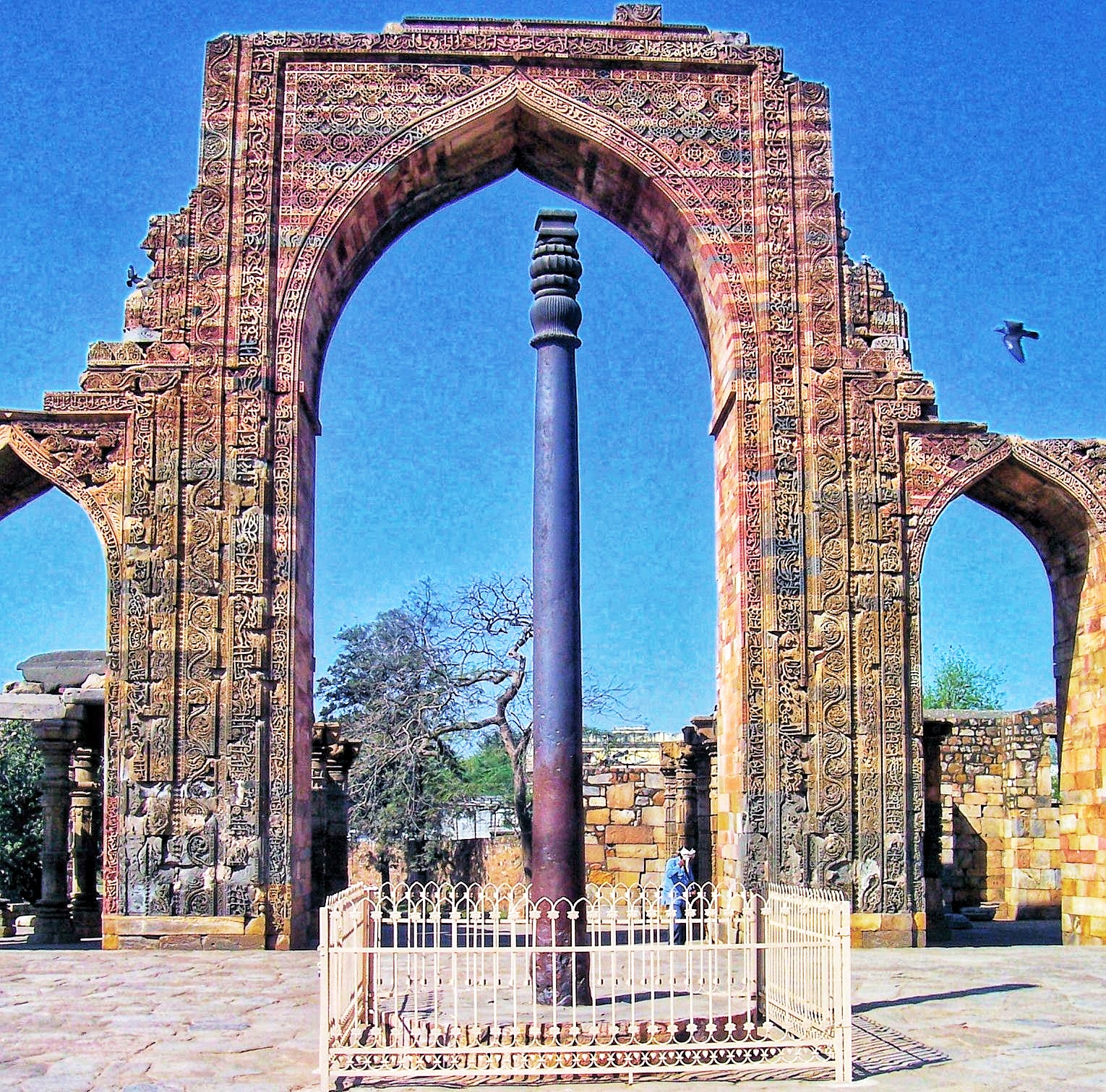
The Iron Pillar of Delhi is a wrought iron column standing 7.21 meters in total height, with 6.10 meters visible above the stone platform and 1.12 meters buried underground, rises from the central courtyard of the Quwwat-ul-Islam mosque within the Qutb complex at Mehrauli in southern Delhi, India. The shaft tapers from a lower diameter of 42 centimeters at ground level to 30 centimeters just below the decorative capital, and the pillar weighs approximately 6.5 metric tons. It was produced during the reign of Gupta emperor Chandragupta II, who ruled approximately 375 to 415 CE, placing its construction at roughly 400 CE. The pillar was not made at its current location. Scholarly consensus, drawing on paleographic analysis of inscriptions, metallurgical evidence, and Gupta-era iconographic parallels, identifies Udayagiri in present-day Madhya Pradesh as the most probable original site of construction, where Chandragupta II is documented to have dedicated a cave shrine to Vishnu.
A secondary inscription in Nagari script dated to approximately 1052 CE, added during the reign of Tomar king Anangpal II, records the reinstallation of the pillar at the fortress city of Lal Kot at Dhilli, the early settlement that became Delhi. The pillar’s incorporation into the Quwwat-ul-Islam mosque complex occurred around 1192 to 1199 CE when Qutb-ud-din Aibak, the slave general of Muhammad of Ghor, built the mosque following his defeat of Prithviraj Chauhan. A cannonball fired at close range, attributed by historians to Nadir Shah’s invasion of Delhi in 1739, left a significant horizontal indentation approximately 4 meters from the current courtyard ground level on the eastern face of the shaft but failed to fracture the column. Captain F. Archer made the first formal British documentation of the pillar in 1828. James Prinsep published the first full translation of its primary Sanskrit inscription in 1838. Alexander Cunningham conducted further study in 1871. The pillar now stands within the Qutb Minar complex, a UNESCO World Heritage Site since 1993, administered by the Archaeological Survey of India. A low protective railing was installed around the pillar in the 1990s, ending a long-standing practice of visitors physically embracing the column.
Iron Pillar of Delhi Material and Craftsmanship
The pillar was produced from wrought iron using the bloomery process, the standard iron-making method of the ancient world in which iron ore and charcoal are heated together in a furnace at temperatures insufficient to fully melt the iron, producing a spongy iron bloom that is then hammered repeatedly to expel slag and consolidate the metal. The pillar was not cast as a single pour but assembled by forge-welding multiple individually produced iron blooms into a unified column through successive cycles of heating and hammering. The base of the shaft retains visible hammer marks across the bottom 60 centimeters, consistent with the assembly process and indicating this section was buried from the point of installation, protecting it from hand polishing by visitors over the centuries.
The key to the pillar’s exceptional corrosion resistance lies in its chemical composition. Research by R. Balasubramaniam of the Indian Institute of Technology Kanpur, published in the journal Current Science in 2002 and in Corrosion Science in 2000, identified three interacting factors responsible. First, the iron contains a phosphorus content of approximately 0.25 percent on average, and in some analytical readings as high as 1 percent, compared to less than 0.05 percent in modern blast furnace iron. Second, the iron contains slag inclusions, small particles of unreduced iron oxides distributed through the metal’s microstructure. Third, the alternating wet and dry cycles of Delhi’s climate provide the specific environmental conditions that allow the protective mechanism to operate.
The high phosphorus content results directly from the ancient Indian smelting technique. Unlike modern blast furnace operations, which add limestone to the furnace and carry away most of the phosphorus in the resulting slag, the ancient Indian bloomery process used no limestone. Instead, charcoal prepared from wood with naturally high phosphorus content, including Cassia auriculata, was used as fuel and as a reducing agent. The absence of limestone preserved the phosphorus in the metal rather than removing it with the slag.
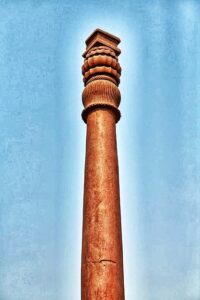
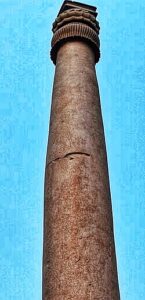
Within approximately three years of the pillar’s erection, the phosphorus, slag inclusions, and cyclic atmospheric wetting and drying initiated a three-stage corrosion mechanism that produced a passive protective film on the iron surface. In the first stage, iron oxidizes normally into amorphous iron oxyhydroxides including lepidocrocite and goethite. In the second stage, the slag inclusions and unreduced iron oxides in the microstructure enrich the interface between metal and rust with phosphorus, which catalyzes the formation of misawite, chemically designated delta-FeOOH, an amorphous iron oxyhydroxide that forms a compact, adherent barrier layer directly against the metal surface. In the third stage, over many centuries, the most critical protective agent develops: crystalline iron hydrogen phosphate hydrate, with the formula FePO4-H3PO4-4H2O, precipitates as a continuous layer at the metal-rust interface, providing the stable long-term barrier that has resisted corrosion for 1,600 years. After sixteen centuries, this entire protective film is only approximately one-twentieth of a millimeter thick. If the surface is scratched, the phosphorus present in the underlying metal reforms the protective film over the damaged area, making the barrier self-healing. Balasubramaniam described the pillar in his research as a living testimony to the skill of metallurgists of ancient India. He also noted that rising urban pollution from vehicle and industrial emissions poses a genuine threat to the film’s stability, as acidic pollutants can react with and damage the passive layer in ways that the Delhi climate of the 5th century would not have produced.
Form and Features
The pillar is cylindrical in form with a very slight upward taper. The visible shaft surface is smooth and exhibits a golden-brown hue in certain lighting conditions, a visual effect produced by the iron phosphate compounds in the protective film rather than by any applied finish. The base rests on a grid of iron bars soldered with lead into the upper layer of the dressed stone pavement, a foundation arrangement that has kept the pillar stable and plumb for the full period of its documented history at the Qutb site.
The capital above the shaft consists of a decorative bell-shaped reeded section of 306 millimeters, above which sits a slanted rod element, circular discs, and a square box pedestal. The square box pedestal contains four holes with fractured iron rods protruding from three of them, which originally supported a now-missing Garuda statue. In Vaishnava iconography, Garuda, the divine eagle vehicle of Vishnu, serves as the standard or dhvaja atop a devotional column. The absence of the Garuda figure, likely lost during the pillar’s relocation from its original site, is the most significant missing element in the pillar’s current form.
The pillar carries inscriptions from multiple periods covering the shaft below the capital. The oldest and most important is a six-line Sanskrit inscription in verse, covering an area 65.09 centimeters by 26.67 centimeters, engraved in the Gupta Brahmi script facing the mihrab arches of the mosque. It describes a king named Chandra, whose military campaigns extended to the Vanga lands of Bengal in the east and the Bactrian territories in the northwest. It praises his personal valor, his devotion to Vishnu, and his installation of the pillar at Vishnupadagiri, meaning the hill of Vishnu’s foot, as a flagstaff in honor of the god. The preservation of this inscription across sixteen centuries, without the blurring and erosion that would normally affect engraved text on exposed metal in an outdoor environment, is itself a direct consequence of the pillar’s corrosion resistance. The Nagari script secondary inscription from approximately 1052 CE, attributed to Anangpal II, is brief and has been interpreted as recording the moment of reinstallation at the Tomar capital.
Function and Use
In its original Gupta period context, the pillar functioned as a kirti stambha, a victory column or column of fame, and simultaneously as a dhvaja, a devotional flagstaff dedicated to Vishnu. The Sanskrit inscription states this purpose directly, recording that the pillar was erected as a standard to honor the god at the hill of Vishnu’s foot. The Garuda figure at the summit, as Vishnu’s vehicle and symbol, completed the devotional program of the column and made its dedicatory purpose visible from a distance.
The choice of iron for a devotional victory column dedicated to a Hindu deity is itself significant. Stone was the standard material for such columns in the Gupta period, making the iron pillar an exceptional and deliberate departure from conventional practice. The decision to use iron, and to produce a column of this scale in that material, announced both the technical capacity of the Gupta state and the exceptional quality of its craftsmen. The pillar’s massive weight and impressive height carried the same message of power and organization that stone columns communicated elsewhere in the ancient world.
When Qutb-ud-din Aibak incorporated the pillar into the Quwwat-ul-Islam mosque complex in the 1190s, its function shifted entirely. It became a visual trophy within an Islamic religious space, its pre-existing presence at the site repurposed as a monument to the conquest of the Tomar Hindu fortress. Neither its Vaishnava dedicatory meaning nor its original site relationship survived this transition intact. The pillar nevertheless continued to attract popular religious attention from Hindu visitors who associated it with the god Vishnu, and the tradition of embracing the pillar to have a wish granted persisted until the protective railing was installed in the 1990s.
Cultural Context
The Gupta Empire, which Chandragupta II ruled at its political and cultural peak, is considered the classical age of Indian civilization. Literature, mathematics, astronomy, philosophy, and visual art all reached exceptional levels of refinement during the Gupta period. Aryabhata, working during the same general period, produced his treatise on mathematics and astronomy in 499 CE. The Buddhist university at Nalanda, which was founded during the Gupta period, became the most important center of learning in Asia for several centuries. The pillar was produced within this context of high institutional and technical achievement, and its metallurgical sophistication reflects the knowledge systems operating across Gupta period specialist workshops.
The pillar’s movement from Udayagiri to the Tomar capital at Lal Kot circa 1052 CE brought it into the political context of the early Delhi region, where Tomar kings were consolidating a new urban center at the location that would develop into medieval and modern Delhi. King Anangpal II’s decision to reinstall the pillar at his capital reproduced the Gupta-era logic of using the object as a legitimizing monument, asserting continuity with an earlier prestigious dynasty through physical possession of its most celebrated artifact.
The Quwwat-ul-Islam mosque, meaning the might of Islam, was the first mosque built in Delhi following the establishment of Muslim rule in northern India. It was constructed on the foundations of 27 pre-existing Hindu and Jain temples, and many of its colonnade pillars are directly reused temple columns, with their original carved figural decoration still visible on some surfaces. The iron pillar, already standing at the Tomar temple site that became the mosque’s location, was retained and surrounded by the mosque’s structure. Its survival in this context, when so many surrounding Hindu temple structures were demolished, was the result of the mosque’s use of the pre-existing site layout rather than any particular preservation decision.
Discovery and Preservation
The pillar was known continuously at its current site from its medieval installation onward and required no rediscovery. It appears in the accounts of Ibn Battuta, the Moroccan traveler who visited Delhi in 1333 and noted it as an ancient monument of unknown origin. British colonial attention to the pillar as an artifact of antiquarian interest began formally with Captain F. Archer’s 1828 documentation. James Prinsep’s 1838 translation of the primary Sanskrit inscription established the pillar’s Gupta period date and its connection to Chandragupta II. Alexander Cunningham’s measurements and study in 1871 provided the first systematic physical record of its dimensions and current condition. These 19th-century colonial studies were the foundation for the Archaeological Survey of India’s subsequent formal protection of the site.
In 1912, researchers began investigating the pillar’s corrosion resistance, a property that had long attracted popular and scholarly attention. Early theories proposed that the specific microclimate of Delhi, where humidity does not exceed 70 percent for extended periods during most of the year, was responsible. By the mid-20th century, material science analysis had shifted focus to the pillar’s composition. The 2002 publication by Balasubramaniam in Current Science, building on his earlier 2000 paper in Corrosion Science, provided the first complete mechanistic explanation of the three-stage protective film formation, resolving a question that had been actively studied for ninety years.
In 1969, the author Erich von Däniken cited the pillar’s corrosion resistance and its production method as evidence of extraterrestrial visitation in his book Chariots of the Gods. When informed by an interviewer in 1974 that the pillar was not in fact rust-free and that its production method was well understood by materials scientists, von Däniken stated he no longer considered the pillar to be a mystery. The Archaeological Survey of India installed the protective railing around the pillar’s base in the 1990s, ending direct physical contact with the column by visitors and protecting the ground immediately around it from the accumulated humidity and salinity produced by large numbers of people pressing against it over many years. Pollution from Delhi’s expanding vehicle traffic and industrial activity represents the most significant ongoing threat to the pillar’s protective film, according to assessments by materials scientists including Balasubramaniam, who warned in published studies that increasing acidic pollutant levels in Delhi’s air could destabilize the ancient corrosion equilibrium that has protected the metal for sixteen centuries.
Why It Matters
The Iron Pillar of Delhi is the oldest large metal structure in the world still standing in its original upright orientation, having remained vertical and corrosion-resistant for approximately 1,600 years through exposure to monsoon rain, summer heat, pollution, a cannonball strike, and multiple changes of political and religious ownership of the site around it. The pillar resolved, through materials science analysis completed in 2002, a question that European and Indian researchers had studied since 1912, demonstrating that its corrosion resistance results from a precisely controlled ancient smelting technique that produced iron with phosphorus content averaging twenty times higher than modern blast furnace iron, a level of compositional control achieved through empirical process knowledge rather than theoretical chemistry. The three-stage protective film mechanism identified by Balasubramaniam at IIT Kanpur has since been proposed as a model for designing long-term corrosion-resistant coatings for nuclear waste storage containers, meaning a 5th-century metallurgical achievement is actively informing 21st-century engineering research. The pillar’s movement across four distinct political and religious contexts, from a Gupta Vaishnava devotional column to a Tomar royal monument to a Delhi Sultanate mosque trophy to a UNESCO protected heritage site within a modern republic, documents in a single object the full arc of northern Indian political history across sixteen hundred years, with each transition leaving visible traces in the form of inscriptions, structural damage, and changed institutional framing that together make the pillar one of the most layered historical documents in South Asian material culture.
https://wikiflo.com/indonesian-gamelan-instruments/
[…] Iron Pillar of Delhi 1600 Year Old Ancient Wonder That Never Rusts […]