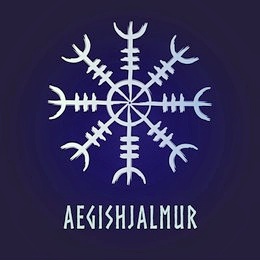
The ancient object warriors carried to become untouchable in battle is known as the Aegishjalmur, a runic symbol from the Norse tradition also referred to as the Helm of Awe or the Helm of Terror. Documented in the oldest surviving texts of Norse literature and preserved in Icelandic manuscripts spanning several centuries, the Aegishjalmur was not a physical helmet in the conventional sense. It was a sacred symbol, inscribed on the body or weapons of a warrior before combat, and it was believed to render the bearer invincible, to paralyze the will of enemies, and to project a force of terror so potent that no adversary could withstand it.
Few objects in the recorded history of warrior cultures carry as precise and consistently documented a claim as this one. The Aegishjalmur appears across multiple independent literary sources, archaeological findings, and folk traditions stretching from the Viking Age into early modern Iceland. Its place in the material and spiritual life of Norse warriors is not speculative. It is documented.
Material and Craftsmanship
The Aegishjalmur was produced in several forms across different periods of its documented use. In its earliest attested form, the symbol was not made from any precious material. It was applied directly to the forehead of the warrior using a carved lead or copper stamp. The warrior pressed the stave between his eyebrows, in the space understood in Norse tradition as the seat of perception and willpower, and recited the formula: “Aegishjalm er eg ber milli bruna mer,” meaning “the Helm of Awe I carry between my brows.”
The choice of lead and copper was deliberate. Both metals were associated in Norse and Germanic folk tradition with binding, sealing, and fixing power in place. Lead in particular was used in magical practice across Northern Europe as a material capable of fixing a spell permanently at the point of application. The small size of the carved stamp, which had to fit within a space approximately half an inch wide on the forehead, demonstrates that the symbol was a precise, miniaturized design requiring skilled craftsmanship to render legibly in metal.
Later iterations, particularly from the 14th century onward as documented in Icelandic grimoires, took the form of physical helmets bearing the symbol engraved or embossed on the surface. These physical objects were described in manuscripts as carrying properties far exceeding those of the earlier forehead application. They were considered among the most powerful protective objects a warrior could possess.
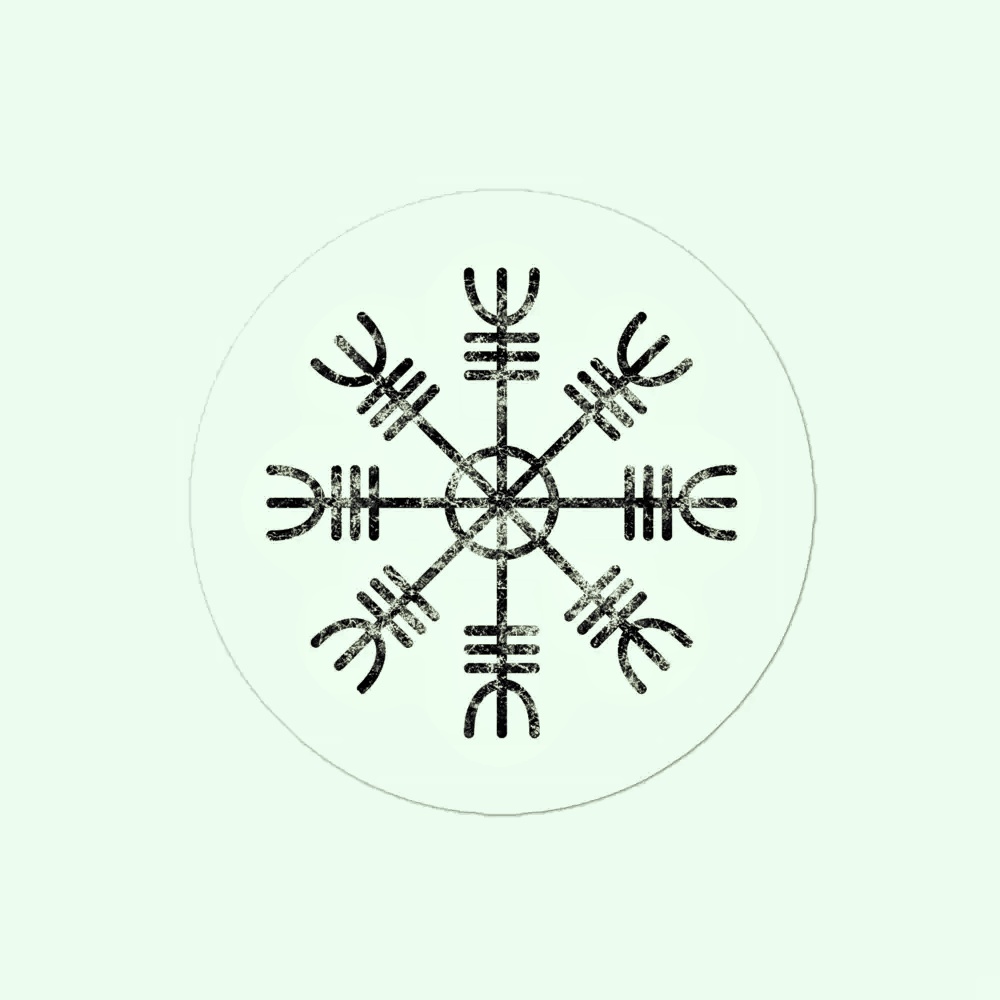
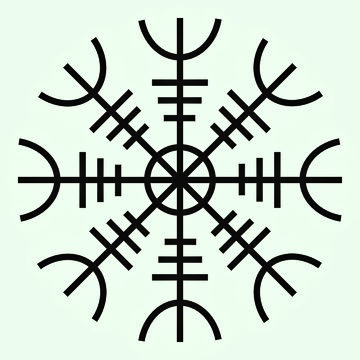
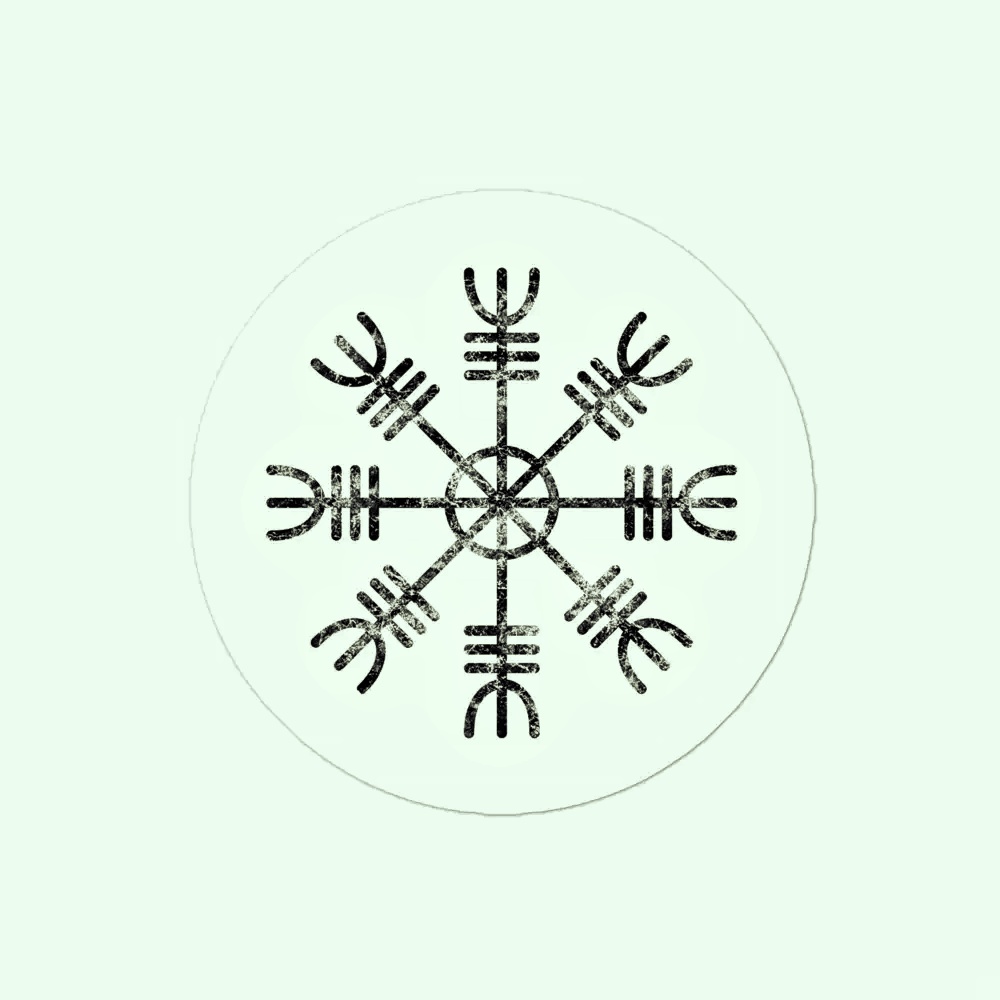
The symbol itself consists of a central point from which eight tridents radiate outward in equal measure, forming a pattern that resembles a wheel or sunburst. Each arm of the symbol incorporates shapes derived from the Algiz rune, which in the Elder Futhark runic alphabet represents protection and shielding. Two additional runic forms are embedded within the overall design: the Z-rune, associated with defensive shielding against attack, and the Isa rune, which translates to ice and was understood to represent the hardening of personal will against an opposing force.
Form and Features
The Aegishjalmur belongs to the category of Icelandic magical staves known as galdrastafir. These are intricate geometric symbols, each designed for a specific purpose, recorded in grimoires that served as the written repositories of Norse magical practice. The most important surviving grimoire containing the Aegishjalmur is the Galdrabók, a manuscript compiled in Iceland during the late 16th and early 17th centuries, though the traditions it preserves are understood to predate the manuscript by several centuries.
Within the Galdrabók and related collections, each stave is accompanied by instructions for its use, the materials required, the position in which it should be applied or placed, and the verbal formulas to be recited during application. The Aegishjalmur entries specify the forehead as the point of application, identify the materials as lead or copper, and provide the full verbal formula. This level of specificity distinguishes the Aegishjalmur from vague or generalized protective symbols. It was a precisely engineered object of ritual technology.
The design geometry of the Aegishjalmur also appears to serve a functional role in how the symbol was understood to operate. The eight radiating arms were interpreted as eight directional projections of protective force, covering the warrior from threats approaching from any direction simultaneously. The central point from which the arms extend represented the bearer himself, positioned at the center of the protective field. This interpretation is consistent across multiple independent sources.
Function and Use
The primary documented function of the Aegishjalmur was to render the warrior who carried it untouchable in battle. This claim appears in the Fáfnismál, a poem within the Poetic Edda, one of the oldest and most authoritative collections of Norse mythology and heroic legend. In the Fáfnismál, the dragon Fafnir attributes his ability to keep all enemies at a distance to his possession of the Aegishjalmur. His statement “none dared come near me” is understood in the text as a direct consequence of the symbol’s power.
The function of the Aegishjalmur operated on two distinct levels as described in the sources. The first was protective shielding: the symbol was believed to create a field of force around the warrior that deflected physical attacks and weakened the effectiveness of weapons directed against him. This protective dimension is consistent with the Algiz runic content of the design.
The second function was psychological and perceptual manipulation of the enemy. The Aegishjalmur was believed to project terror into the minds of those who faced the warrior bearing it. Enemies were described as losing confidence, becoming hesitant, and in some accounts experiencing a form of cognitive paralysis when confronted with a warrior carrying the Aegishjalmur. This psychological dimension is emphasized in several saga accounts and is connected to the Seidr magical tradition of Norse practice, which held that skilled practitioners could alter the perception and judgment of those around them.
The ritual of application was specific and required completion before combat began. The warrior pressed the lead or copper stamp between his eyebrows, applied sufficient pressure to leave an impression of the symbol on the skin, and spoke the formula aloud. This combined physical impression and verbal declaration was understood to activate the symbol’s properties for the duration of the coming battle.
Warriors also inscribed the Aegishjalmur on weapons and shields. Swords bearing runic inscriptions including elements of the Aegishjalmur design have been recovered from archaeological sites across Scandinavia. Placing the symbol on a weapon was understood to extend its protective and terror-projecting properties outward from the warrior himself.
Cultural Context
The Aegishjalmur developed within a warrior culture that integrated spiritual practice directly into combat preparation. Norse warriors did not separate the physical and metaphysical dimensions of battle. Ritual preparation was considered as essential as the sharpening of weapons or the donning of armor. The Aegishjalmur was one component of a comprehensive pre-battle protocol that could also include prayers to Odin, the wearing of particular garments, specific dietary practices, and consultation with practitioners of Seidr.
The symbol’s association with Odin is significant. Odin in Norse cosmology is simultaneously the god of war, wisdom, death, and magical knowledge. He is recorded in the Ynglinga Saga as a master of Seidr, the branch of Norse magic concerned with fate and perception. The Aegishjalmur carries the implicit authority of Odin’s patronage, meaning that a warrior who used it correctly was understood to be operating under divine protection.
The placement of the symbol between the eyes also carries cultural significance that extends beyond Norse tradition. The space between the eyebrows corresponds to what Hindu and Buddhist traditions call the third eye, the seat of consciousness and perception beyond physical sight. Whether through direct cultural contact along trade routes connecting Scandinavia to the Indian subcontinent, or through parallel development, Norse tradition assigned identical significance to this anatomical location. Placing the Aegishjalmur at this point was understood to connect the warrior’s consciousness to the symbol’s field of force at the deepest level.
The Aegishjalmur was worshipped primarily by those who had already demonstrated outstanding achievement in battle or other high-stakes activities. It was not a general protective charm for the fearful or untested. In Benin culture, an analogous principle governed the Ikegobo: only those who had already accumulated genuine success were considered worthy to commission a brass altar. The Aegishjalmur occupied a comparable position in Norse culture. It was a tool for those already proven, who sought to maintain and deepen their warrior status.
Discovery and Preservation
The Aegishjalmur is preserved across three distinct categories of historical evidence: literary sources, manuscript grimoires, and physical artifacts.
The literary sources are the Poetic Edda and Prose Edda, compiled in Iceland primarily during the 13th century but drawing on oral traditions that scholars date to at least the Viking Age, roughly 793 to 1100 AD. Within these texts, the Aegishjalmur appears as a recognized object of established power, not as a novel or unusual concept. The matter-of-fact manner in which the Fáfnismál references it suggests an audience already familiar with its properties and significance.
The manuscript grimoires provide the most technically detailed records. The Galdrabók, compiled in Iceland between approximately 1575 and 1650, contains specific instructions for the Aegishjalmur’s use alongside 46 other magical staves. Icelandic grimoires as a category survive from the 17th century onward, though the traditions they document are considered by scholars to predate the manuscripts by at least two to three centuries. The consistency of the Aegishjalmur’s description across independent manuscript sources supports its status as a genuine, long-established tradition rather than a late invention.
Physical artifacts include runic objects recovered from archaeological excavations across Scandinavia and Iceland. The Golden Horns of Gallehus, a pair of golden horns found in Denmark and dated to approximately the 5th century AD, contain imagery that several researchers including Finn Rasmussen have identified as potentially related to Aegishjalmur symbolism. Depictions of warriors accompanied by radial symbols appear on rock carvings at Tanum in Sweden, dated to the Bronze Age between 1800 and 500 BC, raising the possibility that the symbol’s origins predate the Viking Age by a considerable margin.
The Aegishjalmur as a recorded tradition was preserved through the Icelandic grimoire tradition, which survived even through the Christianization of Scandinavia because Iceland’s relative geographical isolation allowed folk magical practices to persist longer than in mainland Scandinavia. When Jón Ármason compiled Icelandic folk traditions in the 19th century, accounts of the Aegishjalmur made from lead and pressed between the eyebrows were still sufficiently established in folk memory to be recorded in detail.
Why It Matters
The Aegishjalmur represents one of the most thoroughly documented examples of a warrior-carried protective object in all of pre-modern history. Its preservation across literary, manuscript, and material evidence provides a level of historical verification rare among objects of this type.
From a historical standpoint, the Aegishjalmur demonstrates that the Norse warrior tradition was not limited to physical combat technique. It incorporated a sophisticated system of ritual technology that addressed the psychological dimensions of battle as well as the physical. The documented belief that the Aegishjalmur projected terror into the minds of enemies reflects an understanding that battle outcomes depended as much on the mental state of combatants as on physical strength or weapons.
From the standpoint of material culture, the production of Aegishjalmur stamps in lead and copper represents a specialized craft tradition that existed alongside the better-documented practices of sword-making and shield construction. The artisans who produced these objects were working within a precise symbolic grammar requiring exact rendering of a specific geometric design in miniature format. This is skilled work, and its existence confirms that the production of protective ritual objects was a recognized and valued craft within Norse society.
From the perspective of comparative religion and anthropology, the Aegishjalmur stands alongside objects such as the Ikegobo of the Benin Kingdom, the bronze cowrie containers of the Dian Kingdom, and the scarab amulets of ancient Egypt as evidence that warrior cultures across different continents and centuries independently developed systems of material objects intended to extend human capacity beyond its physical limits through ritual engagement with spiritual forces. The Aegishjalmur is among the most precisely documented examples of this universal human practice.
Its continued presence in modern Scandinavian cultural identity, in museum collections, in academic scholarship, and in the living traditions of groups maintaining connection with Norse heritage, confirms that the object’s cultural significance has not diminished in the centuries since the Viking Age ended.