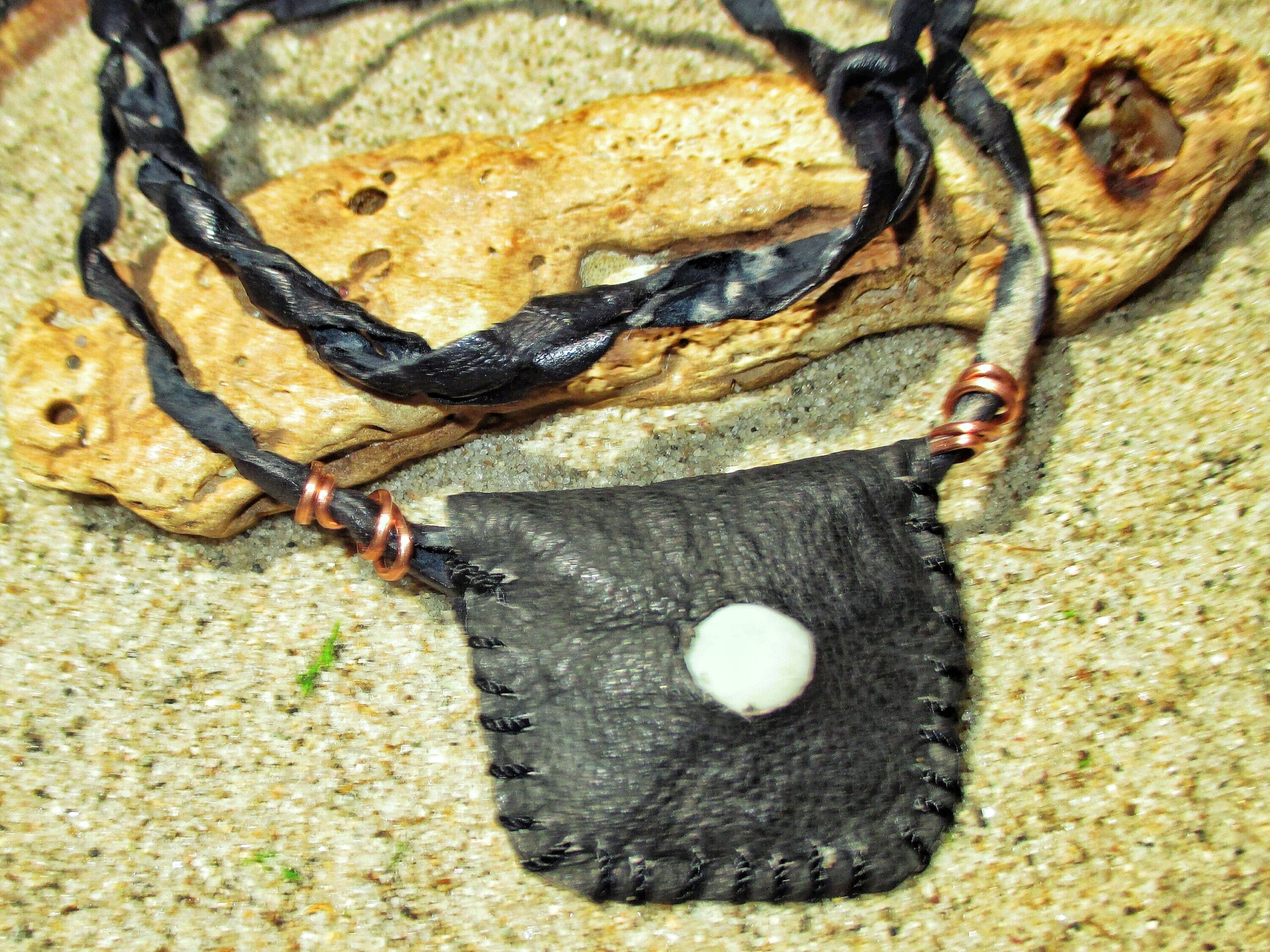
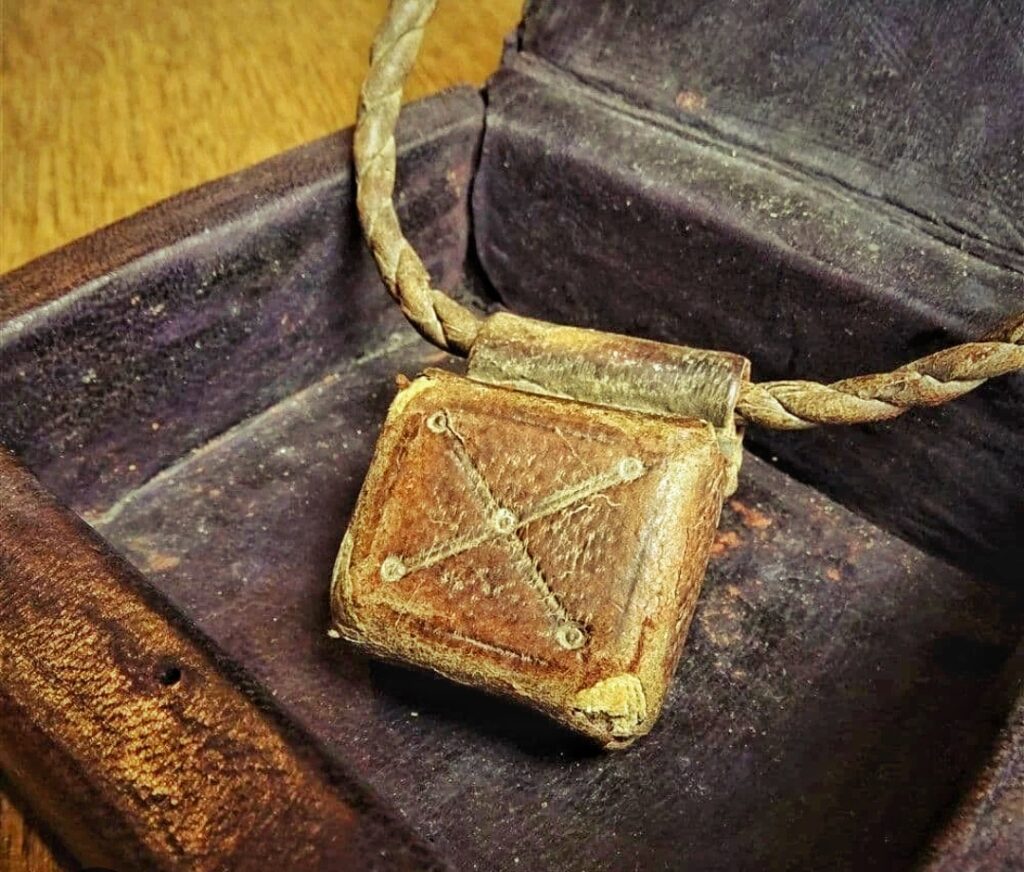
West African protective amulets known as gris-gris served as material instruments of spiritual and financial security for traders across centuries of commercial activity in the region. These talismans originated in the Muslim Mande communities of far West Africa and were believed to protect the wearer from evil or bring luck. Among the various forms of portable sacred objects documented across the region, the gris-gris stands out as the most historically verifiable, the most widely distributed, and the most deeply embedded within the structure of West African trade culture. Traders who carried this object were not engaging in superstition divorced from economic life. They were operating within a coherent system of belief in which spiritual force and commercial outcomes were understood as directly connected.
Origins Within the Muslim Mande Trading World
Beginning in the ninth and tenth centuries, Amazigh traders traveled in caravans from North Africa across the Sahara to the Western Sudan, attracted by the tremendous gold deposits of the region. Islam’s inroads into West Africa developed through multiple paths, including merchant transactions between West Africans and predominantly Arabic-speaking North African traders, and the presence of merchant-scholars in the urban centers of the Western Sudan who performed services and administrative tasks useful to West African kingdoms.
Merchant-scholars’ ability to read and write made them valuable to West African kings. This literacy in Arabic was not merely administrative. It was spiritual. The written word, specifically the written word of the Quran, was understood to carry divine power that could be channeled into physical objects. Out of this intersection of commerce, Islamic scholarship, and indigenous belief, the gris-gris took its earliest documented form.
The word gris-gris has origins among various Mande languages spoken by the Mandinka and Bambara peoples in West Africa and is believed to mean “magic.” The Dyula people, a Mande-speaking Muslim merchant group who spread across the Volta Basin and surrounding territories, were central to the gris-gris tradition. The Dyula were active gold traders as long ago as the time of the ancient African kingdom of Ghana and flourished under the empire of Mali, when they provided a link between the gold-producing forestlands in the south and the trading network of the western Sudan and North Africa.
Dyula communities thrived as enclaves under pagan overlords who valued their trading acumen and protective amulets. Their identity as both merchants and producers of spiritual protection was inseparable.
What the Object Was Made From
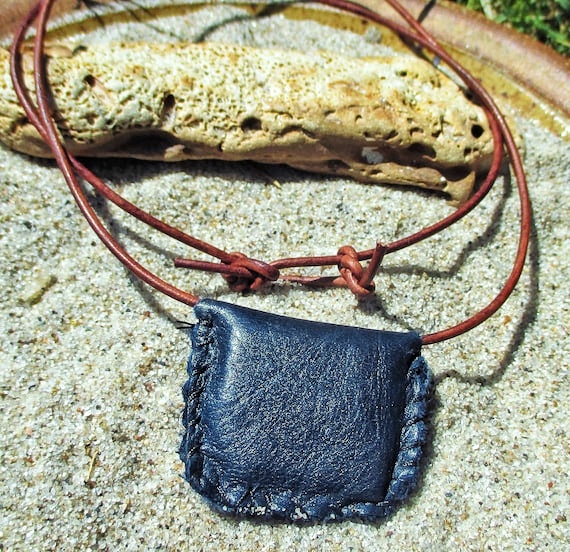
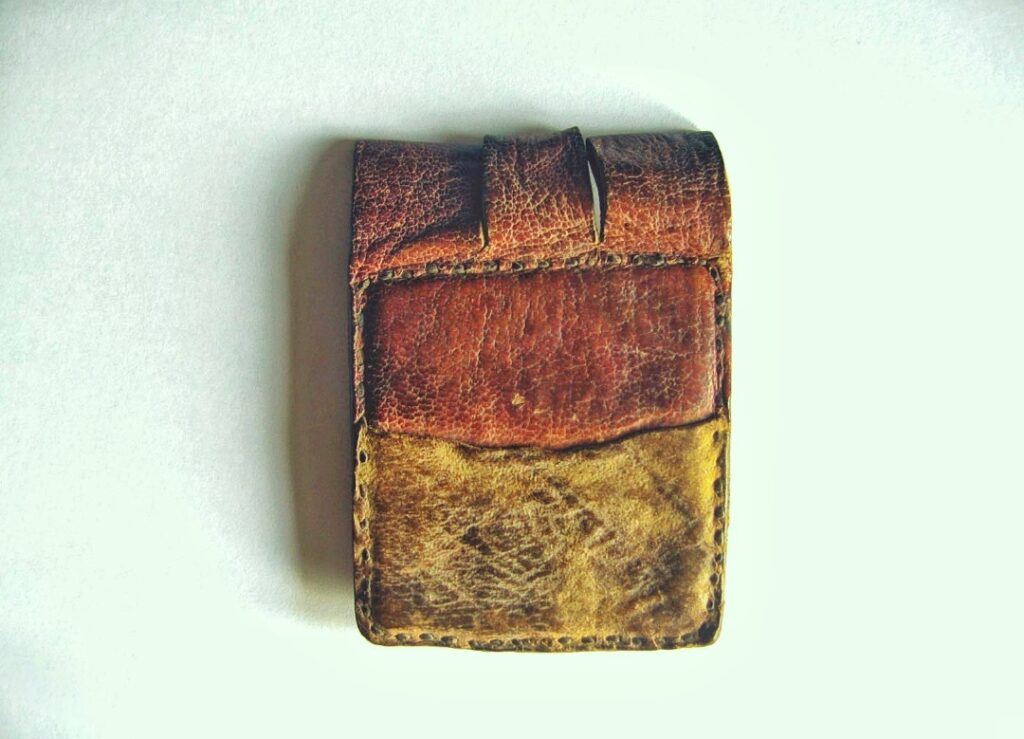
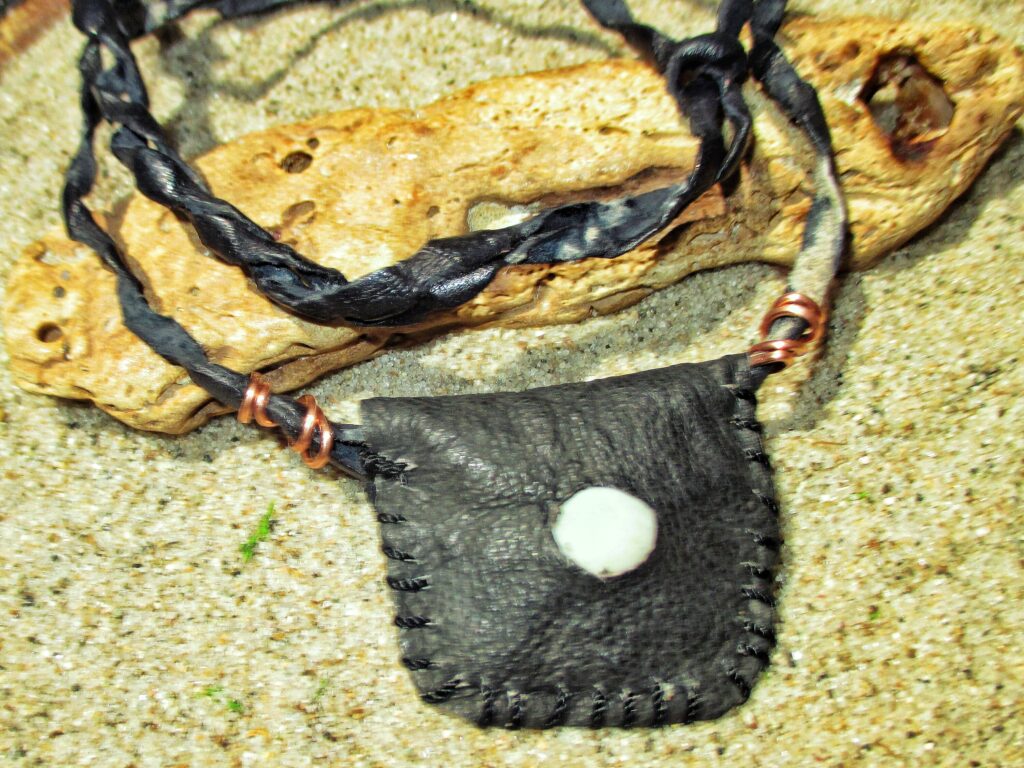
The gris-gris was a small, sealed pouch contained in elaborately etched or plain leather pouches that had either handsewn or handwritten text from the Quran inside them along with special numbers with mystical meanings.
Originally, a gris-gris may have consisted of a folded piece of paper with an inscription from the Quran, written in special ink, with meaningful numbers, words, and symbols in a grid. This piece of paper was folded and tied with string and placed in a leather pouch to be worn on the body or affixed to a meaningful location.
Beyond inscribed paper, the pouch contained other materials selected for their spiritual resonance. Gris-gris were usually fashioned in the form of small sacks that consisted of Quran scriptures written on pieces of paper and herbs. Animal parts such as small bones and stones were also common inclusions, with each element chosen to correspond to the specific purpose for which the object was prepared.
The number of items placed inside was strictly observed. Ingredients are always in odd numbers: one, three, five, seven, nine, or thirteen, never even numbers. For a gris-gris prepared specifically for commercial protection and financial security, coins were among the most documented inclusions, functioning as symbolic anchors for the material outcomes the trader sought.
The ink used for Quranic inscription was itself regarded as carrying spiritual force. The writing had to be precise, often done using special inks derived from charcoal and water, and sometimes incorporating specific plant material. In some documented practices, the marabout would wash the inscribed text off the writing surface into water, which the client then drank, believing the protective power of the verse would be absorbed directly into the body before the physical amulet was sealed and carried.
The Physical Form and How It Was Worn
The finished gris-gris was compact and built for constant wear on the body. It was typically worn around the neck on a leather cord, around the waist in cases of infertility, and around the head, arms, and ankles according to the purpose of the gris-gris.
Where the gris-gris was worn, whether at the neck, waist, or limbs, usually related to its purpose. Protection, health, wealth, and social harmony all required different placement. A gris-gris prepared for financial protection was most commonly worn at the waist or kept close to where money and trade goods were stored on the person.
Once sealed, the object was not to be opened. Doing so was widely understood to neutralize its power. The physical integrity of the sealed pouch was treated as inseparable from the spiritual integrity of its contents. Some gris-gris intended for the protection of a specific commercial space or storage area were not worn on the person at all. Many sellers secured themselves against thievery not only with the assistance of large padlocks but also by placing protective amulets in their stalls and storage cases. This extended the gris-gris from a personal object into a spatial one, with its protective function covering the trader’s goods as well as his body.
How Traders Used It in Commercial Life
The gris-gris carried by traders addressed the specific risks of commercial activity in pre-colonial and early colonial West Africa. Long-distance trading was physically dangerous and financially unpredictable. Caravans crossing the Sahara faced environmental exposure, banditry, and market volatility across journeys that could last weeks or months. The gris-gris was prepared to speak to each of these concerns within a unified spiritual framework.
Islamic scholars in West Africa, known as marabouts or karamokos, were the primary creators of the gris-gris. They practiced a mystical tradition known as Karamokobara, which has two paths: the path of prayer known as seli and the path of the amulet known as siri. Those who follow siri become the experts in these talismans.
Merchants consulted marabouts before undertaking journeys, before entering negotiations, and when facing commercial difficulty. The power was located in the sanctity of the holy work written by the spiritually adept scholar, intended to prevent misfortune, cure illness, or forecast the future. For financial purposes specifically, marabouts selected Quranic verses associated with divine provision and protection of assets.
In regions of West Africa where Muslim clerics and traders were present, their influence reached beyond those they converted because of the value of the services they offered. Even traders who did not practice Islam sought out marabouts for gris-gris production. The spiritual authority of the Islamic scholar was recognized broadly across ethnic and religious lines within the commercial culture of West Africa.
Even non-Muslims in the region began to wear gris-gris sacks, which were called saffis. This cross-religious adoption reflected the perceived practical efficacy of the object, not doctrinal conversion.
The Belief System Behind the Object
The cultural logic of the gris-gris rested on a concept common across West African Islamic communities. It was the idea that Quranic knowledge, when held by a sufficiently learned scholar, could be directed outward as a protective force toward specific earthly ends. Among Mande Muslims, it was believed that Islamic scholars could access great mystical powers that could be employed to prevent misfortune.
Before the arrival of Islam in West Africa, women and children often wore amulets to protect them from a variety of life’s potential hazards. With the arrival of Islam, this practice continued, but their amulets began to include Quranic verses or prayers. In this way, West African Muslims did not disturb the orthodoxy of Islam but rather managed to syncretize it with some West African indigenous beliefs.
The Dyula traders were instrumental in spreading this practice geographically. It is believed that Mande speakers, such as the Dyula people, played a pivotal role in the creation and distribution of Islamic charms, which they called gris-gris. From them, the practice is believed to have spread to other Muslim ethnic groups, such as the Dagomba people, who wrote extensive Arabic manuscripts with magic formulae and prescriptions for preparing amulets.
The marabout occupied a socially recognized position within this commercial world. The marabout is often a scholar of the Quran or religious teacher. Others may be wandering holy men who survive on alms or as spiritual directors of Muslim religious communities, often as leaders of Sufi orders. Muslim Sufi brotherhoods were one of the main organizing forms of Islam in precolonial West Africa. Their dual function as scholars and producers of protective objects made them indispensable figures within the economic culture of the Sahelian trade world.
Documentary Record and Preservation
The historical record of the gris-gris in West African commercial life begins with early European accounts of the Guinea Coast and Senegambia. Descriptions of nominas in West Africa can be found in Valentim Fernandes’ depiction of 1506, which recorded the first modern encounters between the African and European worlds. By the 17th century, English travelers along the West African coast were documenting these objects with increasing specificity.
Richard Jobson, an English explorer who traveled up the Gambia River in 1620 to 1621, produced one of the most cited early English-language accounts of the practice among Mandinka communities, documenting stitched leather packets worn constantly on the person for protective purposes.
The transatlantic slave trade produced a second documentary record that has allowed scholars to trace the origins of the practice and its continuity across the Atlantic. The Mandinka people were the first Muslim ethnic group imported from Sierra Leone to the Americas. They were known for their conjure bags called gris-gris and carried the talismans with them when they boarded slave ships heading to the Americas. Enslaved Muslims were sought out for conjure services requesting them to make gris-gris bags for protection against their enslavers and other dangers.
References to gris-gris used by New Orleans slaves can be found in historical documents dating from as early as 1734. It was observed that when the slaves arrived in Louisiana, they did not want to part with their fetishes, charms, and gris-gris.
Physical examples of West African gris-gris have been preserved in several institutions. An example of an amulet is preserved at the Peabody Museum of Harvard University, catalogued as a purse or amulet case known as mufhadali, under accession number 14-12-50/85506. The Museo delle Civiltà in Rome holds additional examples containing ritual elements associated with spiritual and magico-religious practices.
Foundational works by scholars including Daniela Buono Calainho, Vanicléia Silva Santos, Matthew Rarey, and Cécile Fromont highlight how these practices were monitored by inquisitorial institutions, revealing the complex interactions between African culture and colonial power. Their research forms part of a broader academic effort to document the history of these objects across the Black Atlantic.
Why the Gris-Gris Matters Beyond Its Region
The gris-gris represents something larger than a single category of sacred object. It is a documented point where Islamic learning, indigenous African spiritual practice, and the material demands of long-distance commerce intersected and produced a coherent tradition that persisted across centuries and survived forced displacement across an ocean.
For historians of West Africa, the object provides direct evidence of how Islamic literacy was translated into practical tools for ordinary and extraordinary commercial life. Dyula networks exemplified endogenous African entrepreneurship, predating European involvement and shaping regional economies by establishing market towns and credit systems based on kinship and Islamic law. The gris-gris was part of the same infrastructure, functioning alongside credit systems and commercial networks as a mechanism of risk management understood within the terms of the communities that used it.
For historians of the African diaspora, the gris-gris is significant because it survived the Middle Passage and retained its commercial and protective functions in new environments. The practice of using gris-gris, though originating in West Africa, was translocated to the Americas with enslaved Muslims and preserved and continued by practitioners of Louisiana Voodoo and Haitian Vodou.
The object also challenges simplistic frameworks that treat African spiritual practice and Islamic orthodoxy as incompatible. The gris-gris emerged precisely from the space where these two traditions interacted and produced something that served both. It was not a deviation from Islamic practice within West African communities. It was an expression of how those communities adapted Islamic scholarly authority to address the full range of needs, material and spiritual, that defined commercial life across the region.