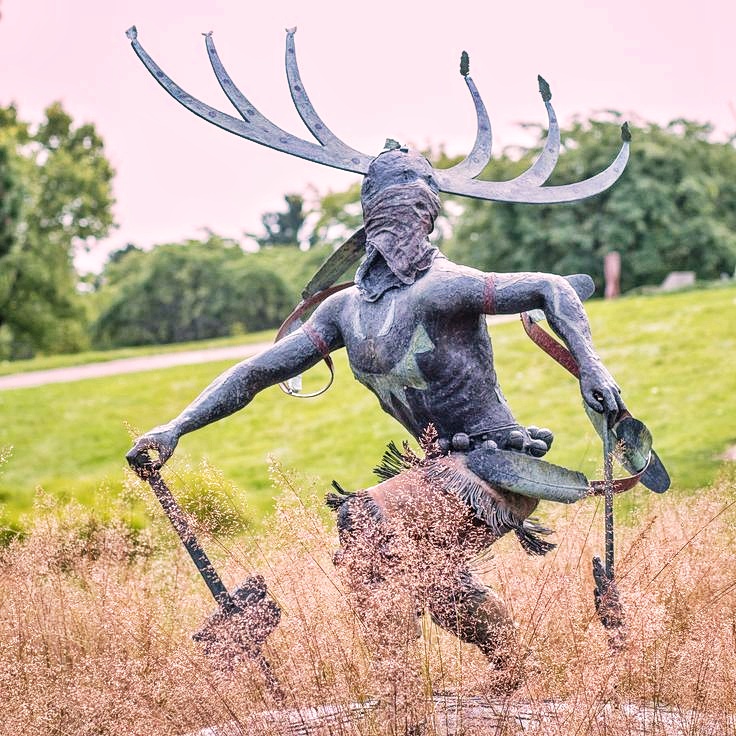
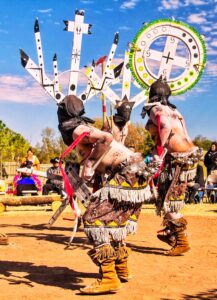
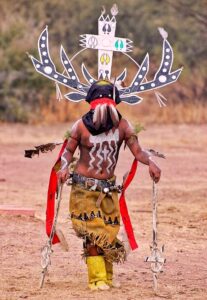
Apache Gan Dancers are ceremonial performers wearing wooden headdresses measuring 60 to 120 centimeters in height, painted with geometric symbols and adorned with mirrors, feathers, and dangling wooden slats, are worn by Apache male dancers embodying the Gaan or Mountain Spirits during ceremonial performances conducted by six federally recognized Apache tribes including the White Mountain Apache, San Carlos Apache, Mescalero Apache, Jicarilla Apache, Fort Sill Apache, and Tonto Apache across Arizona, New Mexico, and Oklahoma. The dance, called Gaan in Western Apache dialects and Gahe in Eastern Apache variants, employs five performers: one messenger or clown figure and four masked dancers representing the four cardinal directions who wear black cloth face masks, elaborately painted wooden crowns, and body paint featuring lightning bolt and geometric designs while carrying painted wooden or yucca spike swords. The tradition, practiced for centuries before European contact, emerged from origin stories describing how the Gaan taught the Apache to live in harmony, with one widespread narrative recounting an Apache boy who fell into a cave inhabited by Mountain Spirits and, upon his death, became one of them before leading the Gaan to his village to initiate protective dances. The ceremony occurs during the na’ii’ees or Sunrise Ceremony marking girls’ coming of age, healing rituals, weather ceremonies, and community protection observances conducted between April and October, typically lasting four days in accordance with the number’s sacred significance in Apache cosmology. Contemporary performance contexts expanded beyond reservation ceremonial use to include educational demonstrations at institutions including the Heard Museum in Phoenix, Grand Canyon National Park, the Indian Pueblo Cultural Center in Albuquerque, and annual celebrations including Apache Ji’i Day in Globe, Arizona, though observers are instructed to maintain silence, minimize movement, and refrain from approaching or touching dancers during performances. The regalia construction traditionally employed yucca spikes for crowns and swords, while contemporary artisans primarily use carved and painted wood, with crown symbols selected individually by dancers based on personal spiritual guidance and including representations of the Apache cross signifying the four sacred directions, totemic animals, stars, circles, and natural phenomena.
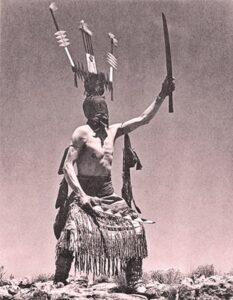
Sacred Apache Gan Dancers Material and Craftsmanship
The crown headdresses are carved from wood, replacing earlier constructions from yucca plant spikes that provided structural framework. The crowns consist of multiple vertical slats arranged radially around a central headband, creating distinctive silhouettes rising 60 to 120 centimeters above the dancer’s head. The slats vary in length, with central pieces typically tallest and outer pieces progressively shorter, creating tapered profiles.
Construction begins with selecting straight-grained wood including pine, cottonwood, or other locally available species offering workability and durability. Craftsmen carve individual slats to uniform thickness, approximately 2 to 3 centimeters wide and 0.5 to 1 centimeter thick, sanding surfaces smooth to accept paint. The slats attach to a hide or fabric headband secured around the dancer’s forehead, with each slat positioned individually and secured through binding or drilling and pegging techniques.
Small wooden pieces dangle from the crown’s lower edges, attached by leather thongs or commercial cord. These dangling elements create characteristic clicking sounds during dancing, contributing to the ceremony’s auditory dimension alongside drumming and singing. The number and arrangement of dangles vary by individual crown design and maker preference.
Mirrors, a relatively recent addition dating to the late 19th or early 20th century when commercially manufactured mirrors became available through trade, are affixed to crown surfaces using adhesive or mechanical fastening. The mirrors flash and reflect light during dancing, creating visual effects associated with spiritual power. Apache tradition connects mirrors with spirituality, viewing reflective surfaces as possessing supernatural properties.
Paint application employs mineral and commercial pigments in colors carrying symbolic significance. Black represents the north direction, blue the south, yellow the west, and white or green the east, though color associations vary between Apache groups. Red frequently appears representing power and vitality. Geometric patterns including crosses, zigzags, circles, triangles, and representations of lightning cover crown surfaces. Some crowns incorporate figurative elements including birds, particularly eagles considered sacred, and other animals significant in Apache cosmology.
The face masks consist of black cloth, typically commercial cotton or other woven material, shaped into hoods covering the entire head and neck. Eye holes allow vision while maintaining the dancer’s anonymity, essential to the transformation from human to spirit being. The masks attach to the crown headbands, creating integrated head coverings.
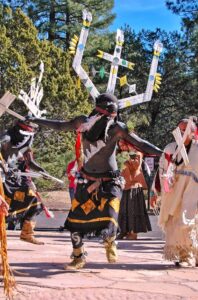
The wooden swords or wands carried by dancers measure 60 to 90 centimeters in length, carved from straight branches or milled lumber and painted with symbols matching those on the crowns. The swords function as ritual implements and communication tools, as dancers are prohibited from speaking during ceremonies and use sword movements and positioning to coordinate actions.
Body paint applied to dancers’ torsos employs mineral pigments mixed with water or fat to create paste consistency. Lightning bolt designs predominate, referencing the Mountain Spirits’ association with storms and rain-bringing power. Additional geometric patterns including crosses, circles, and linear designs cover chest, arms, and back surfaces. The painting process occurs as part of ceremonial preparation under the supervision of trained medicine men who ensure correct application according to traditional protocols.
Form and Features
The dance group consists of five performers with distinct roles and regalia. Four masked dancers wear the elaborate crown headdresses and black cloth face masks while carrying painted swords. These four represent the cardinal directions, with each dancer’s crown featuring color schemes and symbols appropriate to his directional assignment. The messenger or clown, called Grey One in some Apache groups, wears different regalia including a separate mask design and carries a bull-roarer, a ritual implement creating distinctive humming sounds when whirled overhead on a cord.
The crown designs display individual variation reflecting each dancer’s spiritual guidance and maker’s artistic choices. Common elements include the Apache cross, a four-armed symbol representing the four sacred directions and winds, positioned prominently on many crowns. Star patterns appear frequently, typically rendered as four-pointed or eight-pointed geometric forms. Circular and semi-circular shapes reference the sun and moon. Animal representations, particularly eagles due to their sacred status, appear either as recognizable profiles or as abstract symbolic references.
The arrangement of slats creates three-dimensional sculptural forms visible from all viewing angles. Some crowns feature slats of uniform length creating flat-topped silhouettes, while others display graduated lengths producing peaked or tiered profiles. The radial arrangement around the headband creates circular plans when viewed from above, though some makers introduce asymmetry for aesthetic or symbolic purposes.
The mirrors, when present, are typically small circular or rectangular pieces positioned on prominent slat surfaces where light catches them during movement. Their placement considers the crown’s rotation and tilting during dancing, maximizing reflective effects visible to ceremony participants and observers.
The body paint patterns follow traditional designs transmitted through instruction from medicine men and elder dancers. Lightning bolts typically extend diagonally across the torso, rendered as jagged or stepped lines. Horizontal bands may circle the waist or chest. Vertical lines descend from shoulders. The application achieves varying levels of geometric precision depending on the painter’s skill and time available for preparation.
The complete regalia transformation obscures the dancer’s individual identity, essential to the ceremony’s theological framework. The Gaan are not represented by the dancers but rather manifest through them, with the masked and painted figures literally becoming Mountain Spirits during the performance. This transformation requires that observers cannot identify the specific individuals participating, maintaining the spirits’ transcendent character.
Function and Use
The Gaan dance functions primarily within the na’ii’ees or Sunrise Ceremony, the four-day ritual marking an Apache girl’s transition from childhood to adulthood. The ceremony occurs between April and October when weather permits extended outdoor gatherings. The girl, wearing special buckskin regalia, undergoes physical and spiritual trials including running toward the four directions, receiving blessings with sacred pollen and ochre, and dancing in circles while Gaan dancers perform around her.
The Mountain Spirits’ role in this context involves blessing the girl, protecting her during her vulnerable transformational period, and invoking divine power ensuring her successful transition to adulthood. The Gaan dance occurs on the ceremony’s final night, with dancers emerging after dark and performing until dawn. Their presence frightens away malevolent spirits while attracting beneficial supernatural forces ensuring the girl’s future health, fertility, and prosperity.
Healing ceremonies constitute another major context for Gaan performances. When individuals suffer serious illness attributed to spiritual causes, families may sponsor Gaan ceremonies where the Mountain Spirits’ presence drives away disease-causing forces while channeling healing power to the afflicted person. The dancers circle the patient, touch them with swords blessed through ritual preparation, and sprinkle sacred pollen and ochre believed to possess curative properties.
Weather control ceremonies, particularly those seeking rain, employ Gaan dances connecting the Mountain Spirits’ storm-bringing powers to community agricultural needs. Apache groups practicing dryland farming in the arid Southwest depend on seasonal rainfall, making rain ceremonies essential to survival. The Mountain Spirits’ association with storms and lightning makes their invocation logical within Apache theological frameworks understanding natural phenomena as manifestations of spiritual forces.
Community protection and purification ceremonies occur periodically to maintain harmony between human and spiritual realms. These performances clear away accumulated spiritual contamination from the village while reinforcing protective barriers against external threats including enemy raids in the historical period and contemporary social problems including substance abuse and family disruption in modern contexts.
The messenger or clown’s role involves comic relief balancing the sacred intensity of the masked dancers’ performances. This figure interacts with spectators, makes humorous gestures, and generally provides entertainment while simultaneously fulfilling serious spiritual functions including announcing the ceremony’s commencement with the bull-roarer and leading certain ritual actions.
The prohibition against dancers speaking derives from their status as embodied spirits rather than human performers. Communication occurs through sword gestures, body positioning, and movement patterns coordinated during extensive training. This silence enhances the supernatural atmosphere while reinforcing the dancers’ transformed identity.
The four-day ceremony duration reflects the number four’s sacred significance representing the four cardinal directions, four winds, four seasons, and fourfold structure of cosmos recognized in Apache cosmology. Many ritual actions repeat four times, songs contain four verses, and participants perform actions toward each direction sequentially.
Cultural Context
The Apache peoples consist of multiple groups speaking Athapaskan languages who migrated from northwestern Canada to the Southwest between 1000 and 1500 CE. Their arrival postdated Ancestral Puebloan cultures but preceded Spanish contact in the 16th century. The various Apache groups adapted to Southwestern environments including mountains, high deserts, and grasslands, developing subsistence strategies combining hunting, gathering, and raiding supplemented by limited agriculture.
The Gaan tradition appears in all Apache groups with local variations in terminology, performance details, and theological emphasis. Western Apache groups including White Mountain and San Carlos Apache employ the term Gaan and incorporate the bull-roarer, while Eastern Apache including Mescalero use Gahe and omit the bull-roarer. These variations document both shared origins and independent development following the groups’ geographic separation.
Apache religion emphasizes direct interaction with supernatural powers including the Mountain Spirits residing in sacred peaks. Four mountains hold particular significance for different Apache groups: Sierra Blanca, Three Sisters Mountains, Oscura Peak, and Guadalupe Mountains in New Mexico serve as dwelling places for the Gaan and focal points for prayer and pilgrimage. The Mountain Spirits taught the Apache proper behavior, survival skills, and ceremonial practices ensuring harmony between human communities and the natural and supernatural worlds.
Spanish colonial period interactions beginning in the 16th century involved repeated conflicts as Apache groups resisted missionization and Spanish efforts to control territory and resources. Spanish accounts occasionally mentioned Apache dances though detailed descriptions are rare and often distorted by European observers’ lack of cultural understanding and active hostility toward indigenous religious practices.
Mexican independence in 1821 continued patterns of conflict as Mexican states sought to control Apache territories. The Apache maintained military resistance through guerrilla tactics perfected over generations. U.S. conquest following the Mexican-American War brought renewed pressure as American military forces conducted campaigns including General George Crook’s operations during the 1870s and 1880s seeking to force Apache groups onto reservations.
The reservation period beginning in the late 19th century imposed severe restrictions on Apache religious practices. Bureau of Indian Affairs agents and Christian missionaries condemned traditional ceremonies as pagan superstition impeding civilization efforts. The Gaan dance faced particular hostility due to its central importance in Apache spiritual life and its dramatic visual character attracting official attention. Despite these pressures, Apache communities continued performing the dance, sometimes in secret or modified forms, maintaining cultural continuity through periods of active suppression.
The 1978 American Indian Religious Freedom Act provided legal protection for indigenous religious practices, though implementation remained incomplete. Apache communities gradually restored public performances of the Gaan dance, conducted initially only within reservations for community members but later expanding to include educational presentations at museums, cultural centers, and public festivals.
Discovery and Preservation
Early documentation of Apache Crown Dancers appears in late 19th-century photographs including Katherine Taylor Dodge’s circa 1899 images showing Mescalero and Chiricahua Apache performers. These photographs, now held by the Library of Congress, provide visual evidence of crown designs and performance contexts during the reservation’s early years. The images’ ethnographic value must be balanced against recognition that their creation occurred during coercive assimilation policies when photographing indigenous ceremonies often occurred without full informed consent.
Anthropological documentation intensified during the early 20th century as scholars including Pliny Earle Goddard, Grenville Goodwin, and Morris Opler conducted fieldwork among various Apache groups. Their publications described ceremonial contexts, recorded origin stories, and documented material culture including crown construction techniques. This scholarship, while preserving information about traditions facing suppression, simultaneously raised ethical questions about appropriate documentation of sacred practices and the extent to which external observers should publicize religious knowledge.
Museums including the Museum of Northern Arizona, Heard Museum, Field Museum, and Smithsonian Institution acquired crown headdresses and associated regalia through purchases, donations, and collecting activities during the late 19th and early 20th centuries. These acquisitions occurred during periods when poverty on reservations created economic incentives for selling ceremonial objects while government policies actively discouraged traditional religious practices.
Contemporary ethical standards recognize that ceremonial objects including Gaan crowns occupy categories distinct from secular art or ethnographic specimens. Many crowns were created for specific ceremonies and, according to traditional protocols, should be retired to sacred caves after use rather than preserved indefinitely or displayed publicly. The practice of depositing used crowns in limestone caves located in sacred mountains represents ritual completion of the objects’ lifecycle, returning them to the Mountain Spirits’ dwelling places.
Some museums have implemented restricted access policies for Gaan materials, consulting with Apache representatives regarding appropriate storage, display, and research protocols. These consultations address concerns including whether non-Apaches should view sacred objects, whether photography should be permitted, and whether ceremonial items should be repatriated under the Native American Graves Protection and Repatriation Act.
The 1990 NAGPRA legislation created mechanisms for tribes to request repatriation of ceremonially significant objects. Some Apache groups have pursued return of Gaan crowns and associated materials, particularly those documented as having been used in actual ceremonies rather than created specifically for sale or museum acquisition. These repatriation efforts reflect broader movements toward indigenous control over cultural heritage and recognition that religious objects merit treatment different from secular artifacts.
Contemporary performance contexts include both ceremonial use within Apache communities and educational demonstrations at public venues. The distinction between these contexts involves different protocols regarding photography, observer behavior, and the spiritual intensity of performances. Ceremonial performances maintain full sacred character with strict behavioral expectations for all present, while educational demonstrations, though performed with respect and seriousness, acknowledge the different context and adjust certain elements for non-Apache audiences.
Why It Matters
Apache Gaan dancers preserve living religious traditions maintaining continuity with pre-contact spiritual practices despite centuries of suppression under Spanish, Mexican, and American colonial regimes. The performances embody theological concepts fundamental to Apache worldviews including the relationship between humans and Mountain Spirits, the transformation of individual identity during ritual participation, and the maintenance of cosmic harmony through ceremonial action. The tradition documents religious innovation and adaptation, with elements including mirrors representing incorporation of new materials and meanings into existing ceremonial frameworks while maintaining core theological structures. The Gaan dance’s continued performance within Apache communities demonstrates cultural resilience and the successful transmission of specialized knowledge including crown construction techniques, body paint application, choreography, and song cycles across generations despite active efforts to eliminate indigenous religious practices. The expansion of performance contexts to include educational demonstrations reflects contemporary Apache decisions about cultural property boundaries, distinguishing between sacred knowledge appropriate only for community members and information suitable for sharing with non-Apaches as educational outreach. The ongoing negotiations between museums and Apache representatives regarding appropriate treatment of Gaan regalia exemplify broader discussions within indigenous communities and cultural institutions about repatriation, restricted access, and institutional responsibilities toward living religious traditions whose material culture resides in museum collections acquired under historical circumstances of cultural disruption and asymmetric power relations.
https://wikiflo.com/ojibwe-birchbark-canoe/