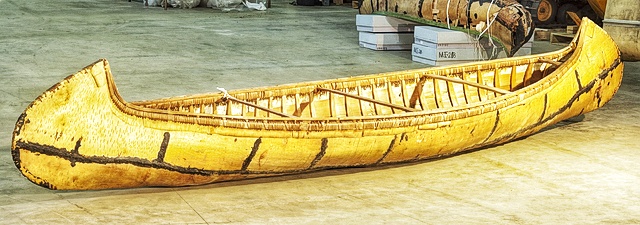
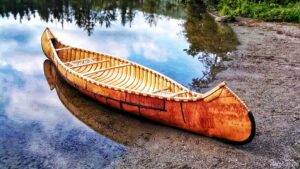
A watercraft built from paper birch bark stretched over a cedar and ash frame, the Ojibwe birchbark canoe is one of the most precisely engineered indigenous technologies in North American history. A standard family travel canoe measured approximately 4.9 meters long, 90 centimeters wide, and 46 centimeters deep, weighing between 30 and 57 kilograms. Larger freight canoes built for the fur trade reached up to 12 meters in length and carried crews of six to twelve paddlers alongside cargo weighing up to 2,300 kilograms. The tradition developed over at least one thousand years across the Great Lakes region of present-day Minnesota, Wisconsin, Michigan, and southern Ontario. European documentation begins with French explorers at Sault Ste. Marie around 1600, and Samuel de Champlain, who traveled through Ojibwe territory from 1615 onward, described the birchbark canoe as the only vessel suited for navigating the North American interior. Major institutional holdings include the Canadian Canoe Museum in Peterborough, Ontario, the Canadian Museum of History in Gatineau, Quebec, and the Mariners’ Museum and Park in Newport News, Virginia, which holds 120 detailed scale models built by ethnologist Edwin Tappan Adney between 1889 and 1950. The Ojibwe people, who call themselves Anishinaabeg meaning the original people, number approximately 300,000 enrolled members across roughly 200 federally recognized bands in the United States and First Nations communities in Canada.
Shocking Truth About Ojibwe Birchbark Canoe: Material and Craftsmanship
Every part of the canoe came from specific trees, harvested at specific times following protocols that governed where, when, and how materials could be taken. Paper birch, called wiigwaas in Ojibwe, provided the outer hull. Its bark was harvested from living trees in spring, when the inner layer separates cleanly from the trunk. Because birch bark’s grain runs horizontally around the tree rather than vertically along it, sheets can be bent in any direction without splitting, making it uniquely suited for canoe construction.
Cedar, called giizhik, was split into thin strips for the interior ribs and floor planking. It is lightweight, straight-grained, and resistant to water damage. White ash, called aagimaak, was used for the gunwales, the long rails running along the top edges of the canoe from bow to stern, chosen because it flexes without breaking under the stress of a loaded hull.
Spruce root, called watap, served as thread. Builders pulled the roots from shallow soil, stripped and split them into thin strands, boiled them to restore flexibility, and stitched them through pierced holes in the bark while still warm and pliable. Completed seams were then sealed with heated spruce or pine gum mixed with charcoal or animal fat to waterproof the hull. This pitch dried out with use and required reapplication daily during long journeys.
Construction began with the bark rather than the frame, which set Ojibwe canoe-building apart from European boat-building methods. Large bark sheets were laid face-down in a sand bed and weighted with stones to shape the hull floor. Stakes drove into the ground along the sides held the hull profile while builders stitched bark panels together. Cedar ribs were steamed until pliable, bent by hand to fit the hull shape, and inserted under tension so their natural springback held the bark outward. Cedar planking was laid between the bark and the ribs to protect the hull from puncture and spread the weight of cargo. No adhesive held the structure together. The entire canoe was held in shape by the tension of bent wood, lashed rails, and stitched bark.
Form and Features
The Ojibwe canoe is identified by its sharply upswept bow and stern, a profile called the longnose form, which set it apart from the lower, flatter profiles of canoes made by eastern Algonquian groups. The high ends deflected waves when crossing the open water of the Great Lakes, where conditions were far rougher than on interior rivers. The hull cross-section was shallow and rounded at the bottom with flared sides, offering stability on calm water while allowing the canoe to be tilted and maneuvered in current.
Builders produced several specialized variants. The ricing canoe, designed for wild rice harvest, measured approximately 4.6 meters long, 89 centimeters wide, and 38 centimeters deep, weighing around 23 kilograms. Its shallow draft and wide, stable platform allowed harvesters to stand and knock rice heads into the hull using wooden sticks without tipping the boat. The hunting canoe was slightly shorter and narrower, built for silent approach through shallow wetlands and the ability to carry a harvested animal back to camp.
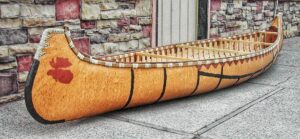
Decorative work appeared on many canoes in the form of incised or painted designs on the outer bark surface. Imagery included clan symbols, geometric patterns, and references to Ojibwe migration history and cosmology, applied using bone or antler tools and pigments including red ochre. Some canoes carried designs created through birch bark biting, a technique in which thin folded bark is bitten through to produce symmetrical patterns, applied along the gunwales or prow. Paddles were carved from cedar or basswood with narrow blades and straight shafts, designed for a high-cadence stroke of 40 to 45 strokes per minute, allowing sustained travel speeds of 7 to 9 kilometers per hour in calm conditions.
Function and Use
The wiigwaasi-jiimaan was the primary vehicle for almost every aspect of Ojibwe life. Fishing required canoes large enough to carry nets, spears, and the weight of significant catches. Wild rice harvest, which was central to the annual food cycle and culturally fundamental to Ojibwe identity, depended entirely on the ricing canoe. Hunting parties used canoes to reach territory across a landscape of lakes, rivers, and wetlands where overland travel was slow and often impossible.
Building a canoe required two to four weeks for a skilled builder working alone and demanded expertise across bark harvesting, root processing, wood splitting and bending, and pitch preparation. Canoe building was a recognized specialty within Ojibwe communities, with master builders holding knowledge considered essential to collective survival.
The canoe’s role in the fur trade between approximately 1600 and 1850 extended its significance far beyond Ojibwe territory. French and later British traders adopted the Ojibwe canoe as the sole viable transport vessel for moving goods through the interior of the continent, a network spanning from Montreal to the Rocky Mountains. The Hudson’s Bay Company and the North West Company depended entirely on Indigenous-built birchbark canoes to move beaver pelts from trapping grounds to coastal trading posts. European traders had no comparable vessel and made no meaningful modifications to the Ojibwe design, adopting it unchanged for commercial use.
Cultural Context
The Ojibwe are the third-largest indigenous group in North America by population, part of the broader Anishinaabe cultural and linguistic family that includes the Odawa and Potawatomi peoples. Their territory centered on the Great Lakes watershed, a landscape defined by thousands of interconnected lakes, rivers, and portage paths collectively known as the boundary waters. This environment made watercraft not a convenience but a necessity, and the birchbark canoe developed in direct response to conditions specific to that geography.
Within Ojibwe cosmology the wiigwaas tree held spiritual significance before its material utility was considered. Harvesting bark required acknowledgment of the tree’s spirit, an offering, and adherence to protocols that ensured the tree survived the harvest. This relationship between builder and material was not incidental to the construction process but governed it, meaning canoe-making was understood as a relationship with the natural world rather than a purely technical exercise.
The canoe also carried ceremonial functions. Funeral rites in some Ojibwe communities involved placing a canoe with the deceased or burying canoe-related tools alongside the body, reflecting the vessel’s role as a vehicle for the journey into the afterlife. In the Ojibwe migration story, known as the Seven Fires Prophecy, the canoe features prominently as the means of movement from the Atlantic coast westward to the Great Lakes over multiple generations, embedding the craft in the community’s foundational historical narrative.
Contact with European traders brought iron tools that made construction faster and more precise but did not alter the fundamental design or the materials used. The fur trade period from the early 1600s through the mid-1800s created sustained demand for canoes that exceeded what any single community could produce, leading to the development of specialized canoe-building camps supplying the trade networks.
Discovery and Preservation
Edwin Tappan Adney, an American artist and ethnologist born in 1861, produced the most thorough systematic documentation of North American birchbark canoe construction in the historical record. Working from 1889 through 1950, Adney built 120 precisely measured scale models of canoe types from across the continent, including multiple Ojibwe variants, and compiled construction notes, measurements, and drawings covering materials, techniques, and regional variations. His models were donated to the Mariners’ Museum in Newport News, Virginia, where they remain. His research was published posthumously in 1964 as The Bark Canoes and Skin Boats of North America, co-authored with Howard Chapelle, and remains the foundational scholarly reference on the subject.
The Canadian Canoe Museum in Peterborough, Ontario, holds the largest institutional collection of Indigenous watercraft in the world, including historic Ojibwe birchbark canoes acquired from private collections, expeditions, and community donations. The museum opened in 1997 and operates a living crafts program in which Indigenous builders demonstrate and teach traditional construction techniques.
Contemporary revival of the wiigwaasi-jiimaan tradition has been led by Ojibwe master builders including Wayne Valliere of the Lac du Flambeau Band of Lake Superior Chippewa in Wisconsin. Valliere has built canoes for the University of Wisconsin-Madison, cultural institutions, and tribal programs, teaching the full construction process as part of language and cultural revitalization efforts. His canoes are built using entirely traditional materials and methods, including harvesting birch bark, splitting cedar, and processing spruce root by hand, and have been exhibited publicly as demonstrations of living traditional knowledge.
The primary preservation challenge for historic birchbark canoes is environmental. Bark, root, pitch, and wood are all organic materials that degrade under fluctuating humidity, light exposure, and temperature. Most museum-held examples require controlled storage at stable humidity levels between 45 and 55 percent relative humidity and temperatures between 15 and 18 degrees Celsius to prevent bark cracking and root lashing deterioration. Conservation treatment is limited primarily to stabilization, as restoration of degraded pitch seams or replacement of failed lashings risks altering original materials in ways that compromise authenticity.
Why It Matters
The wiigwaasi-jiimaan represents a technological achievement developed entirely from locally available materials across a millennium of accumulated knowledge, producing a vessel that European traders adopted unchanged for commercial use across an entire continent. Its construction encoded a complete understanding of the mechanical properties of birch bark, cedar, ash, and spruce root, applied without written documentation or formal engineering, transmitted entirely through direct instruction and practice. The canoe’s role in the fur trade made it the vehicle through which the North American interior was commercially connected to Atlantic markets, making it a direct instrument in the formation of both Canadian and American economic geography. The ongoing revival of canoe-building by Ojibwe master builders represents one of the more documented cases of traditional ecological and technical knowledge being actively maintained and transmitted within a living community, providing scholars, conservators, and Indigenous cultural programs a functioning model of knowledge continuity that extends well beyond the object itself.
https://wikiflo.com/lakota-ghost-dance-shirts/
[…] Ojibwe Birchbark Canoe: 7 Shocking Truth Behind This Ancient Indigenous Watercraft […]