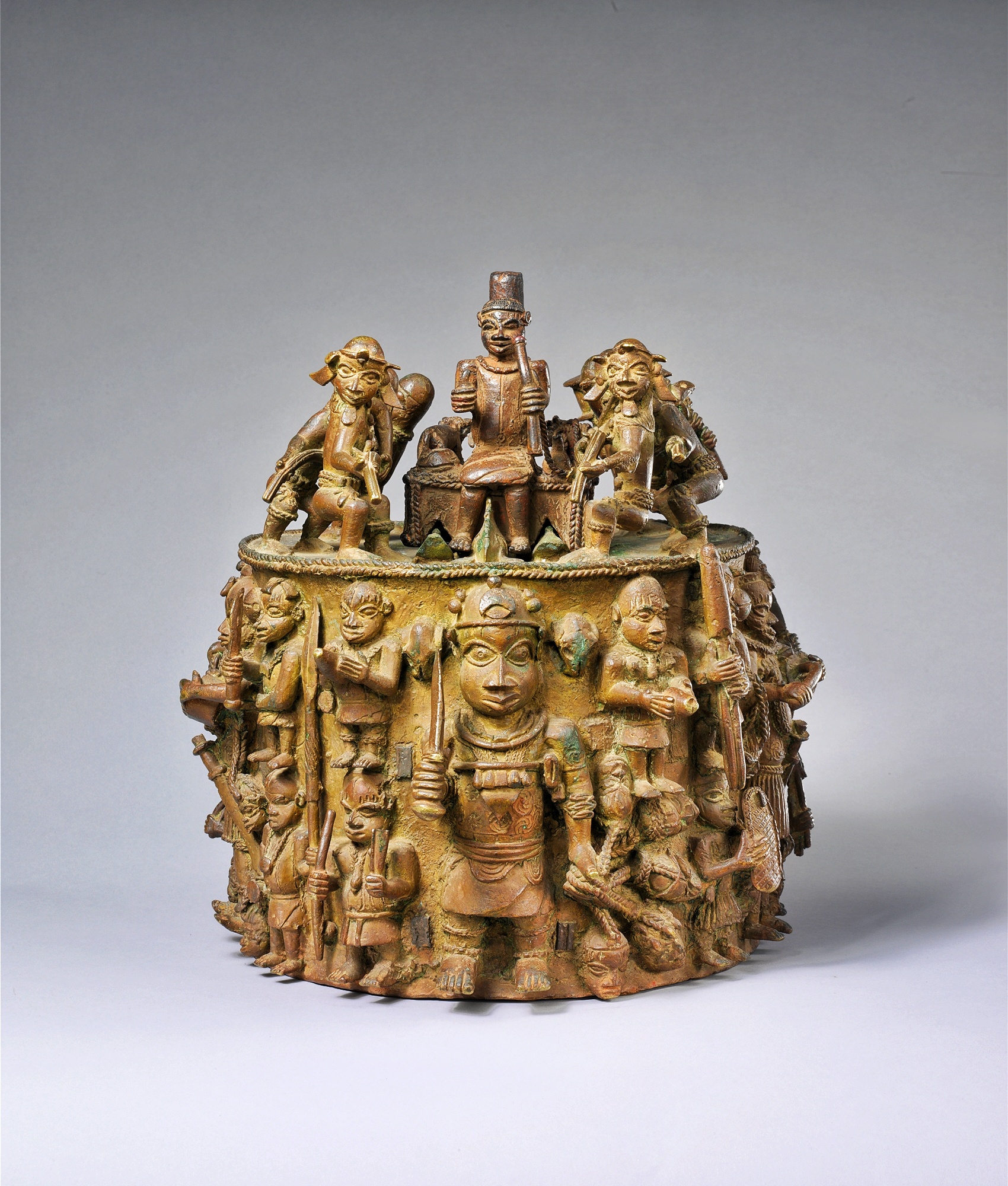
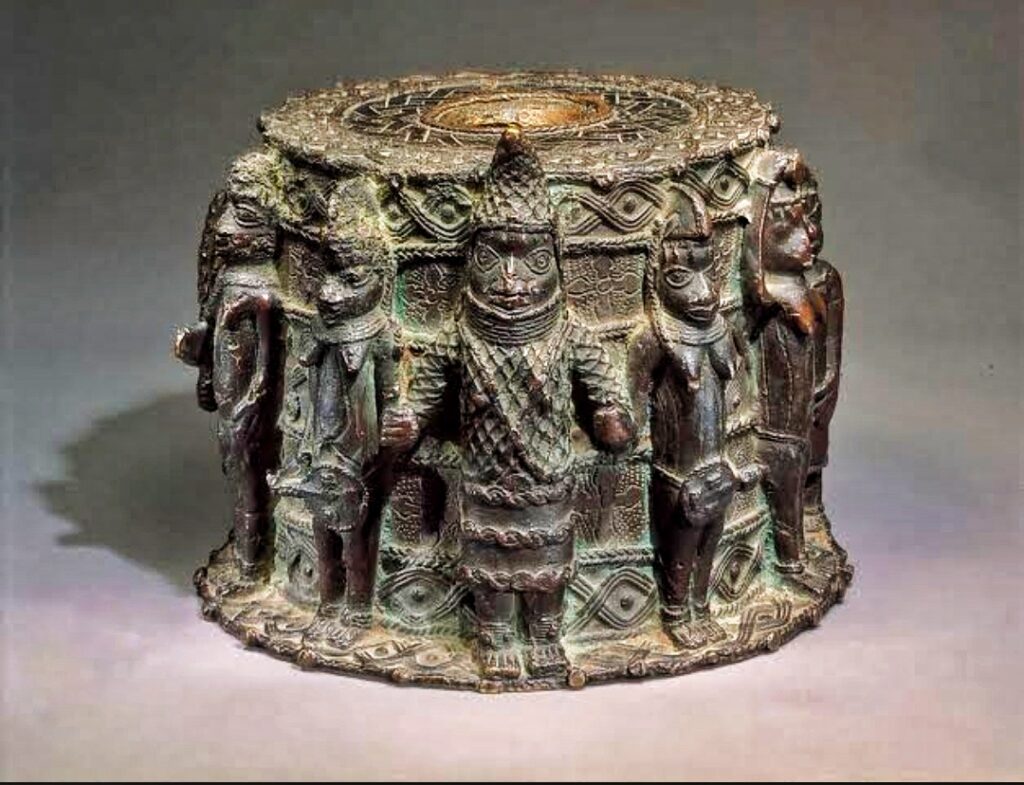
Inside the Metropolitan Museum of Art in New York, the British Museum in London, and the Barber Institute of Fine Arts in Birmingham, there sits a cylindrical brass object that most visitors walk past without a second look. It does not carry a famous name. It is not as dramatic as the bronze heads or as recognizable as the palace plaques. But among the nobility of the Benin Kingdom in what is now southern Nigeria, this object was the most personal and most powerful wealth ritual a person could own.
The Benin Kingdom gold object is called the Ikegobo, and it was built on a single belief: that the human hand is the true source of all wealth, and that if you honored your hand correctly, your hand would multiply everything it touched.
What the Ikegobo Was
The Ikegobo, pronounced ee-keh-GOH-boh, is a cylindrical brass altar that the Edo people of the Benin Kingdom dedicated to the hand. Not the physical hand alone, but the spiritual force that the hand represented in Benin religious belief. That force covered a person’s capacity for action, their effectiveness in business, their ability to accumulate wealth, their skill with tools, and their power to win physical and economic contests against rivals.
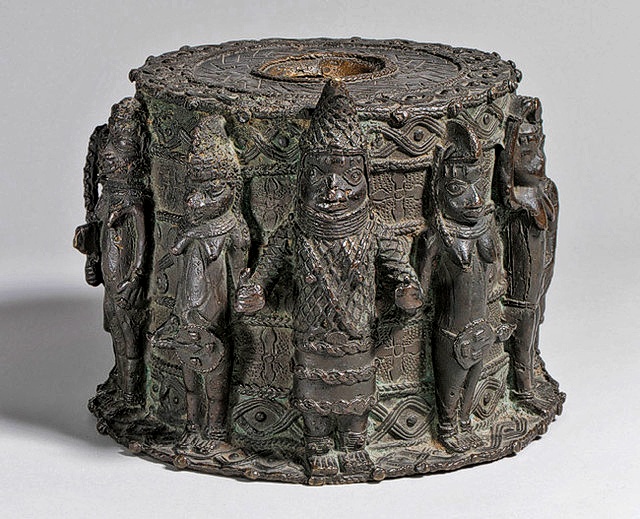
In Benin culture, the human personality was understood to have two governing forces. The head governed a person’s intelligence, their reasoning, and the qualities they were born with. The hand governed what they actually did with those qualities in the world. Success came from the hand. Wealth came from the hand. Power came from the hand. A person who became rich and respected was said to have a strong hand, and the Ikegobo was the physical altar on which that strength was honored, fed, and maintained.
Offerings and prayers were made directly to the Ikegobo to attract wealth and prosperity. The object was not decorative. It was active. It was worked.
Who Could Own One
The Ikegobo was not available to everyone. The material from which it was made directly reflected the rank of whoever commissioned it. Ordinary people who had achieved some level of success could commission an Ikegobo made from clay. More successful individuals and lower-ranking chiefs commissioned them in wood. The most powerful men in the kingdom, those who had accumulated serious wealth and military achievement, commissioned theirs in brass.
Brass was a controlled material in the Benin Kingdom. The Oba, the divine king, held authority over who could use brass for ritual objects. Commissioning a brass Ikegobo required not just wealth but royal permission. It was a statement that the Oba himself had recognized your achievements as worthy of this level of honor.
There was one notable exception to the rule that only men could own brass Ikegobo. The Iyoba, the Queen Mother of the Edo people, held a rank that placed her above all other women in the kingdom and equal to the highest chiefs. She was the only woman permitted to commission a brass Ikegobo, and the surviving examples made for Iyobas are among the most beautifully crafted objects in the entire Benin artistic tradition.
How the Object Was Built
Each Ikegobo was cast in brass using the lost-wax method, one of the most demanding metalworking techniques in the ancient world. A model was first built in wax with every figure and decorative detail already in place. That wax model was then encased in clay, the wax was melted out through small channels, and molten brass was poured in to fill the exact space the wax had occupied. When the clay was broken open, the finished object emerged.
The figures carved in relief around the outside of each Ikegobo depicted the person who commissioned it, along with their attendants, warriors, and symbols of their achievements. A military commander who had won a famous battle might have that battle depicted in miniature around the body of his altar. A wealthy chief might show tribute payments arriving at his feet. The Oba himself appeared on some of the most elaborate examples, surrounded by leopards and kneeling chiefs.
At the top of the cylindrical altar was an opening designed to receive a carved ivory tusk. The tusk connected the altar to the spirit world above and linked the owner’s personal wealth ritual to the broader ancestral power of the kingdom. Ivory was exclusively controlled by the Oba, who held a monopoly over the elephant trade. Having ivory on your Ikegobo was another layer of status that very few people could access.
The Ritual of the Ikegobo
The Ikegobo was not placed on a shelf and admired. It was the center of active ritual practice. Owners made regular offerings to their altar, including food, animal blood, and palm wine. These offerings were not symbolic gestures. In Benin religious practice, they were understood as real transactions between the living person and the spiritual force embodied in the object.
The belief was direct: if you fed your hand altar and honored the force of the hand properly, your hand would continue producing wealth. If you neglected it, your ability to generate success and accumulate gold would weaken. The Ikegobo was a maintenance system for prosperity.
Among warriors and military commanders, the Ikegobo carried additional meaning. The hand that wielded weapons, that led men into battle, that seized territory and extracted tribute, was the same hand honored on the altar. A general who made regular offerings to his Ikegobo before a campaign was asking the spiritual force of his own productive capacity to remain at full strength. Several documented accounts from Benin oral tradition describe military commanders who attributed their battlefield victories directly to the power of their hand altars.
The Ikegobo and the Structure of Wealth in Benin
Understanding why the Ikegobo was believed to multiply gold requires understanding how wealth functioned in the Benin Kingdom. Wealth in Benin was not simply about accumulating objects. It was about demonstrating that your achievements were spiritually legitimate, that the ancestors approved of your prosperity and intended for you to continue accumulating it.
A man who became wealthy without honoring the proper spiritual obligations was considered dangerously exposed. His wealth had no foundation in the spirit world, which meant it could be taken from him by forces he could not see. The Ikegobo created that foundation. It formalized the relationship between the owner and the spiritual source of their success. It told the ancestors, the community, and any rival who looked at it that this person’s wealth was protected.
This is why the most powerful men in Benin, men who already had significant wealth, were the ones most likely to commission elaborate brass Ikegobo. They were not using the altar because they were struggling. They were using it because they understood that maintaining and growing wealth required constant spiritual investment, just as it required constant economic and political activity.
What Happened to the Ikegobo in 1897
In February 1897, British military forces invaded Benin City in what they called a Punitive Expedition. The invasion was triggered by the killing of a British delegation that had ignored explicit instructions to postpone their arrival during a sacred festival period. Within weeks, British forces had burned the palace, executed senior chiefs, sent the Oba into exile, and looted thousands of sacred objects from the royal shrines and compounds.
Among the thousands of objects taken were numerous Ikegobo. Several of them ended up in the British Museum in London, where they remain today. Others were sold at auction in the years following the invasion and eventually made their way into collections across Europe and North America. The Metropolitan Museum of Art in New York holds significant examples. The Barber Institute of Fine Arts in Birmingham holds the Ikegobo of the Iyoba, the hand altar made for the Queen Mother.
Nigeria and the current Oba of Benin, His Royal Majesty Oba Ewuare II, have consistently called for the return of these objects. Some institutions have begun returning pieces in recent years, but the majority remain outside Nigeria.
The Ikegobo Today
What is remarkable about the Ikegobo is how completely it encodes a philosophy of wealth that was sophisticated enough to account for both the practical and the spiritual dimensions of prosperity simultaneously.
The Benin nobility understood that achieving wealth was not enough. Wealth had to be maintained, protected, and grown. That required action in the physical world and correct relationship with the spiritual world at the same time. The Ikegobo was the instrument that kept both dimensions aligned.
Several examples of the Ikegobo remain in active ceremonial use in Benin City today, commissioned by modern Edo chiefs and businesspeople who maintain the tradition of honoring the hand. The objects in museum collections in London, New York, and Birmingham represent the royal and chiefly versions of a practice that was and remains part of living Benin culture.
For the Edo people, the hand altar was never a relic. It was a working object built for a specific purpose. And the purpose, stated plainly, was to ensure that the hand which had already produced wealth would keep on producing it.