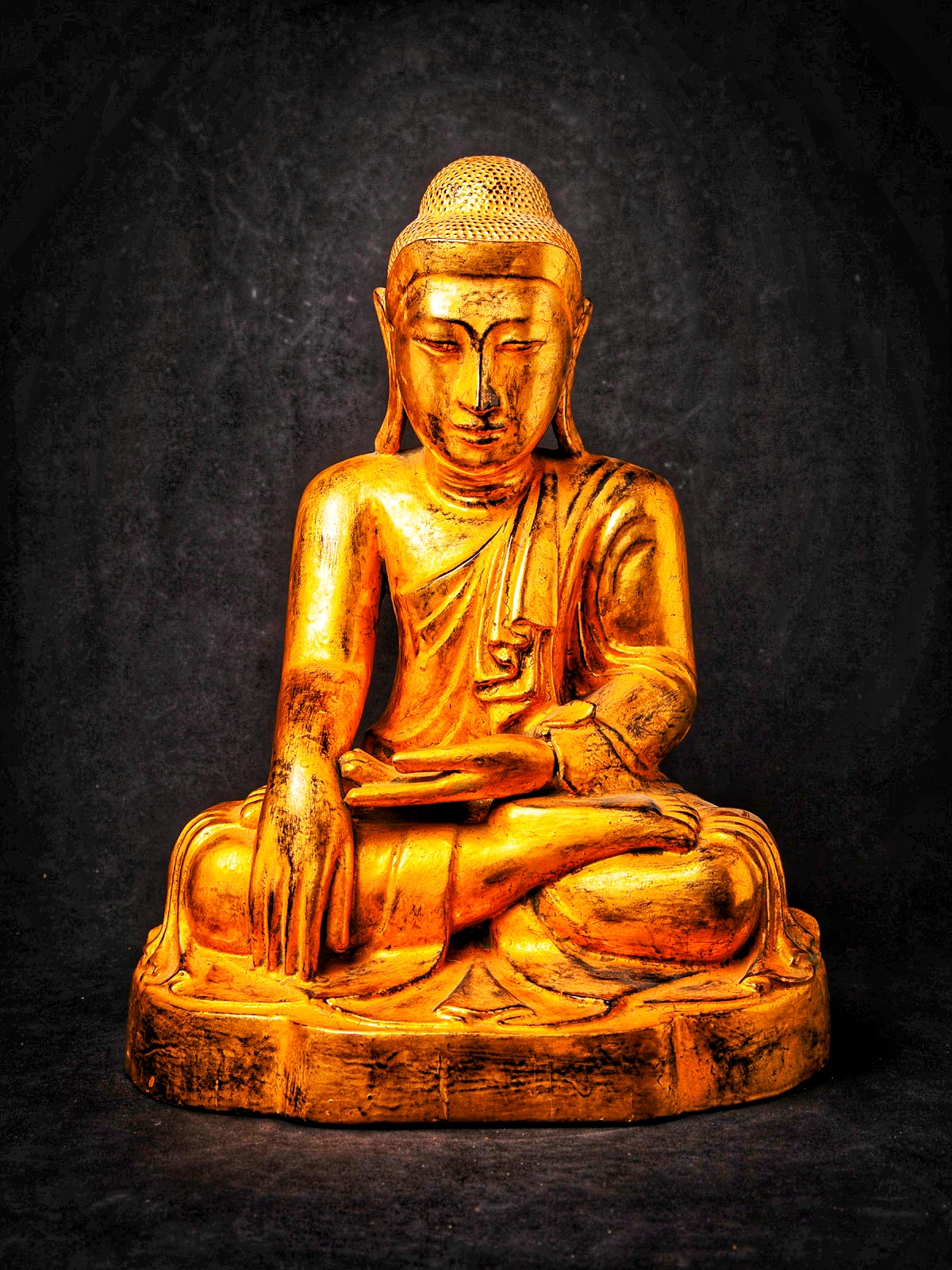
The Burmese Mandalay Buddha is a bronze seated Buddha image measuring 3.8 meters in height and weighing approximately 6.5 metric tons, enshrined at the Mahamuni Pagoda located southwest of Mandalay city between 82nd and 84th Streets, Mandalay Region, Myanmar, is the most sacred Buddha image in the country and one of the most venerated in all of Southeast Asia. The statue sits on an ornate pedestal 1.8 meters tall and is positioned in the bhumisparsha mudra, the earth-touching gesture symbolizing the moment of Siddhartha Gautama’s enlightenment. The original bronze image is no longer visible in its true form. Centuries of gold leaf application by male devotees have accumulated a coating approximately 15 centimeters thick across most of the statue’s body, distorting the original contours and adding considerable mass to the figure’s lower sections. The right hand, crown, and other royal insignia remain free of gold leaf, suggesting they were added to the image at a later date than the original casting.
The statue was removed from its original location at Dhanyawadi in the Arakan Kingdom, present-day Rakhine State in western Myanmar, and transported to Amarapura, then the Konbaung dynasty capital near present-day Mandalay, in 1784 following King Bodawpaya’s military conquest of Arakan. The pagoda built specifically to house it was completed in 1785. Archaeologists estimate the image was cast around the 2nd century CE during the reign of King Chandra Surya, who ascended the throne in 146 CE, though traditional belief holds it was cast in 554 BCE in the physical presence of Gautama Buddha. The statue is among five images that Burmese Buddhist tradition identifies as authentic likenesses of the Buddha made during his lifetime. The Mahamuni Pagoda is open daily from 6 am to 8 pm and charges an entry fee of approximately 10,000 kyats per foreign visitor. The temple is administered by the Mahamuni Pagoda Trust under the supervision of Myanmar’s Ministry of Religious Affairs and Culture.
Burmese Mandalay Buddha Material and Craftsmanship
The statue was cast in bronze, an alloy of copper, tin, and lead, using methods consistent with metalworking practices of the Arakan Kingdom in the early centuries CE. The image’s original casting weight, before gold leaf accumulation began, is not precisely documented, as the centuries of continuous gilding have added substantially to the figure’s total mass. The statue’s original surface detail across most of the body is no longer accessible for study because of the gold coating. What remains visible without gold leaf, primarily the right hand and crown, indicates that these elements were crafted to a high standard of finish with clearly rendered jewelry and iconographic details.
The gold leaf application practice, called shwe cha in Burmese, involves male devotees pressing individual sheets of gold leaf directly onto the statue’s surface. Each sheet is extremely thin, measuring a fraction of a millimeter. The accumulation of millions of individual applications across many centuries has built the current 15-centimeter-thick coating. When a fire destroyed portions of the pagoda in 1884, 91 kilograms of gold were recovered from the site, an indication of the density of gold concentrated in and around the image by that point. The figure currently weighs approximately 6.5 metric tons total including accumulated gold.
The six large bronze statues also housed in the temple courtyard, including three lions, two warrior guardian figures, and a three-headed Erawan elephant, were brought from Angkor Wat in Cambodia as war loot in the 15th century. These Khmer bronzes, not part of the Mahamuni image itself, are venerated separately. Devotees believe rubbing a part of any of these bronze statues heals the corresponding part of the human body.
The Mandalay style of Buddha image, which the Mahamuni image influenced and which flourished under King Mindon from 1853 onward, is distinguished by a more naturalistic face with slightly slanted eyes, naturally curved eyebrows, thicker lips, and a rounded hair bun at the crown. Robes in the Mandalay style are depicted with elaborate folded and edged hems, often inlaid with mirror glass, a technique that became a defining decorative element of the period. This style spread beyond Myanmar through the export of images to Buddhist communities across Southeast Asia and became the dominant reference for what is internationally recognized as the Burmese Buddha type.
Burmese Mandalay Buddha Form and Features
The Mahamuni image sits in the bhumisparsha mudra, with the right hand resting on the knee and reaching downward with the fingertips touching the earth. This gesture references the moment when Siddhartha Gautama, seated under the Bodhi tree at Bodh Gaya and facing the demon Mara’s challenges to his right to attain enlightenment, called upon the earth goddess Wathundaye to bear witness to his accumulated merit across countless previous lives. In Burmese Buddhist iconography this gesture is called maravijaya, meaning the conquest of Mara. It is the most common hand gesture in Burmese Buddha images across all periods.
The statue wears a crown set with diamonds and rubies. In Burmese Buddhist iconography, royal crowns on Buddha images reference the legend that Indra, king of the gods, placed a crown on Siddhartha’s head at birth to honor his future attainment, and the convention of depicting the Buddha with royal regalia indicates divine sovereignty over the cosmos rather than earthly kingship. The crown’s gemstone settings are confirmed to be genuine precious stones, and their value has attracted theft attempts, including an incident in 1997 when thieves drilled a hole into the statue’s abdomen believing jewels were concealed within.
The sanctum sanctorum housing the image is a compact chamber approximately four meters on each side, with a seven-tiered pyatthat roof above it. The pyatthat, a tiered spire derived from the Sanskrit word prasada, is the architectural form in Burmese tradition reserved for royalty and for sacred images of the highest rank. The seven tiers above the Mahamuni image signal its status as the most venerated image in the country.
The 252 gilded and carved pillars lining the colonnaded corridors leading to the shrine are decorated with lacquerwork and mirror glass mosaic, a technique using small pieces of colored and reflective glass set into lacquered surfaces that is one of the most characteristic decorative arts of the Mandalay period. The outer halls connecting the shrine to the temple’s east and west entrances are filled with shops selling offerings including incense, candles, flowers, and gold leaf packets.
Function and Use
The Mahamuni image functions as the primary national palladium of Myanmar, fulfilling the same role that the Emerald Buddha performs in Thailand: an object whose physical safety and veneration are understood as directly linked to the protection and prosperity of the country. This status was asserted formally by King Bodawpaya when he captured the image in 1784, an act publicly framed as securing divine protection for the Konbaung dynasty and the Burmese state rather than as looting. Every subsequent Burmese ruler has maintained the image’s primacy within the national religious hierarchy.
The daily ritual cycle at the temple is among the most elaborately documented of any Buddhist shrine in Southeast Asia. Each morning at approximately 4 am, the presiding sayadaw, a senior monk of the Thudhamma Nikaya order, accompanied by attendants, washes the face of the image with perfumed water and brushes its teeth using a brush made from neem tree branches. This ceremony, called the face-washing ritual, is witnessed each morning by large numbers of devotees and treats the image as a living presence requiring personal care rather than as an inanimate object of worship. The ritual draws directly from Burmese Theravada practices of buddhānussati, mindful recollection of the Buddha’s qualities through focused attention on his image.
Gold leaf application by male devotees continues throughout daily visiting hours. Women are not permitted to approach the main statue directly and observe the image and gold leaf application through an adjacent television monitor showing a live feed from the shrine chamber. This gender restriction applies to the main image only. The six Khmer bronze statues in the courtyard are accessible to both male and female visitors.
An annual festival held in January or February at the pagoda, called the Mahamuni Pagoda Festival, draws thousands of pilgrims from across Myanmar and from Burmese Buddhist communities in Thailand, China, and the broader diaspora. Monks chant sutras continuously during the festival days, and the event combines religious observance with cultural performances and market activity in the surrounding temple grounds.
Cultural Context
The Konbaung dynasty, founded by King Alaungpaya in 1752 and lasting until the British annexation of Upper Burma in 1885, was the last royal dynasty of Myanmar and one of the most expansionist in Burmese history. The dynasty waged wars against the Arakan Kingdom, the Mon Kingdom, Siam, and China, and maintained the capital at successive cities including Sagaing, Inwa, Amarapura, and finally Mandalay, which King Mindon established as the capital in 1857. The seizure of the Mahamuni image from Arakan in 1784 was understood by the Konbaung court as one of the most significant legitimizing acts of the dynasty, securing both material and spiritual supremacy over a defeated rival kingdom.
King Mindon, who founded Mandalay in 1857 and ruled until 1878, was one of the most devout Buddhist rulers in Burmese history. He convened the Fifth Buddhist Council at Mandalay in 1871, the first such council in several centuries, gathering 2,400 monks to recite and verify the entire Pali Canon. The canon was then inscribed on 729 marble slabs, each housed in its own small stupa at the Kuthodaw Pagoda at the foot of Mandalay Hill, creating what is called the world’s largest book. Under Mindon’s patronage, Mandalay became the center of Burmese Buddhist scholarship, artistic production, and monastic life, and the Mandalay style of Buddha image achieved its mature form during his reign. The style’s emphasis on warm, naturalistic facial features, elaborate robe treatment with inset mirror glass, and devotional accessibility reflected the broader religious priorities of the period.
The Arakan community, now referred to as the Rakhine people, has maintained a distinct perspective on the Mahamuni image since its removal in 1784. Rakhine scholars and historians document the seizure as a cultural deprivation, noting that approximately 30,000 Arakanese prisoners of war were used as forced labor to carry the image across the mountain range separating Rakhine State from central Myanmar. Whether the image currently in Mandalay is the original cast or a replacement has been debated by Rakhine scholars, some of whom argue the genuine image remained in Arakan and was substituted before transport, while Burmese tradition uniformly holds that the Mandalay image is the original. No scientific analysis has been conducted to resolve the question.
Discovery and Preservation
The image’s documented history in Arakan spans many centuries. King Anawratha of the Pagan Empire attempted to transport the image to Bagan in the 11th century and failed, an episode recorded in Burmese chronicles as the image’s supernatural refusal to be moved. King Tabin Shwe Htee of the First Toungoo Empire attempted the same in the 16th century without success. King Bayinnaung of the same dynasty made a third attempt, also unsuccessful. The Konbaung dynasty’s success in 1784 was therefore understood as a singular achievement beyond what three earlier dynasties had accomplished.
The transport operation took over four months. Crown Prince Thado Minsaw led a force exceeding 20,000 troops in the capture of Mrauk-U, the Arakanese capital. Because the statue was too large to move intact, it was disassembled into sections and transported by elephant on overland segments and by barge along rivers. It was reassembled and reinstalled at Amarapura, Bodawpaya’s capital, within the newly built pagoda completed in 1785. When King Mindon established Mandalay as the new capital in 1857 and the court relocated from Amarapura, the image remained at its 1785 site, which is located within what is now the southern portion of Mandalay city.
Two major fires damaged the pagoda complex, in 1879 and in 1884. The 1884 fire during King Thibaw’s reign destroyed the seven-tiered pyatthat spire and surrounding devotional halls. The 91 kilograms of gold recovered from the fire debris was subsequently fashioned into a robe now draped on the image. The current temple structure was built in 1896 by Minister Kinwun Mingyi U Kaung around the original 1785 shrine. The State Law and Order Restoration Council, Myanmar’s military government, undertook renovation work in 1996. The 1997 theft attempt that resulted in a hole drilled into the image’s abdomen prompted increased security measures around the shrine. The hole was repaired during a subsequent restoration.
The image has never been subjected to scientific or archaeological analysis. Its material composition, exact date of casting, and original geographic origin remain officially undetermined, as no government or international body has been granted permission to conduct physical testing on what is classified as a living sacred object under the care of the Mahamuni Pagoda Trust and Myanmar’s Ministry of Religious Affairs.
Why It Matters
The Mahamuni image is the only major national palladium in Southeast Asia whose physical form has been deliberately and continuously transformed by collective devotional practice over many centuries, with 15 centimeters of accumulated gold leaf now constituting as much of the statue’s current visual reality as the original bronze beneath. This accumulation is itself a historical record, each layer representing an individual act of veneration compressed into a mass that now alters the statue’s shape permanently. The image’s forcible removal from Arakan in 1784, using tens of thousands of prisoners of war as labor, documents the use of sacred objects as instruments of political conquest and dynastic legitimacy in Burmese imperial history in one of the most explicitly documented episodes of this kind in the region. The Mandalay style of Buddha image that developed under the image’s influence became the dominant export form of Burmese Buddhist art, spreading to Theravada communities across Thailand, Laos, Cambodia, Sri Lanka, and the global Burmese diaspora. The restriction of gold leaf application to male devotees only, maintained without interruption at the primary shrine for as long as the practice has been documented, makes the Mahamuni temple one of the most significant active sites in Asia for the study of gender structure within Theravada Buddhist ritual practice.
https://wikiflo.com/sarcophagus-of-junius-bassus/
[…] Burmese Mandalay Buddha The Most Sacred Ancient Statue in Asia […]