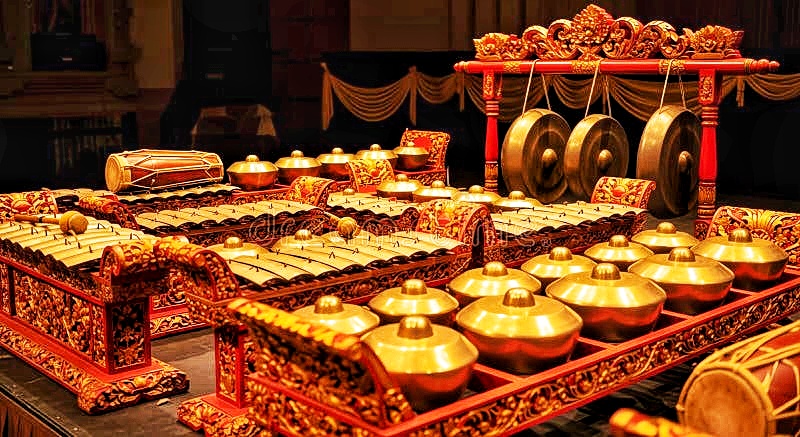
Indonesian Gamelan Instruments are an ensemble of predominantly bronze percussion instruments produced and maintained in the royal courts of Java and Bali since at least the 12th century CE, with archaeological evidence from relief carvings at Borobudur temple placing antecedent instrument forms as far back as the 8th century. A full Central Javanese court gamelan, known as a gamelan ageng, typically contains between 60 and 80 individual instruments organized into three functional families, covering a combined tonal range of four octaves. The gong ageng, the largest instrument in the ensemble and the one considered to hold the spiritual essence of the entire set, can measure up to 135 centimeters in diameter, though instruments between 80 and 90 centimeters are more common in active court collections today. Individual bronze keys on the saron, the primary melodic metallophone, measure approximately 3 centimeters wide by 25 to 30 centimeters long and are tuned by filing the underside of the bronze bar after casting. A complete gamelan set at a major royal court such as the Kraton Yogyakarta or the Surakarta Sunanate is classified as pusaka, meaning sacred heirloom property, assigned a personal honorific name prefixed by Kangjeng Kyahi, roughly translated as the venerable one, and treated as a living entity requiring ritual maintenance, offerings of flowers, food, and incense placed before the instruments on Thursday evenings. The Kraton Yogyakarta currently holds approximately 20 distinct gamelan sets of different types and ceremonial purposes.
Among the oldest surviving court gamelan sets are the Gamelan Munggang and Gamelan Kodok Ngorek, both held at the Kraton Yogyakarta and Surakarta courts and dated to the 12th century. The Gamelan Sekaten sets Kyai Guntur Madu and Kyai Guntur Sari at Surakarta and Kyai Guntur Madu and Kyai Naga Wilaga at Yogyakarta date to the 16th century, with Kyai Guntur Sari documented as made in 1566 and Kyai Guntur Madu at Surakarta made in 1642 during the reign of Sultan Agung. A Central Javanese gamelan set forged in the late 1950s by the Mangkunegaran Gamelan Factory in Surakarta and brought to the United States for the 1964 New York World’s Fair now resides at Cornell University’s Department of Music, ownership transferred from the Metropolitan Museum of Art in 2021. Gamelan was inscribed on UNESCO’s Representative List of Intangible Cultural Heritage of Humanity on December 15, 2021, at the 16th session of the Intergovernmental Committee held in Paris.
Indonesian Gamelan Instruments Material and Craftsmanship
The bronze instruments of a gamelan, comprising the gongs, metallophones, and gong-chimes, are made from an alloy of copper and tin. The formal Javanese term for a gamelan is gangsa, a word possibly derived from tembaga meaning copper and rejasa meaning tin, or alternatively from the numbers tiga meaning three and sedasa meaning ten, referencing a proportion of three parts tin to ten parts copper used in the alloy. Proportions vary in practice by workshop and period, with lead occasionally added to lower costs or adjust tonal properties.
Bronze gamelan instruments are produced through a two-stage process of casting followed by cold hammering. The instrument is first rough-cast in a two-part clay mold to produce a shape close to the final dimensions. After cooling, the instrument is reheated and hammered repeatedly on an anvil to achieve its final shape, thickness, and surface. For keyed instruments such as the saron, gender, and bonang, the final tuning is done by filing the underside of the bronze bar or pot after hammering. Removing material from the center of the underside lowers the pitch. Removing material from the ends raises it. This filing process is the most critical stage and is performed by a master smith, the only person trusted to determine when the pitch is correct. A single gong ageng can require several weeks of intermittent hammering and cooling. The gong ageng is always cast and tuned first because every other instrument in the set is subsequently tuned to match its fundamental pitch.
Each gamelan set is tuned entirely to itself. No two sets are tuned identically because no external pitch standard is used as a reference. This means a saron from one gamelan cannot be substituted into another gamelan without destroying the coherence of both sets. This self-contained tuning system defines each gamelan as an indivisible acoustic unit rather than a collection of interchangeable parts.
Wooden components of a gamelan, including the instrument frames, resonance boxes, suspension racks for gongs, and keyboard supports, are carved from jackfruit wood or teak and decorated with relief carvings painted in the specific colors and motifs assigned to that court’s visual identity. Kraton Yogyakarta instruments use a green and gold color scheme with stylized wings and floral motifs. Surakarta court instruments favor red, gold, and black with different decorative programs. These visual identities make court gamelan sets immediately recognizable as belonging to specific royal houses.
Form and Features
The instruments of a complete Central Javanese court gamelan are organized into three functional groups. Balungan instruments carry the main skeletal melody. Punctuating instruments mark the phrase structure and larger cyclical units of the music. Elaborating instruments ornament, extend, and anticipate the main melody in layered simultaneous variations.
The balungan group consists of four types of bronze key metallophone. The demung is the largest, with the lowest pitch range, its keys suspended over a wooden trough resonator. The saron barung sits an octave higher. The saron peking plays two octaves above the demung. The slenthem is a lower-range metallophone with individual keys suspended over tuned bamboo or metal tube resonators beneath each bar, producing a more diffuse, sustained tone. A court gamelan typically includes two to four of each saron type.
The punctuating group consists of gongs of varying sizes. The gong ageng, the largest, marks the end of the longest musical phrase structure, called the gongan. The gong suwukan is smaller and marks intermediate phrase divisions. The kempul gongs, suspended vertically on a rack, mark shorter subdivisions. The kenong, a set of large pot-shaped gongs resting horizontally on cords within a wooden frame, and the kethuk, a smaller fixed pot gong, further subdivide the metric structure. The kenong in a full court set can number ten or more, each tuned to a different pitch of the scale.
The elaborating group contains instruments of different timbres and construction. The bonang barung and bonang panerus are sets of small pot gongs arranged in two rows on a horizontal rack and struck with padded sticks, playing anticipatory patterns ahead of the balungan melody. The gender barung and gender panerus are thin-keyed metallophones with individual tube resonators producing a sustained, shimmering tone, played with two mallets simultaneously. The gambang is a wooden xylophone. The rebab is a two-string spiked fiddle of Middle Eastern origin, played with a horsehair bow, providing a continuous melodic line. The siter and celempung are plucked zithers. The suling is a bamboo end-blown flute. The kendhang is a double-headed barrel drum played with the hands, which controls tempo and transitions and functions as the ensemble’s leader despite carrying no melodic content. Male choral singers, called gerong, and solo female vocalists, called pesindhen, are included as part of the elaborating layer in most full court performances.
A complete double court gamelan contains two complete sets of all instruments, one tuned to the slendro scale and one tuned to the pelog scale. Slendro divides the octave into five roughly equidistant tones. Pelog is a seven-tone scale with unequal intervals, of which five receive principal stress in any given mode. These two tuning systems are performed on entirely separate sets of instruments and share, by design, one or two pitches in common between them.
Function and Use
Within the royal courts of Java, specific gamelan sets were reserved strictly for specific ceremonial functions and could not be used for any other purpose. The Gamelan Munggang and Gamelan Kodok Ngorek at both the Yogyakarta and Surakarta courts are played only for the highest-order royal ceremonies: the sultan’s coronation, royal weddings, the reception of state guests of equivalent rank, and the royal birth and death ceremonies. General public access to these sacred sets is not permitted, and no private individual or institution outside the two courts may legally possess a similar set. A Javanese saying, it is not official until the gong is hung, reflects how deeply embedded gamelan performance is in the formal legitimization of ceremonial events.
The Gamelan Sekaten sets at Yogyakarta and Surakarta have a specific annual function. Each year, beginning on the 6th of the month of Mulud in the Javanese calendar, the sets are carried in formal procession from the palace at 11 pm to two open pavilions positioned in front of the Great Mosque of each city. They are played continuously every day for one week, except Thursday night, to mark the week leading up to the Prophet Muhammad’s birthday, the Mawlid an-Nabi. On the eve of the birthday itself, the sets are returned to the palace at 11 pm. The Sekaten sets play only loud instruments with no singers or soft elaborating instruments, producing a majestic, penetrating sound intended historically to attract the surrounding population toward the mosque. Playing was performed only by royal family members and despignated courtiers in prescribed traditional dress.
Beyond the palace walls, the gamelan ageng serves the full range of social and religious functions in Javanese and Balinese life. Wedding ceremonies, circumcision ceremonies, birth ceremonies, funerary rites, the harvest festival, the Javanese ritual exorcism ceremony called ruwatan, shadow puppet theater wayang kulit, classical court dance performances, and the sending of troops to war in earlier centuries all required specific gamelan performances with specific repertoire matched to each occasion. In Bali, virtually all Hindu religious ceremonies include gamelan performance, and the Gamelan Selonding, a very old iron key metallophone ensemble from the village of Tenganan in East Bali, is restricted entirely to temple ritual use and is not performed publicly outside those contexts.
Claude Debussy heard a Javanese gamelan at the 1889 Paris Exposition Universelle and described it as a music with no parallel in European composition. His later works, particularly the piano preludes and the orchestral nocturnes, show direct influence from the layered, non-developmental texture of gamelan music. Benjamin Britten, John Cage, Lou Harrison, and Olivier Messiaen also cited gamelan as a significant influence on their compositional development.
Cultural Context
The courts of Yogyakarta and Surakarta emerged from the 1755 division of the Islamic Mataram Sultanate under the Treaty of Giyanti, brokered by the Dutch VOC, which split the kingdom into two rival successor states. Each court inherited and subsequently commissioned its own parallel set of royal gamelan ensembles, generating two distinct but closely related traditions of court gamelan repertoire and performance practice that persist today. The Yogyanese style favors a slightly slower tempo and more restrained dynamic range. The Surakarta or Solonese style allows more rhythmic flexibility and a broader tonal palette in elaborating instruments. These differences were codified in the 19th century when both courts developed written notation systems for their repertoire, the first time gamelan music, which had been transmitted entirely through oral memory, was committed to written form. Neither system was intended for reading during performance but for preserving the court’s repertoire in written records.
The spread of Islam across Java from the 15th century onward did not eliminate gamelan from Javanese cultural life, partly because the Sufi strand of Islam practiced by most Javanese, which valued music as a means of spiritual connection, was compatible with existing traditions. The Sekaten festival itself was reframed as an Islamic celebration while using instruments and ceremonial protocols originating in the Hindu-Buddhist Majapahit court tradition. This layer of cultural continuity through religious transition, maintaining older practices within new frameworks, is a recurring feature of Javanese cultural history that the gamelan embodies more visibly than almost any other object.
The Majapahit Empire (1293 to approximately 1527), which controlled most of the Indonesian archipelago at its height, maintained a dedicated government office for supervising performing arts including gamelan, documented in the Kakawin Nagarakertagama, a palm-leaf manuscript written in 1365 CE by the court poet Mpu Prapanca. This is the earliest written document to specifically mention the word gamelan and document its institutional role within Javanese governance.
Discovery and Preservation
The earliest physical evidence for gamelan is found in the relief carvings at Borobudur temple in Central Java, constructed in the late 8th to early 9th centuries CE, which depict musicians playing instruments including gongs, metallophones, drums, and stringed instruments in configurations recognizable as early gamelan ensembles. These carvings predate the oldest surviving court instruments by approximately three to four centuries.
The division of the Mataram Sultanate in 1755 created two separate institutional custodians for the Central Javanese court gamelan tradition. Roger Vetter, a professor at Grinnell College who first visited the Kraton Yogyakarta in 1973 and returned multiple times through 2019, produced the most comprehensive English-language documentation of the Yogyakarta palace gamelan collection, cataloguing all 20 sets held there, their instrumentation, ceremonial functions, individual instrument histories, and tuning relationships in a published website and through academic articles. His work documented that most palace gamelan sets were not originally constructed with their current instrumentation but were modified, expanded, and supplemented over multiple reigns as new instrument types were developed and added.
Western institutions began acquiring gamelan sets for academic teaching purposes in the 1950s and 1960s, when the Mangkunegaran Gamelan Factory in Surakarta became the primary producer of gamelan sets for export. Gamelan programs are now active at more than 200 universities and colleges worldwide. K.R.T. Wasitodiningrat, a composer from the Yogyakarta court known internationally as Pak Cokro, had one of his gamelan compositions included on the Voyager Golden Record launched by NASA in 1977, selected as representative of Indonesian culture for potential contact with extraterrestrial intelligence.
By 2025, Indonesia’s Gamelan Goes to School program, implemented as part of the country’s obligations following the 2021 UNESCO inscription, had introduced gamelan instruction as a component of standard school curricula across multiple provinces. Provincial gamelan associations, gamelan festivals, and government-funded cultural diplomacy programs sending gamelan specialists to universities in Europe, the United States, and Japan are also components of the post-inscription safeguarding framework.
Why It Matters
The royal court gamelan of Java is the only major orchestral instrument tradition in the world in which every instrument is tuned specifically to every other instrument in its set and cannot be substituted into or combined with any other ensemble, making each complete gamelan a single indivisible acoustic object rather than a collection of individual instruments. The oldest surviving court sets at Yogyakarta and Surakarta date to the 12th and 16th centuries, placing them among the oldest playable musical instruments still in active institutional use anywhere in the world. The treatment of court gamelan sets as living sacred entities requiring weekly ritual offerings, personal honorific names, and restricted ceremonial access documents a category of object relationship without parallel in the material culture of any other musical tradition. The division of the Mataram Sultanate in 1755 and the consequent development of two distinct but parallel court traditions at Yogyakarta and Surakarta created a living comparative laboratory in which the same musical heritage diverged in measurable ways across 270 years of separate institutional cultivation. The inscription of gamelan on the UNESCO Intangible Cultural Heritage list in 2021 established the tradition as a reference point in international debates about how living performance practices that exist simultaneously as functional ceremonial instruments, sacred palace heirlooms, and globally distributed academic teaching tools should be classified, protected, and transmitted across future generations.
https://wikiflo.com/burmese-mandalay-buddha/
[…] Indonesian Gamelan Instruments Most Sacred Ancient Music in the World […]
[…] Indonesian Gamelan Instruments Most Sacred Ancient Music in the World […]