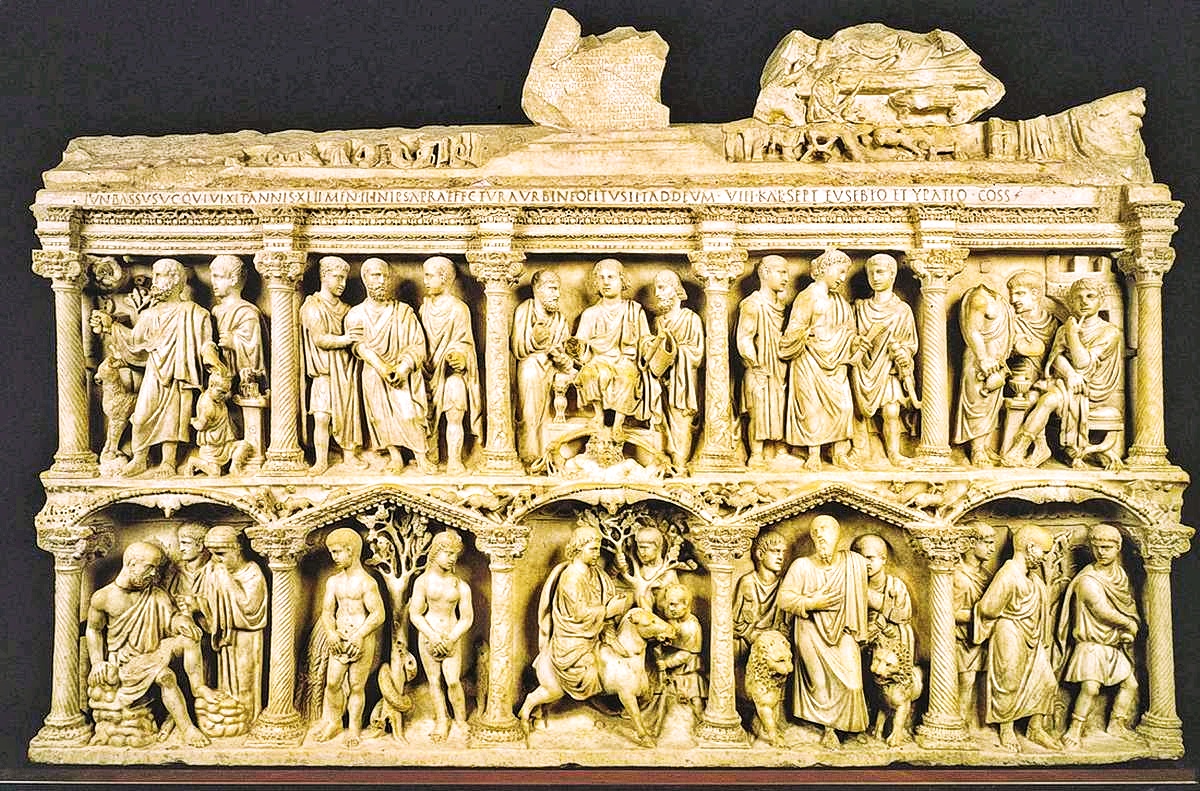
The Sarcophagus of Junius Bassus is a white marble sarcophagus measuring approximately 182 centimeters in height, 234 centimeters in width, and 152 centimeters in depth was carved in 359 CE for the burial of Junius Bassus, a Roman senator and urban prefect who converted to Christianity shortly before his death at the age of 42. The piece has been described by scholars as “probably the single most famous piece of early Christian relief sculpture.” The sarcophagus was originally placed in or beneath Old Saint Peter’s Basilica in Rome, positioned near the confessio, the underground chamber associated with the burial site of the Apostle Peter. Workers rediscovered it during excavations beneath the high altar of the basilica in either 1595 or 1597, with historical records differing on the precise year. Additional fragments bearing inscriptions were recovered during further archaeological excavations beneath Saint Peter’s conducted between 1940 and 1943. The sarcophagus was removed from the Vatican Grottoes in 1954 and has since been permanently housed in the Museo Storico del Tesoro della Basilica di San Pietro, the Treasury Museum of Saint Peter’s Basilica in Vatican City, where photography and filming of the original are prohibited. The marble is believed to have been sourced from the Proconnesus quarries in Asia Minor, a major supplier of premium white marble to Roman workshops during the 4th century CE. The inscription along the upper edge of the sarcophagus, recorded in the Corpus Inscriptionum Latinarum as CIL VI, 32004, reads in Latin: IUN BASSUS VC QUI VIXIT ANNIS XLII MEN II IN IPSA PRAEFECTURA URBI NEOFITUS IIT AD DEUM VII KAL SEPT EUSEBIO ET YPATIO COSS, translating as “Junius Bassus, vir clarissimus, forty-two years and two months old, performing the duties of city prefect, went newly baptized to God on 25 August during the consulship of Eusebius and Hypatius,” confirming the date of death as 25 August 359 CE.
Sarcophagus of Junius Bassus Material and Craftsmanship
The sarcophagus is carved from white marble consistent with material exported from the Proconnesus quarries on the island of Proconnesus in the Sea of Marmara, present-day Turkey. Proconnesian marble was quarried in semi-finished blocks and transported by sea to Rome, where specialized workshops completed the carving. The fine grain of the stone allowed sculptors to achieve the deeply undercut relief and precise facial modeling visible across the ten figural panels. The material’s cost and quality, combined with the labor intensity of the finished product, placed this commission at the highest level of late Roman funerary expenditure, appropriate to a patron of senatorial rank serving as prefect of the city.
The carving technique employs deep relief in which figures stand well forward from the background, creating pronounced shadows between forms that enhance legibility when the monument is viewed under natural light. According to art historian Ernst Kitzinger, the sculptural style reflects “a far more definite reattachment to aesthetic ideals of the Graeco-Roman past” compared to earlier Christian sarcophagi such as the Dogmatic Sarcophagus and the Sarcophagus of the Two Brothers, both also held in the Vatican. The figures display soft, naturalistic modeling rather than the flattened, hieratic quality that had characterized official Roman relief carving in the period of the Arch of Constantine several decades earlier. This return to classical Hellenistic-influenced style was likely a deliberate choice by the workshop and patron, signaling cultural refinement and connecting the tomb’s iconography to established Greco-Roman artistic traditions.
The two central columns on each register are decorated with grapevines and climbing Erotes, small winged figures associated with love and abundance in Roman decorative art. The two outermost columns on each register are spirally fluted. The columns are carved in the Corinthian order, with elaborate capitals supporting arched and triangular pediments alternating across the facade to create visual rhythm dividing the ten narrative panels.
Form and Features
The sarcophagus body is organized as two horizontal registers of five niches each, separated and framed by Corinthian columns, producing ten individual pictorial compartments across the front face. The arrangement creates what Kitzinger described as a “multitude of miniature stages,” allowing viewers to examine each scene independently rather than reading a continuous frieze narrative. This compartmentalized format, while not invented for this monument, reaches its most refined expression here among surviving early Christian sarcophagi.
The ten niches contain the following scenes, arranged left to right across the upper register: the Sacrifice of Isaac, the Arrest of Peter, Christ Enthroned between the Apostles Peter and Paul, the Arrest of Christ before Pilate, and the Judgment of Pilate. Across the lower register, left to right: Job in Distress, Adam and Eve, Christ’s Entry into Jerusalem, Daniel in the Lion’s Den, and the Arrest of Paul. Within the damaged spandrels of the lower register, smaller scenes rendered with lambs substituting symbolically for human figures depict additional episodes including the Three Youths in the Fiery Furnace, the Striking of the Rock, the Multiplication of the Loaves, the Baptism of Christ, the Receiving of the Law, and the Raising of Lazarus, according to Elizabeth Struthers Malbon’s analysis in her 1990 Princeton University Press publication, The Iconography of the Sarcophagus of Junius Bassus: Neofitus Iit Ad Deum.
Christ appears three times across the front face and is consistently rendered as a youthful, beardless figure with hair slightly longer than the surrounding figures, consistent with the iconographic conventions of early Christian art in this period. In the central niche of the upper register, Christ is depicted seated on a throne with his feet resting on a canopy held by the figure of Coelus, the personification of the sky, with Peter and Paul standing to either side. According to the Judaism and Rome academic project, the seated Christ’s posture and throne closely echo imperial imagery, particularly representations of enthroned emperors, suggesting the deliberate adaptation of Roman political iconography to communicate divine sovereignty.
The short ends of the sarcophagus carry traditional Roman decorative motifs depicting the Four Seasons, represented by putti engaged in seasonal tasks including harvesting grapes. The lid survives only in fragmentary form. The damaged portions that remain show scenes of feasts and a burial procession consistent with standard pagan sarcophagus decoration, leading some scholars to suggest the lid may not have been originally made to accompany the base. A poem originally comprising eight verse couplets, now fragmentary, was inscribed on the lid’s tabula, praising Bassus in largely secular terms and recording details of his funeral.
Function and Use
The sarcophagus served as the burial container for the remains of Junius Bassus following his death on 25 August 359 CE. Its placement near the confessio of Saint Peter’s Basilica, proximate to the presumed burial site of the Apostle Peter, was not incidental. Proximity to apostolic remains was among the most desirable burial positions available in 4th-century Rome, reflecting both religious conviction and social status. The choice of location indicates that Bassus or his family held sufficient standing to secure burial within the basilica at this specific location.
Beyond its immediate funerary function, the sarcophagus served as a public statement of faith and identity. The inscription’s description of Bassus as neofitus, meaning newly baptized, presented his deathbed conversion as an act of humility rather than late opportunism, framing his entry into Christian community as sincere even at its final moment. The deployment of an extensive program of Old and New Testament scenes across the tomb’s exterior transformed the monument into a visual declaration of Christian belief, directed at the visitors who would view it in the basilica.
According to scholar Jas Elsner, writing in the volume Rome the Cosmopolis, the Christian narratives effectively enclosed the body of the deceased prefect “in a symbolic structure rooting his baptism in both scripture and the specifically Roman inheritance of scripture,” producing a monument that simultaneously expressed Christian faith and reinforced Rome’s institutional centrality within Christianity through its association with the martyred apostles buried in the city.
Cultural Context
Junius Bassus was born around 317 CE into a prominent senatorial family. His father, also named Junius Bassus, had served as praetorian prefect of the prefecture of the Gauls from 318 to 331 CE and held the consulate in 331 under Emperor Constantine the Great. The younger Bassus pursued a comparable career in imperial administration, serving as urban prefect of Rome under Emperor Constantius II in 359, a position that placed him as the chief administrative officer of the city with authority over the Senate and responsibility for judicial, financial, and public works matters.
The sarcophagus was commissioned in the period immediately following the Edict of Milan of 313 CE, through which Emperor Constantine I and co-emperor Licinius formally legalized Christianity and extended religious tolerance throughout the Roman Empire. The 46 years between legalization and Bassus’s death in 359 had produced rapid changes in the public expression of Christian belief, enabling elite patrons to commission overtly Christian funerary monuments in expensive materials placed in prominent locations for the first time. The Junius Bassus sarcophagus represents one of the earliest surviving examples of this new category of high-status Christian burial art.
According to Elizabeth Malbon, the iconographic program reflects what she characterizes as the process by which “political power structures and images are being taken over by religious power structures and images, as Christianity is transformed from a persecuted faith to a tolerated tradition.” The selection of scenes emphasizing judgment, divine authority, deliverance from trial, and martyrdom carried particular resonance for a patron who had spent his career as a judge and magistrate. Scholars including those at the Judaism and Rome academic project have noted that each individual scene depicted on the sarcophagus can be paralleled in other Christian artworks of the period, confirming that the iconographic program drew on an established shared visual vocabulary rather than representing an innovation in subject matter.
The figure of Daniel in the Lion’s Den, originally carved as a nude figure in the classical tradition, was subsequently replaced by a modern clothed figure, the palliatus, at a later date when the nudity was considered inappropriate for the religious context. This modification documents the changing standards applied to sacred imagery across subsequent centuries.
Discovery and Preservation
The sarcophagus remained buried beneath Old Saint Peter’s Basilica from the time of Bassus’s interment in 359 CE until its rediscovery during building work associated with the construction of the new Saint Peter’s Basilica, which Pope Julius II initiated in 1506. The date of rediscovery is recorded variously as 1595 or 1597 in historical sources, with both dates appearing in scholarly literature without definitive resolution. Following recovery, the sarcophagus was initially displayed within the basilica before being relocated in the 17th century to the Vatican Grottoes beneath Saint Peter’s, where it remained for approximately three centuries.
Between 1940 and 1943, archaeological excavations conducted beneath Saint Peter’s Basilica as part of a broader investigation of the site’s early Christian stratigraphy recovered additional fragments bearing inscriptions associated with the sarcophagus, supplementing the contextual record. The sarcophagus was transferred from the Grottoes to the Museo Storico del Tesoro della Basilica di San Pietro in 1954, where it has remained on permanent display. The museum is located adjacent to the basilica and requires a separate admission fee of 10 euros for adult visitors as of 2025, with reduced admission for visitors aged 7 to 17 and free access for children under 6. Due to conservation concerns, the original sarcophagus cannot be photographed or filmed, and a replica is displayed separately within Vatican City for general viewing purposes.
The inscription on the sarcophagus is catalogued in the Corpus Inscriptionum Latinarum as CIL VI, 32004. The lid inscription, which survives only in fragmentary form, is catalogued separately as CIL VI, 41341a.
Why It Matters
The Sarcophagus of Junius Bassus stands as one of the earliest surviving examples of high-status Christian funerary sculpture produced in the decades immediately following the legalization of Christianity in the Roman Empire, documenting the transition of Christian artistic expression from modest catacomb imagery to monumental marble commissions accessible to the Roman senatorial elite. The monument’s program of ten Old and New Testament relief panels, executed in a classicizing style consciously referencing Hellenistic sculptural traditions, demonstrates how 4th-century Roman workshops and patrons adapted established imperial iconography to communicate Christian theological claims about divine authority, salvation, and the relationship between Rome and the apostolic church. The inscription identifying Bassus as neofitus provides one of the few datable, individually identified examples of elite conversion and Christian burial from this formative period, anchoring broader historical arguments about Christianity’s integration into Roman aristocratic life under Constantius II. According to scholar Ernst Kitzinger, the sarcophagus represents the most developed expression of the trend toward compartmentalized narrative relief in early Christian funerary art, a formal innovation that influenced subsequent Christian visual programs in both sculptural and architectural contexts.
https://wikiflo.com/pueblo-pottery/
[…] Sarcophagus of Junius Bassus: The Most Famous Early Christian Masterpiece […]