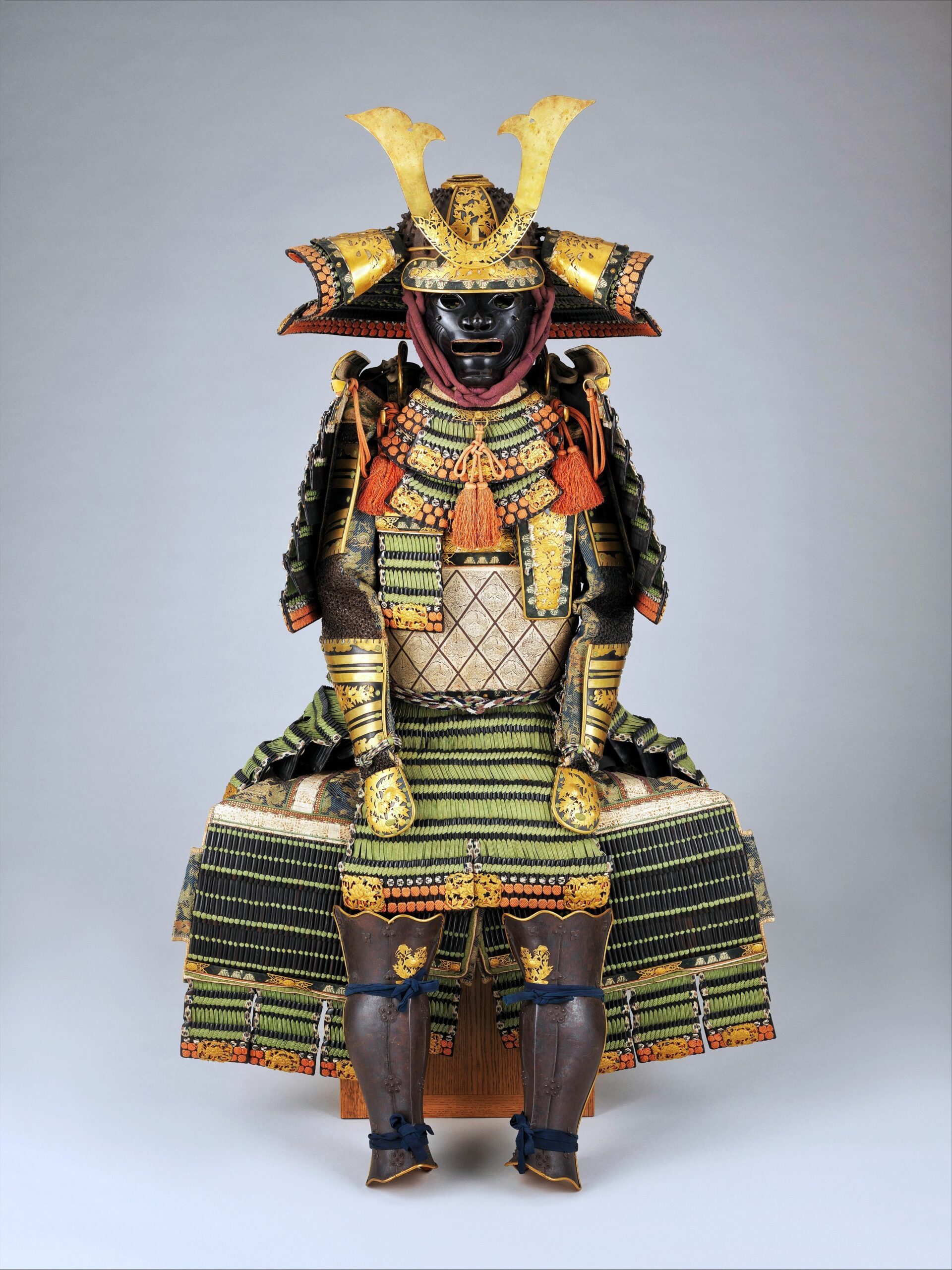
Do-maru Samurai Armor Developed in Japan during the late Heian period (794–1185 CE), the do-maru is a form of Japanese lamellar body armor that became the dominant armored garment of the Japanese foot soldier and, later, the mounted samurai class. The name translates literally as “body wrap,” reflecting the armor’s defining characteristic: a curved construction that wraps entirely around the torso and fastens at the wearer’s right side rather than at the front or back. Originating as practical infantry protection, the do-maru underwent centuries of refinement, evolving from a simple functional garment into one of the most technically sophisticated and aesthetically elaborate forms of personal armor produced anywhere in the premodern world. By the Muromachi period (1336–1573 CE), it had largely supplanted the older oyoroi style favored by mounted aristocratic warriors, becoming the preferred armor of samurai across social ranks. Surviving examples are held in Japanese imperial collections, major shrines, and museums worldwide, and are regarded as masterworks of both metallurgical and textile craftsmanship.
Do-maru Samurai Armor Material and Craftsmanship
The do-maru is a composite construction, assembling dozens of distinct materials into a unified protective garment. Its structural foundation consists of small individual scales called kozane, cut from iron or leather and lacquered heavily to resist moisture, rust, and physical impact. A single suit of do-maru could incorporate several hundred to over two thousand individual kozane depending on the period, the patron’s wealth, and the intended level of protection. Iron kozane were hammered thin, shaped with a slight curvature, and coated with multiple layers of urushi lacquer, a resin derived from the sap of the Toxicodendron vernicifluum tree native to East Asia. Urushi lacquer, when applied in successive thin coats and allowed to cure under controlled humidity, produces a surface of exceptional hardness, water resistance, and durability. Colors ranged from deep black to red-brown depending on the pigments and iron compounds introduced during the lacquering process.
The kozane were assembled into horizontal rows called kebiki-odoshi or sugake-odoshi depending on the lacing pattern used. Each scale overlapped its neighbor and was bound together using silk or leather cords threaded through small holes punched along the upper and lower edges of each plate. The lacing color, material, and density were not merely decorative choices. Dense lacing offered greater resistance to blade penetration but absorbed water during rain or river crossings, increasing the armor’s weight substantially. Sparser lacing patterns, developed and favored in the later Sengoku period (1467–1615), addressed this practical problem while still maintaining structural coherence.
The leather components, including certain scale types and backing materials, came from deer or bear hide, processed and treated to improve flexibility and resistance. Silk, imported from China or produced domestically in Japan’s growing silk industry, provided the lacing cords in the finest commissioned examples, with color choices communicating the wearer’s identity, clan affiliation, or aesthetic preferences. Protective elements including shoulder guards (osode), thigh guards (kusazuri), and arm coverings were constructed using the same kozane-and-lacing methodology, ensuring uniform construction throughout the complete suit.
Form and Features
The do-maru wraps around the entire torso, opening along the wearer’s right side where it is secured with cords or toggles. This right-side opening distinguishes it from the older oyoroi, which opened at the back. The opening’s placement was both practical and tactical, keeping the most heavily laced and reinforced portions of the cuirass facing forward and to the left, the directions from which mounted opponents most frequently attacked infantry.
The cuirass itself is divided into horizontal bands of assembled kozane, typically three to four bands in height, each band slightly overlapping the one below. The lower edge of the cuirass flares outward slightly, accommodating the hip and allowing freedom of movement at the waist. Attached to the bottom of the cuirass are hanging skirt panels called kusazuri, typically divided into seven or eight separate sections to allow the legs to move independently during walking and combat. Each kusazuri panel is itself composed of additional rows of kozane laced together, providing protection for the upper thighs and lower abdomen.
The helmet associated with the do-maru, though technically a separate component, typically followed contemporary design conventions including a multi-plate iron bowl riveted together called a hachi, with a pronounced neck guard called a shikoro composed of additional lamellar plates. The face was protected by a removable iron half-mask or full mask called a menpo, often cast with exaggerated fearsome features including stylized mustaches and grimacing mouths. These masks contained a small hole at the chin to allow sweat to drain during combat.
Shoulder guards in do-maru construction are generally smaller and more closely fitted to the body than the large rectangular osode of the oyoroi tradition, reflecting the do-maru’s origins as infantry armor where freedom of arm movement was more critical than the broad coverage needed for mounted archery. The overall silhouette is more compact and cylindrical than earlier Japanese armor forms, sitting closer to the body and distributing weight more evenly across the shoulders and hips.
Surviving examples preserved at institutions such as the Tokyo National Museum and the Kasuga Taisha shrine in Nara display lacing patterns in red, dark blue, white, and multicolored combinations. One of the most celebrated surviving do-maru, designated a National Treasure of Japan, is housed at the Oyamazumi Shrine in Ehime Prefecture. Dating to the Nanbokucho period (1336–1392), it retains substantial original lacing and lacquer, offering a rare view of the armor in a condition close to its original appearance.
Function and Use
The do-maru served first and foremost as protection for the torso, neck, and upper legs during close-range ground combat. Its development coincided with a shift in Japanese warfare away from the aristocratic mounted archery duels that characterized Heian-period battles toward the large-scale infantry engagements that became standard from the Kamakura period (1185–1333) onward. Foot soldiers required armor that allowed rapid movement, easy donning and removal, and resistance to sword cuts, spear thrusts, and arrows fired at close range.
The lacquered iron scales were designed to deflect rather than absorb impacts. An arrow or blade striking a lacquered surface at an angle would be redirected rather than penetrating directly, and the layered scales meant that even a strike that penetrated one scale would encounter additional layers beneath. The lacing between scales, while vulnerable to cutting weapons if exposed, held scales in alignment during impact, preventing the armor from deforming or splaying apart under force.
The do-maru was donned by wrapping it around the body and securing the right-side opening, a process typically assisted by an attendant. Full armor assembly including helmet, mask, arm guards, and leg protection could require considerable time, meaning that samurai expecting imminent battle would ideally arm before departure rather than at the battlefield’s edge. The complete suit, despite its considerable component count, was designed to be worn for extended periods, with the weight distributed sufficiently across the body to allow hours of active movement.
As the samurai class adopted the do-maru from the 13th century onward, additional elaboration was introduced. Finer silk lacing replaced leather cords in high-status commissions. Lacquer colors became more varied and symbolically significant. The integration of decorative elements including gilt metal fittings, embossed leather panels, and clan mon (heraldic crests) transformed the do-maru from functional infantry equipment into a visible statement of the wearer’s identity, status, and martial lineage.
Cultural Context
The do-maru emerged within Japan’s feudal military culture, in which the samurai class occupied both a martial and an administrative role under the shogunal governments of the Kamakura and Muromachi periods. Armor in this context carried meanings that extended well beyond protection. A samurai’s armor was an heirloom object, passed between generations, presented as gifts between lords and retainers, and dedicated to Shinto shrines as votive offerings following military victories. Several of the finest surviving do-maru entered shrine collections precisely through this practice of dedication, which explains their exceptional state of preservation relative to armor that remained in active use.
The aesthetic philosophy governing do-maru construction reflected broader Japanese aesthetic values. The concept of mono no aware, an appreciation for transient beauty, appeared in the use of rich silk lacing that, though perishable, was chosen over more durable materials for its visual and tactile qualities. The careful attention to lacquer finish, lacing pattern, and decorative fittings expressed the warrior’s understanding that martial life and aesthetic refinement were not opposing values but complementary ones.
The Sengoku period placed new demands on armor. As firearms introduced by Portuguese traders in 1543 entered Japanese warfare, armors were increasingly tested against bullets, and some surviving suits bear tameshi gusoku marks, deliberate bullet dents stamped into breastplates to demonstrate that the armor had been proof-tested. Armor makers responded by thickening plates, shifting toward more solid breastplates in some designs, and developing hybrid forms combining lamellar tradition with solid plate elements. The do-maru remained a fundamental reference point throughout these innovations, and its construction principles informed the designs that followed.
Armor production was controlled by hereditary families of specialist craftsmen, including the Myochin school, active from the Kamakura period and continuing through the Edo period (1603–1868). These schools maintained proprietary techniques for iron working, lacquering, and assembly, and their signatures on surviving armor pieces are used today by scholars to date and attribute specific examples.
Discovery and Preservation
Unlike many categories of historical artifact recovered through archaeological excavation, the majority of significant surviving do-maru have remained in continuous institutional custody since their creation or shortly thereafter. Shinto shrines including Oyamazumi, Kasuga Taisha, and Itsukushima Shrine on Miyajima Island accumulated armor through centuries of votive dedication and have maintained these collections with varying degrees of conservation effort. The controlled interior environments of shrine treasure houses, combined with Japan’s dry winter climate in many shrine locations, contributed to the survival of organic components including silk lacing and leather backing that would otherwise have deteriorated within decades.
The Meiji government’s reorganization of Japan’s cultural institutions in the late 19th century prompted systematic documentation of armor collections held by shrines, temples, and former daimyo households. The designation of outstanding examples as Kokuhо (National Treasures) under cultural property legislation provided legal protection against export, alteration, or sale, and authorized funding for professional conservation. Japan currently designates dozens of individual armor suits or components as National Treasures, with a larger number holding the secondary designation of Important Cultural Property.
Western museum collections acquired do-maru and related armor primarily through 19th and early 20th century purchases and donations, often assembled by diplomats, military officers, and collectors during Japan’s period of engagement with Western nations following the Meiji Restoration of 1868. The Metropolitan Museum of Art in New York, the Victoria and Albert Museum in London, the Museum of Fine Arts in Boston, and the Ethnologisches Museum in Berlin all hold notable Japanese armor collections assembled during this period. Conservation challenges for collections outside Japan include managing humidity fluctuations that stress lacquer surfaces and silk lacing, and identifying appropriate consolidants and storage environments for materials whose original manufacturing chemistry differs substantially from European metalwork traditions.
Current preservation practice for do-maru involves controlled storage at stable relative humidity between 50 and 60 percent, periodic inspection of lacing cords for deterioration, and careful cleaning of lacquer surfaces without solvent application that could dissolve historic finish layers. Textile components are examined under magnification for insect damage and fiber degradation. Major restoration campaigns, when undertaken on National Treasure examples, involve interdisciplinary teams of conservators, textile specialists, and lacquerwork craftsmen trained in traditional techniques.
Why It Matters
The do-maru occupies a foundational position in the history of Japanese armor, marking the transition from elite mounted warrior equipment to a broadly adopted form of protection suited to the realities of medieval infantry warfare. Its construction methodology, assembling hundreds of individually prepared components into a coherent and flexible protective system, represents a distinctive solution to the engineering problems of personal protection that developed independently from European plate armor traditions during roughly the same historical period. The surviving examples held in Japanese shrine collections and international museums provide direct material evidence of feudal Japan’s metallurgical capacity, textile production, and aesthetic culture. Beyond their historical value, these armors continue to inform the work of living craftsmen who maintain traditional armor-making skills, ensuring that the technical knowledge embedded in do-maru construction remains accessible rather than lost to time.
https://wikiflo.com/remarkable-religious-art-collection-vatican/
[…] Do-maru Samurai Armor – Japan’s Remarkable 794 CE Lamellar Body Armor […]