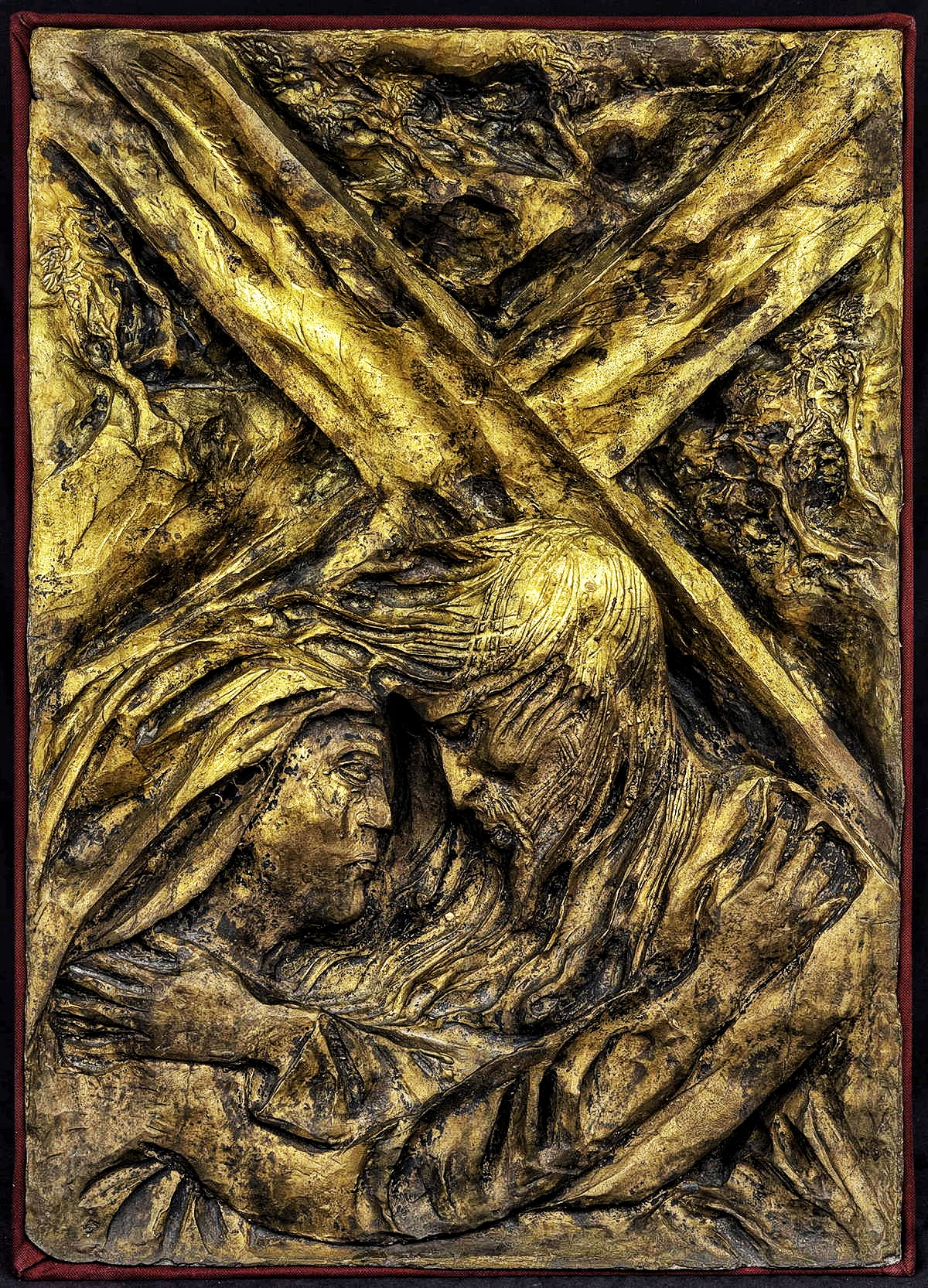
This Religious Art Collection holds approximately 9,000 paintings, sculptures, works on paper, installations, and artistic objects produced between the late 19th century and the early 21st century. Occupies 55 rooms across the Borgia Apartment of the Apostolic Palace, the two floors of the Salette Borgia, a series of rooms below the Sistine Chapel, and a series of rooms on the ground floor of the Vatican Museums complex in Vatican City. The collection was officially inaugurated by Pope Paul VI on 23 June 1973 as the youngest of the Vatican’s museum collections and, according to the Vatican Museums’ institutional website, represents one of the largest institutional collections of contemporary sacred art in the world. The works were assembled primarily through donations made by artists, collectors, and public and private entities between approximately 1964 and the present day, following Paul VI’s address to a gathering of contemporary artists in the Sistine Chapel on 7 May 1964, an event described in institutional records as the Mass of Artists, in which the pope called publicly for the renewal of the historic relationship between the Catholic Church and modern art.
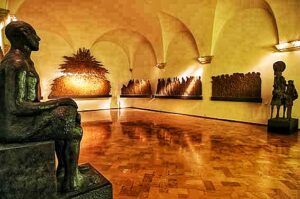
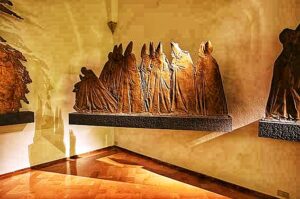
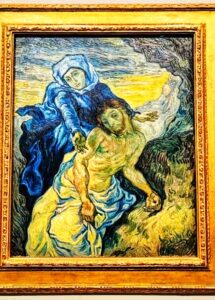
The operational assembly of the collection was directed over approximately ten years by Msgr. Pasquale Macchi, Paul VI’s personal secretary. The collection has been managed since its inauguration by Mario Ferrazza, who holds the longest continuous curatorial tenure of any member of the Vatican Museums’ staff. Works displayed in the collection span Post-Impressionism, Expressionism, Cubism, Surrealism, abstract art, and figurative modernism, produced by approximately 250 international artists from Europe, the Americas, and beyond. Among the most significant individual holdings are the Pietà after Delacroix by Vincent van Gogh, measuring 41.5 by 34 centimeters, donated by the Diocese of New York in 1973; the polychrome wood sculpture Blessed Are the Pure of Heart by Paul Gauguin; three works by Salvador Dalí including Angelic Passage; a work by Pablo Picasso; four watercolors by Marc Chagall; three paintings by Georges Rouault; and the Matisse Room, inaugurated in June 2011 and housing preparatory cartoons, designs, chasubles, and bronze objects related to Henri Matisse’s Chapel of the Rosary at Vence on the French Riviera, donated to the Vatican Museums in 1980 by the artist’s son Pierre Matisse. The collection’s permanent contemporary art gallery, housing works from the late 20th and early 21st centuries, was installed in November 2021.
Material and Craftsmanship of the Collection of Modern and Contemporary Religious Art
The collection encompasses works in virtually every medium available to artists in the late 19th and 20th centuries. This Religious Art Collection includes works in oil, bronze, wood and tapestry. The Van Gogh Pietà is oil on canvas, consistent with the painter's standard working practice across his entire career. Painted in July 1889 at the Saint-Paul-de-Mausole asylum at Saint-Rémy-de-Provence, it is a copy made after a black and white print of a 1850 work of the same subject by Eugène Delacroix, with Van Gogh imposing his own color interpretation onto the composition since no color original was available to him at the asylum. The Vatican version, measuring 41.5 by 34 centimeters, is the smaller of two versions painted by Van Gogh. The larger version, measuring 73 by 60.5 centimeters, is displayed at the Van Gogh Museum in Amsterdam.
The Gauguin Blessed Are the Pure of Heart is a polychrome carved wood sculpture, consistent with Gauguin’s documented practice of wood carving executed alongside his painting throughout his career in France and Polynesia. The Religious Art Collection preserves these techniques across all its galleries. The Vatican piece represents one of a small number of explicitly sacred subjects produced by Gauguin during a career that more typically addressed Polynesian mythological and everyday imagery. The carving’s polychrome surface, combining multiple applied colors across the carved wood form, reflects Gauguin’s characteristic integration of flat, non-naturalistic color application with carved three-dimensional surfaces.
The Matisse Room contains works in multiple media produced between 1947 and 1951 as part of Matisse’s design for the Chapel of the Rosary at Vence. The preparatory cartoons displayed are large-scale drawings executed in Matisse’s characteristic cut-paper technique, in which coloured paper was cut into shapes and composed directly, a working method the artist developed in the final decade of his life after physical illness made conventional painting increasingly difficult. Three full-scale sketches, each more than 5 meters in height and drawn to scale, formed the basis of the stained glass windows for the apse and nave of the Vence chapel. The colors used by Matisse to represent the stained glass program are documented in institutional descriptions as green representing vegetation, yellow representing the sun, and blue representing the Mediterranean Sea. The five silk chasubles, liturgical vestments designed by Matisse for the five liturgical colors of the Catholic Church calendar, were produced to be worn by celebrating priests during Mass at the Vence chapel. A bronze cast of the altar crucifix and a maquette for the bronze cross of the bell tower complete the three-dimensional elements of the Matisse Room’s holdings.
Form and Features of the Religious Art Collection
The collection is organized by the nationality of its contributing artists, with rooms grouped according to the country of origin of the artist or artists represented therein. A dedicated room adjacent to the Borgia Apartments houses works by late 19th and early 20th-century French artists, including the Van Gogh Pietà, the Gauguin sculpture, and the pastel Saint Joan of Arc by French Symbolist painter Odilon Redon. The Religious Art Collection is organized by the nationality of contributing artists. The majority of the collection is housed in a series of larger renovated former papal chambers running beneath the Sistine Chapel, which the American Magazine’s institutional description of the collection characterizes as spacious renovated former papal chambers that open onto each other.
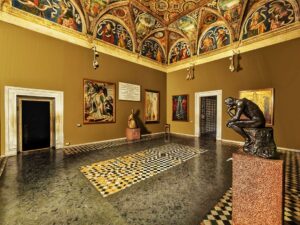
The Borgia Apartment itself, where approximately 500 pieces by 250 artists are displayed, was the private residential apartment of Pope Alexander VI Borgia, who reigned from 1492 to 1503 and who commissioned the frescoed decoration of the apartment from the Umbrian painter Bernardino di Betto, known as Pinturicchio, between 1492 and 1494. The walls of the Borgia Apartment retain Pinturicchio’s 15th-century fresco program while simultaneously serving as display space for 20th-century works, creating a layered visual environment in which the Renaissance decorative scheme and the modern art collection coexist without physical alteration to either. This arrangement, unique among the Vatican’s museum spaces, places works by Francis Bacon, Salvador Dalí, and their contemporaries within rooms whose original 15th-century fresco ceilings and decorated walls were produced for one of the most controversial papal figures of the Italian Renaissance. This Religious Art Collection creates a unique dialogue between centuries.
Rooms dedicated to individual artists include the Matisse Room inaugurated in 2011, a room dedicated to Italian modernist sculptor Marino Marini, and a room housing the work of Italian painter Renato Guttuso in the collection’s eighth room. The Marini room was assembled primarily through donations by the sculptor’s wife Marina Marini, who gave multiple bronze works to the Vatican. The Marini holdings include a bronze crucifix catalogued as Crocifisso, a relief sculpture catalogued as Crocifissione, and a bronze bust of a juggler catalogued as Giocoliere.
The three works by Dalí in the collection include Angelic Passage, described in The American Magazine’s account of the collection as washed in iridescent green hues. Four watercolors by Chagall are held in the collection. Latin American representation includes Martyrdom of St. Esteban by Mexican muralist José Clemente Orozco and Dancing Warrior by Diego Rivera. According to the same source, the international scope of the displayed works and the variety of styles, including Cubist, Post-Impressionist, Expressionist, Surrealist, and abstract movements, makes the collection browseable despite what the same account acknowledges is the relative scarcity of major canonical masterworks relative to the Vatican’s other galleries.
Function and Use
The collection functions within the Vatican Museums as the final major gallery encountered by visitors on the standard one-way route through the complex, positioned between the Gallery of Maps and the Sistine Chapel. Visitors exit the Gallery of Maps and pass through the collection’s rooms before entering the Sistine Chapel, making the modern art gallery the immediate precursor to Michelangelo’s ceiling and Last Judgment fresco. According to The American Magazine’s account, this positioning means that visitors fatigued by several hours of transit through the museum’s preceding galleries frequently bypass the modern collection without meaningful engagement, drawn directly toward the Sistine Chapel. The Vatican Museums’ institutional documentation describes the route as passing from the Borgia Apartment up to the Sistine Chapel.
The collection’s institutional function extends beyond display. It operationalizes the theological and cultural argument articulated by Paul VI in his 1964 Sistine Chapel address: that the Catholic Church required contemporary art as a vehicle for communicating spiritual truths to modern audiences in the same way that Renaissance and Baroque patronage had communicated them to earlier generations. According to Paul VI’s homily as recorded in Vatican institutional records, the pope stated that if the Church were deprived of the assistance of artists, its ministry would become faltering and uncertain, acknowledging that artistic expression was not peripheral but constitutive of the Church’s capacity to address the world. The collection exists as the institutional response to this claim, assembling evidence across 55 rooms that the dialogue between contemporary art and Catholic spiritual themes was not only possible but already actively underway. This Religious Art Collection serves as institutional proof of that sacred dialogue.
Cultural Context of the Collection of Modern and Contemporary Religious Art
The founding of the collection in 1973 took place during a period of significant internal Catholic institutional change initiated by the Second Vatican Council, convened by Pope John XXIII in October 1962 and concluded under Paul VI in December 1965. Vatican II, as the council is commonly designated, produced a set of documents addressing the relationship between the Catholic Church and modern culture. The council’s constitution Gaudium et Spes, issued in December 1965, addressed the Church’s relationship to contemporary society and included explicit affirmation of the value of art, including modern art, as an instrument of human culture and spiritual expression. This doctrinal context provided the formal theological foundation for Paul VI’s subsequent initiative to bring contemporary art into the Vatican through the collection.
Paul VI had personal and longstanding interests in modern art that preceded his pontificate. As Archbishop of Milan from 1954 to 1963, he had cultivated relationships with Italian and international artists and had developed a theological framework for understanding modern art as a legitimate, if sometimes difficult, arena of spiritual engagement. His election as pope in June 1963, during the Second Vatican Council, brought this framework into the governance of the Church at its highest level and made the assembly of a modern art collection a papal priority from early in his pontificate. This Religious Art Collection reflects Paul VI’s lifelong commitment to sacred art.
The decision to house the collection in the Borgia Apartment of Alexander VI carried implicit historical commentary. Alexander VI, born Rodrigo de Lanzol i de Borja in 1431, occupied the papal throne during one of the most controversial periods in the history of the Renaissance papacy, his pontificate associated in historical accounts with nepotism, simony, political violence, and allegations of personal corruption. The use of his apartment to display contemporary art addressing themes of redemption, spiritual struggle, and modern religious experience created a layered institutional environment in which the modern collection’s themes were physically situated within the space most associated with the papacy’s historically contested relationship to the spiritual ideals it claimed to represent.
The November 2009 gathering of 260 international artists in the Sistine Chapel convened by Pope Benedict XVI, documented in Vatican News accounts and referencing institutions including the Iraqi-born architect Zaha Hadid and Japanese artist Kengiro Azuma among the attendees, repeated Paul VI’s 1964 gathering in form and intent, re-affirming that the institutional dialogue initiated in 1964 continued as official Vatican policy through successive pontificates. Pope Francis followed this pattern with a meeting of artists in the Sistine Chapel in June 2023 to mark the collection’s 50th anniversary. Each papal gathering reaffirmed the importance of this Religious Art Collection.
Discovery and Preservation
The collection’s assembly did not follow the archaeological or purchase-based acquisition model of the Vatican’s older museums but was built almost entirely through a ten-year campaign of diplomatic outreach and correspondence conducted by Msgr. Pasquale Macchi following Paul VI’s 1964 Sistine Chapel address. Macchi contacted artists, their estates, private collectors, and institutional donors across Europe and the Americas, presenting each the opportunity to donate works with spiritual or religious content to the Vatican collection. This approach produced a collection whose provenance is characterized by voluntary donation rather than purchase, confiscation, or excavation, making it structurally distinct from every other major collection in the Vatican Museums. The majority of the works entered the Vatican as gifts, with their donors motivated by varying combinations of personal religious belief, institutional prestige, artistic recognition, and in some cases direct personal relationships with Paul VI or Macchi.
The initial 1973 collection consisted of approximately 1,000 works, according to the Patrons of the Arts in the Vatican Museums. By the time of the collection’s 50th anniversary in June 2023, the total had grown to approximately 9,000 works, an increase of approximately nine times the founding collection over five decades, documenting the continuous expansion of the collection through subsequent donations and acquisitions under Paul VI’s successors. This Religious Art Collection grew from 1,000 to 9,000 works over 50 years.
The Matisse Room, inaugurated in June 2011, represents the most significant single addition to the collection after its founding. The decision by Pierre Matisse in 1980 to donate the Vence Chapel preparatory materials to the Vatican followed his father’s own stated preference: Matisse had expressed to his son that he wished the preparatory sketches to be donated to a museum after completion of the chapel, so that the drawings and the stained glass windows would not remain in the same place. The collection entered Vatican custody in 1980 but remained in storage for 31 years due to the absence of adequate space and the technical requirements of displaying works of the delicate nature of the cut-paper cartoons. According to the Archdiocese of Baltimore’s reporting on the 2011 inauguration, Vatican Museums laboratories developed high-technology air conditioning and lighting systems specifically designed to create the proper protective environment for the Matisse materials, and the project was supported by the Côte d’Azur and Principality of Monaco chapter of the Patrons of the Arts in the Vatican Museums. The restoration of the Matisse Virgin and Child painting within the collection was funded by the California chapter of the Patrons of the Vatican Museums in 2002. Major donors have helped expand this Religious Art Collection significantly.
Why the Collection of Modern and Contemporary Religious Art Matters Today
The Collection of Modern and Contemporary Religious Art represents the only institutional initiative in the history of the Catholic Church to systematically assemble contemporary art from across the major international art movements of the 20th century within a papal museum, documenting through approximately 9,000 works by 250 international artists the capacity of Surrealist, Expressionist, Cubist, and Post-Impressionist art to engage with sacred and spiritual themes in forms legible to Catholic theological interpretation. The collection’s founding process, directed through approximately ten years of correspondence and outreach by Msgr. Pasquale Macchi following Paul VI’s 1964 Sistine Chapel address, established a model of collection-building through voluntary artist and collector donation that produced a provenance structure fundamentally different from every other major Vatican collection, with no work acquired through purchase, excavation, confiscation, or treaty, a distinction that has insulated the collection from the repatriation disputes that affect older Vatican holdings. The Matisse Room, assembling the full preparatory program of Henri Matisse’s Chapel of the Rosary at Vence including three full-scale cartoons each exceeding 5 meters in height, a drawing of the Virgin and Child, five silk chasubles, and bronze altar objects, constitutes the only institutional collection in the world dedicated to the complete documented design process of Matisse’s final and self-described most important work, donated in 1980 and displayed from 2011. According to Vatican News’s account of the collection’s 50th anniversary in 2023, the ongoing proposal by the Patrons of the Vatican Museums to intermingle modern and contemporary works with the collections of the older Vatican departments, if implemented, would extend the institutional dialogue between ancient, Renaissance, and modern art beyond the collection’s current 55-room perimeter into the broader fabric of the Vatican Museums as a whole. This Religious Art Collection remains the only institutional collection of its kind worldwide.
No other Religious Art Collection documents 20th century sacred art so comprehensively. This Religious Art Collection stands as a permanent monument to sacred creativity.
https://wikiflo.com/the-remarkable-champa-sculptures-of-vietnam-5th-to-15th-century-collection/
[…] https://wikiflo.com/remarkable-religious-art-collection-vatican/ […]