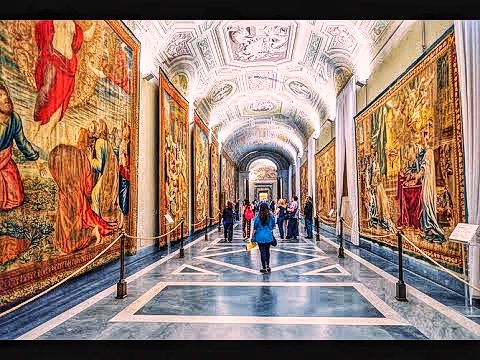
A corridor measuring approximately 75 meters in length, located on the third floor of the Belvedere wing of the Vatican Apostolic Palace between the Gallery of Candelabra and the Gallery of Maps, houses two distinct cycles of Flemish and Roman tapestries mounted on opposing walls, accompanied by a barrel-vaulted ceiling decorated with trompe l’oeil frescoes painted between 1788 and 1789. The gallery in its current single-room configuration was established at the direction of Pope Pius VII Chiaramonti, who reigned from 1800 to 1823. The principal cycle, designated the Scuola Nuova, or New School, consists of eleven surviving tapestries from an original set of twelve, woven between 1524 and 1531 in the Brussels workshop of master-weaver Pieter van Edingen van Aelst at a total documented cost of 20,750 ducats, described in contemporary accounts as an amount equivalent to approximately 560 years of wages for a skilled artisan of the period. The cartoons for the Scuola Nuova series were produced by pupils of Raphael, principally Giulio Romano and Gianfrancesco Penni, working from drawings and compositional ideas left by Raphael before his death on 6 April 1520. Each tapestry in the Scuola Nuova series stands 5.11 meters in height including the woven border friezes on three sides, with border friezes measuring 80 centimeters in width. The opposing wall displays eight tapestries produced between 1663 and 1679 at the Barberini workshop in Rome, depicting scenes from the life and pontificate of Pope Urban VIII Barberini, who reigned from 1623 to 1644. The Scuola Nuova tapestries were first exhibited in the Sistine Chapel and subsequently transferred to the Gallery of Tapestries in 1838, where they have remained on permanent display. The gallery is currently accessible to the public as part of the standard Vatican Museums admission, which as of 2025 costs 20 euros for adults, with reduced rates for children and students.
Gallery of Tapestries Material and Craftsmanship
The Scuola Nuova tapestries were woven using wool, silk, and gold and silver thread, a combination of materials that places them at the most expensive end of the technical spectrum available to 16th-century Flemish workshops. Wool formed the structural warp and provided the body of each tapestry, while silk thread was used in areas requiring smooth surface transitions, fine facial modeling, and subtle color gradation. Gold and silver thread, produced by wrapping thin strips of precious metal around a silk or linen core, was woven into areas of garments, decorative borders, and architectural details, creating reflective surfaces that changed in appearance as ambient light conditions shifted. The two Roman weavers Angelo da Cremona and Joanne Lengles de Calais, who inspected the completed Scuola Nuova series on behalf of the papal commission in 1531, certified them in writing as being well and faithfully made, and described the series as more intricate and richer in gold and silk than the earlier Acts of the Apostles tapestries woven by the same workshop for Pope Leo X between 1515 and 1519.
The woven border friezes surrounding each tapestry on three sides, absent from the top edge where a canopy was placed in ceremonial display settings, are decorated with coats of arms, mythological figures, and decorative motifs consistent with the high-border tapestry convention established in Flemish luxury weaving of the late 15th and early 16th centuries. The borders of the Scuola Nuova series carry the coat of arms of Pope Clement VII, under whose papacy the series was commissioned and completed, a falcon appears at the center of the lower horizontal border. The borders themselves are, according to contemporary accounts, richer in their decorative program than comparably bordered tapestries of the same school and period.
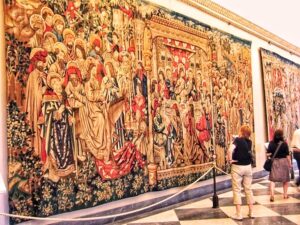
The Barberini tapestries on the opposite wall were produced approximately 130 years after the Scuola Nuova by a Roman workshop founded in 1627 by Cardinal Francesco Barberini, nephew of Pope Urban VIII, in the Monumental Complex of Sant’Angelo a Ripa Grande near the Porta Portese in Rome. The Barberini workshop represented the only significant Italian challenge to Flemish dominance in luxury tapestry production during the 17th century. Three tapestries from the opening portion of the Barberini series, produced between 1664 and 1666, were designed by the painter and architect Antonio Gherardi of Rieti, who worked under the influence of Pietro da Cortona. The stylistic contrast between the two cycles is substantial, the Scuola Nuova representing the late Italian High Renaissance approaching Mannerism, and the Barberini series reflecting a more ceremonial and formally rigid Baroque aesthetic.
Gallery of Tapestries Form and Features
The Scuola Nuova series is divided into two thematic groups of six tapestries each. The first group depicts episodes from the Infancy of Christ, encompassing the Adoration of the Shepherds, the Adoration of the Magi, the Presentation in the Temple, the Massacre of the Innocents in two separate panels depicting the scene as taking place inside and outside the city respectively, and the Flight into Egypt. The second group depicts episodes following the Resurrection of Christ, encompassing the Resurrection, the Noli Me Tangere, the Supper at Emmaus, the Miraculous Draught of Fishes as a typological episode, and additional scenes from the post-Resurrection narratives. Of the original twelve tapestries, eleven survive in the Vatican collections. Nine are displayed in the gallery at any given time, with the remaining tapestries held in reserve due to conservation requirements or rotation.
The Resurrection of Christ tapestry is the most discussed individual panel in the Scuola Nuova series. The figure of Christ is depicted standing upright on the stone that sealed the tomb, his right hand raised in the three-fingered gesture of the Trinity. The weavers incorporated an optical effect into the rendering of Christ’s eyes, achieved through the precise placement of highlight threads at an angle relative to the viewing position, such that the eyes appear to follow the viewer as they walk along the gallery. This optical illusion, produced through deliberate technical calculation in the weaving rather than through any subsequent addition or alteration, is the single most frequently noted feature of the gallery by institutional guides and visitor accounts.
The Massacre of the Innocents panels are among the most compositionally complex in the series. They depict soldiers seizing infants from their mothers with high levels of figural density and emotional intensity, with crowds of figures rendered at multiple spatial depths across the picture plane. The compositional complexity of these panels required the weaving team to maintain consistent thread counts and color sequences across exceptionally intricate figural arrangements, representing some of the most technically demanding sections of the entire commission.
A small fragment of one of the original cartoons used to produce the Scuola Nuova tapestries survives and is displayed within the gallery. The fragment depicts the face of a terrified young woman, a detail likely from the Massacre of the Innocents cartoon. It is one of the very few surviving physical remains of the working cartoons for the series, which were not preserved intact after the weaving was completed. According to research published in the Brussels City Museum’s academic journal, the cartoons were collected after completion by the Dutch artist Govert Flinck between approximately 1615 and 1660, who subsequently cut them into smaller fragments. The Ashmolean Museum in Oxford holds eighteen fragments identified by their collectors’ marks as originating from the Scuola Nuova cartoons.
The Barberini tapestries on the right wall number eight and depict episodes from the life and career of Maffeo Barberini before and during his pontificate as Urban VIII. Individual panels include Maffeo Barberini graduating at the University of Pisa, Barberini regulating the outflow of Lake Trasimeno, his appointment as cardinal by Pope Paul V Borghese, the construction of the fort of Castel Franco Emilia between 1628 and 1634 to defend the borders of the Papal States, and Urban VIII preserving Rome from plague and famine. These tapestries were commissioned by Cardinal Francesco Barberini in honor of his uncle’s memory following Urban VIII’s death in 1644.
Function and Use
The Scuola Nuova tapestries were originally intended for use in the consistories, the formal meetings of the College of Cardinals convened by the pope at Christmas and Easter, according to Vatican inventory records cited in the Brussels City Museum’s academic journal on the cartoons. Their irregular dimensions, varying between panels, indicate that they were designed for a specific interior space within the Vatican whose precise identification remains debated, with the irregular widths suggesting the tapestries were produced to fit around fixed architectural elements such as doors or pilasters. The full series of twelve tapestries was too large in total extent to hang simultaneously in any single identified consistorial space, suggesting that the set was displayed in rotating groups of six, with each group hung for the duration of one of the major liturgical seasons.
The use of tapestries in formal ecclesiastical interior decoration served both aesthetic and practical functions simultaneously. Tapestries insulated stone-walled rooms against cold and dampness, absorbing heat from braziers and fireplaces that would otherwise dissipate through cold stone surfaces. In the Sistine Chapel, where the tapestries were first displayed in 1519, the lower register of the walls had been designed to receive decorative hangings when the chapel was built under Pope Sixtus IV in the 1480s, with the fresco cycles of the 15th-century masters occupying the middle register above and Michelangelo’s ceiling occupying the vault above that. The tapestries were intended from the beginning of the Sistine Chapel’s construction to occupy this lower zone, completing the decorative program of all three registers of the chapel’s wall surfaces.
The Barberini tapestries served a different function from the Scuola Nuova series, functioning as monuments of papal commemoration and family glorification rather than liturgical decoration. Their depiction of Urban VIII’s secular career, civic achievements, and administrative accomplishments alongside his ecclesiastical offices presented a complete portrait of the pontificate for posterity.
Cultural Context
The commission of the Scuola Nuova series by Pope Clement VII took place in the period immediately following one of the most catastrophic events in the history of Renaissance Rome. The Sack of Rome, carried out by the unpaid troops of Emperor Charles V between May and August 1527, devastated the city, killed or drove out much of its population, destroyed enormous quantities of artworks and manuscripts, and effectively ended the Roman High Renaissance as a period of sustained artistic production. Clement VII was imprisoned in the Castel Sant’Angelo for several months during and after the sack. The commission of the Scuola Nuova tapestries, which were ordered in 1524 before the sack and delivered in 1531 after the city had partially recovered, represents a continuity of papal artistic patronage across this rupture. The tapestries arrived in Rome as a signal that the papacy retained the institutional capacity and financial resources to commission works of the highest luxury standard, despite the catastrophe of 1527.
The relationship between the Scuola Nuova and the earlier Acts of the Apostles series, known as the Scuola Vecchia or Old School, which was designed by Raphael during his lifetime for Pope Leo X between 1515 and 1519 and is displayed in the Pinacoteca Vaticana, defines the institutional context within which the Scuola Nuova was conceived. The Scuola Vecchia cartoons were sent to Brussels in 1515 or 1516, woven in Pieter van Aelst’s workshop, and first displayed in the Sistine Chapel on 26 December 1519. Their enormous critical success established van Aelst as the most prestigious tapestry weaver working for the papal court and secured his workshop the subsequent Scuola Nuova commission. The original Scuola Vecchia cartoons, seven of which were purchased by King Charles I of England in 1623, are now held at the Victoria and Albert Museum in London, where they were placed on permanent loan by the British Royal Collection in 1865 and where they remain as the most important surviving examples of Raphael’s large-scale design work.
According to Apollo Magazine’s 2020 review of the temporary rehinging of the Scuola Vecchia tapestries in the Sistine Chapel to mark the 500th anniversary of Raphael’s death, the cost of the Scuola Vecchia tapestries was, according to one contemporary account, five times the amount Michelangelo received for painting the Sistine Chapel ceiling, reflecting the premium placed by 16th-century patrons on luxury textile production relative to painted decoration.
Discovery and Preservation
The preservation history of the tapestries in the Gallery of Tapestries is defined by two major episodes of confiscation, each followed by eventual recovery, which together produced the most turbulent documented custody history of any textile collection in the Vatican Museums.
During the Sack of Rome in May 1527, the Scuola Vecchia tapestries that had been displayed in the Sistine Chapel since 1519 were stolen by the invading troops. Some panels were seized by pirates, others were reportedly melted down to recover the silver and gold thread woven into their surfaces. Scholar John Shearman argued, according to Apollo Magazine’s 2020 account, that all but two panels, the Conversion of Saul and Paul Preaching at Athens, had been recovered by the 1530s, with the Conversion of the Proconsul recovered only as a fragment. Missing panels were subsequently replaced through additional weavings produced from the original cartoons, which had remained in Brussels. The Scuola Nuova tapestries, commissioned after the sack and delivered in 1531, remained in Vatican custody without comparable disruption until the late 18th century.
In 1797, during Napoleon Bonaparte‘s Italian campaign, French troops confiscated numerous artworks and objects from Roman collections under the terms of the Treaty of Tolentino, signed by Pope Pius VI. The Scuola Nuova tapestries were among the objects taken to Paris. When the French occupied Rome again in 1798, the tapestries were removed and transported northward. According to multiple institutional sources, the tapestries were eventually acquired by a Genoese dealer, from whom Pope Pius VII purchased them back in 1808 for an undisclosed sum. Their return to Vatican custody after this purchase restored them to Rome before the broader recovery of Vatican artworks negotiated by Antonio Canova under the Treaty of Paris in 1815 following Napoleon’s defeat.
The ceiling of the gallery was decorated between 1788 and 1789 under the pontificate of Pius VI by the Lucca-born figurative painter Bernardino Nocchi, assisted by Domenico Del Frate for painted scenes and figures, and by the ornamental painter Antonio Marini for decorative elements. The ceiling program, conceived as an allegory celebrating the virtues and achievements of Pius VI, depicts Roman imperial precedents for enlightened rule, including the Clemency of Titus at the center of the vault, flanked by the Peace of Marcus Aurelius in the East, and the figure of Antoninus Pius praised by the sages of his time for his goodness and compared to the legendary king Numa Pompilius. The central portion of the ceiling carries Pius VI’s coat of arms supported by the personifications of Architecture, Painting, and Sculpture. The trompe l’oeil technique of the ceiling, creating the visual illusion of three-dimensional sculptural forms and spatial depth within a flat painted surface, is described in visitor literature as one of the more technically accomplished examples of late 18th-century decorative fresco painting in the Vatican.
Why It Matters
The Scuola Nuova tapestries of the Gallery of Tapestries document the most expensive single decorative textile commission of the Italian Renaissance period, at a total cost of 20,750 ducats certified by two independent Roman assessors in 1531 as having been faithfully executed and surpassing in richness and complexity the earlier Acts of the Apostles series that had established the international reputation of Pieter van Aelst’s Brussels workshop. The series preserves the compositional legacy of Raphael across the full program of both his Infancy of Christ and post-Resurrection scenes through the interpretive work of his closest pupils, Giulio Romano and Gianfrancesco Penni, whose cartoon designs translated Raphael’s surviving drawings and documented compositional ideas into a complete monumental textile cycle after his death in 1520. The survival of a fragment of one of the original Scuola Nuova cartoons within the gallery, alongside eighteen further cartoon fragments identified at the Ashmolean Museum in Oxford and documented in the Brussels City Museum’s academic journal, provides the primary physical evidence for the design process and working methods of the Raphael workshop in the posthumous continuation of the master’s decorative commissions. The tapestries’ two episodes of confiscation during the Sack of Rome in 1527 and during Napoleon’s Italian campaign in 1797 to 1798, followed in the latter case by their purchase from a Genoese dealer by Pope Pius VII in 1808, constitute one of the most extensively documented cases of the repeated disruption, dispersal, and recovery of a single ecclesiastical textile collection across three centuries of European political upheaval.
https://wikiflo.com/do-maru-samurai-armor/
[…] Gallery of Tapestries: Vatican’s Most Famous Medieval Art Collection […]