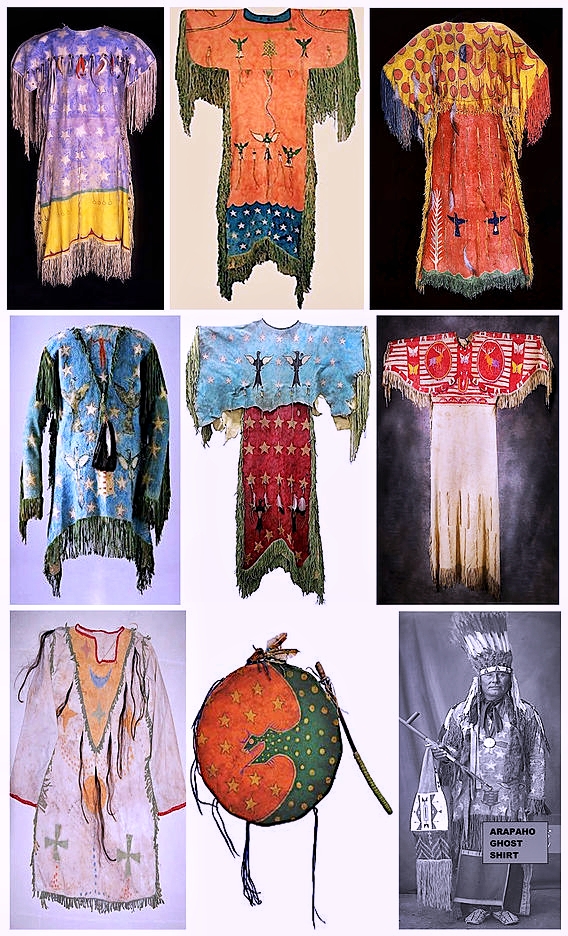
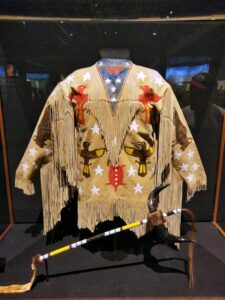
Buckskin and muslin garments measuring approximately 60 to 90 centimeters in length, decorated with painted symbols including stars, eagles, buffalo, crescents, and geometric patterns, were worn by Lakota Sioux participants in the Ghost Dance religious movement between 1889 and 1890. The shirts originated from teachings attributed to Chief Kicking Bear, who introduced the concept to Lakota bands around 1890 as an elaboration of Northern Paiute prophet Wovoka’s Ghost Dance vision received during the January 1, 1889 solar eclipse. Wovoka’s original teachings emphasized peaceful coexistence and spiritual renewal through circle dancing, but Lakota interpretation incorporated belief that the painted shirts provided spiritual protection against bullets and physical harm. The garments were constructed from white or natural-colored cloth, either animal hide or commercially available muslin, painted during sacred rituals with mineral pigments and personal vision symbols believed to channel wakan, the Lakota concept of sacred mystery. Between 150 and 300 Lakota wearing ghost shirts were killed on December 29, 1890, during the Wounded Knee Massacre when U.S. Seventh Cavalry troops opened fire on Big Foot’s band near Wounded Knee Creek, South Dakota, definitively disproving the shirts’ protective claims and effectively ending the Ghost Dance movement among Plains tribes. Surviving examples are held by the Smithsonian Institution’s National Museum of Natural History catalogued as E358273-0 and other institutions, while Glasgow City Council repatriated one shirt to the Lakota in 1998, and contemporary scholarship debates whether these objects should be classified as religious artifacts requiring restricted access or historical material culture appropriate for public display and study.
Lakota Ghost Dance Shirts Material and Craftsmanship
The shirts employed two primary materials: buckskin prepared from deer or elk hides through traditional tanning processes, and white muslin cloth acquired through trade or government ration distribution. Buckskin shirts required extensive preparation including hide scraping, brain tanning to soften fibers, and smoking to prevent water damage. Muslin shirts, more common due to material availability on reservations, were constructed from commercially woven cotton fabric distributed by Indian agents as part of government provision programs.
Construction followed traditional Plains garment patterns with minimal tailoring. Buckskin versions featured two hide panels joined at shoulders and sides with sinew stitching, leaving openings for head and arms. Sleeves were either attached separately or formed from the hide’s natural shape. Muslin versions employed similar patterns executed with commercially available thread and needles. The garments hung loosely over the torso, typically extending to mid-thigh length.
Decoration occurred through painting rather than quillwork or beadwork traditional to earlier Lakota clothing. Mineral pigments including ochres for reds and yellows, charcoal for black, and kaolin for white were ground into powder and mixed with water or animal fat as binding medium. Some shirts incorporated commercial paints when available. Application occurred with brushes fashioned from plant fibers or commercially acquired implements.
The symbolic content varied by individual, reflecting personal visions experienced during Ghost Dance ceremonies. Common motifs included five-pointed stars representing celestial power, eagles symbolizing spiritual strength and connection to the Creator, buffalo representing renewal of traditional lifeways and return of plentiful herds, crescents referencing the moon’s cyclical renewal, and geometric patterns including crosses and circles with cosmological significance. The placement and combination of symbols followed vision instructions received during trance states induced by continuous dancing and fasting during multi-day ceremonies.
Fringe decorations appeared on some examples, cut from the garment’s lower edges or sleeves. Paint sometimes extended onto the fringe elements. The absence of metal ornaments, glass beads, or other trade materials on most surviving examples suggests deliberate choice to emphasize indigenous materials and spiritual purity over decorative elaboration.
Form and Features
The shirts displayed relatively uniform basic construction while individual decoration created unique examples. The loose-fitting silhouette allowed freedom of movement during dancing, which involved participants holding hands in large circles moving in a clockwise direction while singing Ghost Dance songs. The white or natural color held symbolic significance representing spiritual purity and the new earth prophesied to emerge following the cataclysm that would remove European Americans.
Painted symbols covered varying amounts of surface area. Some shirts featured dense decoration filling most available space, while others displayed minimal symbolic elements against plain backgrounds. The distribution patterns often emphasized the chest, back, and shoulder areas most visible to other participants during ceremonies. Sleeve decoration tended toward geometric patterns or repeated smaller motifs rather than large pictorial elements.
The star motifs typically appeared as five-pointed forms rendered with angular rather than curved lines, reflecting the difficulty of creating smooth curves with available painting tools. Size varied from approximately 5 to 15 centimeters diameter. Stars often appeared in clusters suggesting constellations or distributed across the garment representing celestial realms.
Eagle representations ranged from highly schematic to relatively naturalistic depending on the painter’s skill and vision specificity. Some showed only essential identifying features including curved beaks and wing outlines, while others included feather details and anatomically accurate proportions. Eagles typically appeared in profile view with wings extended, though frontal representations also occurred.
Buffalo images similarly varied in detail level. Some showed complete animal profiles including horns, humped shoulders, and characteristic stance, while others reduced the buffalo to essential curved outline suggesting the species without detailed rendering. The buffalo’s symbolic importance to Lakota culture, representing both physical sustenance and spiritual power, made it among the most frequently depicted subjects.
Geometric elements including crosses, circles, rectangles, and diagonal lines created borders, divided compositional spaces, or stood as independent symbols. The four-pointed cross referenced the four cardinal directions and winds fundamental to Plains cosmology. Circles represented the sacred hoop of the world and the continuous cycle of life. These abstract elements often combined with representational imagery in complex compositional arrangements.
Text inscriptions occasionally appeared on shirts, though the predominantly oral nature of Lakota culture made written elements uncommon. When present, text might include the wearer’s name, the date, or brief phrases in English or Lakota.
The shirts showed no standardized form of blessing or consecration marks distinguishing them from ordinary clothing beyond the painted symbols themselves. The transformation from mundane garment to sacred object occurred through the ritual context of their creation and use rather than through any particular construction technique or material property.
Function and Use
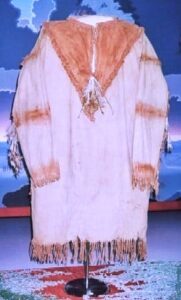
The shirts functioned within the Ghost Dance religious movement as vehicles for spiritual power believed to protect wearers from harm. This protection extended beyond physical danger to include spiritual threats, with the shirts acting as barriers against malevolent forces. The belief in bullet-proof properties, while historically the most discussed aspect, represented only one dimension of a broader protective function.
Participants wore the shirts during Ghost Dance ceremonies conducted at reservations including Pine Ridge and Rosebud in South Dakota during 1889 and 1890. The dances occurred at intervals prescribed by Wovoka’s teachings, typically lasting multiple days and involving hundreds of participants forming concentric circles around a central pole or individual leading the ceremony. Dancers moved in clockwise direction while singing songs received in visions, often achieving trance states described as death-like where they claimed to visit deceased relatives and preview the renewed world prophesied to emerge.
The shirts’ creation involved ritual preparation. The painting occurred during sacred ceremonies with prayers and songs accompanying each symbol’s application. The process transformed mundane cloth into spiritually charged objects believed to embody supernatural power. This transformation paralleled other Plains traditions including the blessing of war shields and medicine bundles, extending established religious practices into new forms addressing contemporary crises.
U.S. government agents and military officials interpreted the shirts as evidence of hostile intent. Agent James McLaughlin at Standing Rock Agency reported that Ghost Dance participants claimed the shirts made them invulnerable to soldiers’ bullets, interpreting this as preparation for armed uprising. These reports, combined with the large gatherings of Lakota performing the dances, generated alarm among government officials who had spent decades attempting to eliminate indigenous religious practices and compel cultural assimilation.
The shirts’ failure to provide physical protection at Wounded Knee definitively contradicted the protective claims. Survivors reported that many dancers wearing ghost shirts fell under gunfire from Seventh Cavalry troops’ rifles and four Hotchkiss guns firing explosive shells. Black Elk, present at the massacre, later recalled seeing “butchered women and children lying heaped and scattered all along the crooked gulch,” many still wearing their ghost shirts. This empirical disconfirmation ended belief in the shirts’ bullet-proof properties and contributed to the Ghost Dance movement’s rapid decline following the massacre.
After Wounded Knee, surviving shirts became historical artifacts rather than active religious objects. Some remained in family possession, while others were collected by soldiers, Indian agents, or anthropologists including James Mooney, who conducted systematic documentation of the Ghost Dance for the Smithsonian Institution’s Bureau of American Ethnology. These collecting activities occurred during a period when prevailing attitudes viewed indigenous cultures as vanishing remnants requiring preservation through museum acquisition rather than as living traditions warranting respect and autonomy.
Cultural Context
The Ghost Dance emerged during the reservation period following the Lakota’s military defeat and confinement to restricted territories under the 1868 Fort Laramie Treaty and subsequent reductions including the 1889 land cession that divided the Great Sioux Reservation into smaller units. The buffalo herds that had sustained Plains economies were exterminated through systematic hunting campaigns, with an estimated 30 to 60 million animals reduced to fewer than 1,000 by 1889. Government ration distributions provided inadequate nutrition, and drought conditions during 1889 and 1890 caused crop failures for Lakota attempting to adopt agriculture as mandated by assimilation policies.
These conditions created receptivity to Wovoka’s message promising supernatural intervention reversing these catastrophes. Emissaries including Good Thunder, Yellow Bird, and others traveled to Nevada to meet Wovoka in late 1889, returning with teachings adapted to Lakota theological frameworks. The Lakota interpretation emphasized the removal of white settlers and return of buffalo rather than Wovoka’s original emphasis on peaceful coexistence, reflecting the more confrontational relationship between Lakota and U.S. authorities compared to the Northern Paiute context.
The Ghost Dance represented a form of religious revitalization, a phenomenon documented by anthropologists studying societies under extreme stress who develop new religious movements promising restoration of traditional lifeways through supernatural means. Similar movements occurred among other colonized peoples worldwide, demonstrating common patterns of religious innovation as responses to cultural disruption and political subordination.
U.S. Indian policy during this period actively suppressed indigenous religious practices. The 1883 Code of Indian Offenses criminalized ceremonies including the Sun Dance, give-away ceremonies, and plural marriage. Indian agents held authority to imprison individuals participating in prohibited activities. The Ghost Dance’s emergence directly challenged these prohibitions, creating confrontation between Lakota assertions of religious autonomy and government demands for cultural conformity.
The assassination of Sitting Bull on December 15, 1890, during an arrest attempt by Indian police at Standing Rock Reservation intensified tensions. Sitting Bull had permitted Ghost Dancing on his land despite agent demands to prohibit it. His death triggered flight by some Lakota fearing further arrests, including Big Foot’s band which was intercepted by cavalry troops leading to the Wounded Knee confrontation.
Discovery and Preservation
James Mooney, ethnologist employed by the Smithsonian’s Bureau of American Ethnology, conducted fieldwork among Ghost Dance participants during 1890 and 1891, documenting the movement through interviews, observations, and artifact collection. His 1896 publication “The Ghost-Dance Religion and the Sioux Outbreak of 1890” provided the first scholarly documentation. Mooney commissioned Ute artist Yellow Nose to create paintings depicting Ghost Dance ceremonies, now held by the Smithsonian.
The Smithsonian acquired multiple ghost shirts through Mooney’s collecting activities and subsequent donations. Specimen E358273-0, an Arapaho buckskin example, demonstrates construction and decoration typical of the tradition. The institution’s holdings document regional variations across tribes that adopted the Ghost Dance, including Arapaho, Cheyenne, and Lakota examples.
Military personnel collected shirts from Wounded Knee’s aftermath. Officers and enlisted men took items from the battlefield as trophies, a practice common following conflicts with Native Americans. Some shirts entered private collections, others were donated to museums, and some remained in family possession for generations before surfacing in auctions or institutional acquisitions.
Glasgow City Council in Scotland held a ghost shirt acquired during the late 19th century, possibly through William “Buffalo Bill” Cody’s Wild West Show which toured Europe and employed Lakota performers including survivors of Wounded Knee. Following decades of requests from Lakota representatives, the council voted in 1998 to return the shirt, making it among the first repatriations of Ghost Dance materials to tribal authorities.
The 1990 Native American Graves Protection and Repatriation Act created legal frameworks requiring federally funded institutions to inventory culturally sensitive items and consult with tribes regarding repatriation. Ghost Dance shirts occupied ambiguous status under NAGPRA’s categories, as they were neither funerary objects nor items with ongoing ceremonial use after the movement’s end. However, their sacred character and association with the Wounded Knee Massacre prompted some institutions to implement restricted access policies and consultation protocols with Lakota representatives regarding display and research.
Contemporary debates address appropriate treatment of these objects. Some Lakota leaders request that ghost shirts not be photographed or displayed publicly, viewing them as sacred items requiring respectful treatment similar to Christian religious artifacts. Others accept museum display as educational opportunity documenting historical trauma and resistance. These diverse perspectives reflect broader discussions within Native American communities about museum relationships, cultural property rights, and competing approaches to heritage preservation.
Conservation challenges include deterioration of organic materials including buckskin, muslin, and paint. Environmental factors including light exposure, humidity fluctuations, and insect damage threaten long-term preservation. Institutions holding examples have implemented climate-controlled storage and limited display durations to slow deterioration while maintaining some public access.
Why It Matters
Lakota Ghost Dance shirts document religious innovation during reservation period crisis when systematic destruction of indigenous lifeways prompted spiritual responses promising supernatural intervention reversing catastrophic changes through ceremonial practice. The shirts exemplify revitalization movements occurring across colonized societies worldwide where religious innovation addresses political powerlessness through supernatural frameworks promising restoration of disrupted social orders. The tragic failure of protective claims at Wounded Knee demonstrates how desperate conditions generate beliefs contradicting physical reality while revealing the devastating consequences when military force crushes nonviolent religious movements. The objects raise ongoing questions about appropriate institutional treatment of sacred materials from living cultures, balancing educational value against indigenous requests for restricted access and repatriation. The shirts preserve material evidence of specific historical moment when Plains peoples attempted spiritual resistance to genocidal policies, documenting both indigenous agency and the violent suppression that destroyed these efforts. Contemporary debates regarding their display and ownership reflect broader reckonings with colonial-era collecting practices and institutional responsibilities toward objects acquired through circumstances of cultural disruption and asymmetric power relations.
https://wikiflo.com/hopi-kachina-dolls/
[…] Why Lakota Ghost Dance Shirts Were Believed to Stop Bullets […]