The Pawnee Morning Star Bundle is a sacred collection of ceremonial objects kept by a designated priest of the Skidi band of the Pawnee people, the Morning Star bundle served as the spiritual and material center of the only ceremony involving human sacrifice documented among Native North American Plains cultures north of Mexico. The bundle held a warrior’s costume used to dress the man designated to lead the raid for a captive, a war club used at the moment of sacrifice, tally sticks used by priests to count ceremonial songs, sacred arrows, paint materials, and other ritual objects whose full contents were documented by James R. Murie, a Skidi Pawnee ethnographer, between 1914 and 1921.
No standardized external dimensions apply to all examples, as the bundle was wrapped in hide and its size varied with its accumulated contents. The ceremony was practiced exclusively by a single village within the Skidi band, known as Village Across a Hill, located along the Loup River in present-day central Nebraska. The last documented Morning Star sacrifice took place on April 22, 1838, when a fifteen-year-old Lakota girl named Haxti was killed. The ceremony ended through a combination of internal opposition from Pawnee leaders and external pressure from United States Indian agents.
The Pawnee Nation of Oklahoma, headquartered in Pawnee, Oklahoma, has approximately 3,200 enrolled members today, reduced from a pre-contact population estimated above 60,000. The primary institutional holdings related to the Morning Star bundle and broader Skidi ceremonial material are at the Field Museum of Natural History in Chicago, which acquired approximately 400 Skidi ethnographic objects in 1906 under catalog accession numbers including Pawnee Sacred Bundle No. 71898, and at the American Museum of Natural History in New York, which holds additional Pawnee ceremonial material documented by Clark Wissler during fieldwork conducted between 1902 and 1905.
Pawnee Morning Star Bundle Material and Craftsmanship
The Morning Star bundle, like all Pawnee sacred bundles, was not a crafted object in the conventional sense. It was an assembled collection of materials whose power came from their ceremonial history and the spiritual protocols attached to them rather than from skill in manufacture.
The outer wrapping was tanned buffalo or deer hide, tied with sinew cord. Inside, the contents were arranged according to protocols transmitted orally from priest to priest across generations. The warrior’s costume inside the bundle included a specific set of garments and regalia that the raiding party leader wore before departing to capture a girl from an enemy village. These items were treated as charged with the power of the Morning Star and were not worn for any other purpose.
The war club kept in the bundle was the instrument used to strike the captive’s head at the moment of sacrifice, performed simultaneously with a sacred arrow shot through her heart from the Skull bundle, a separate but related ceremonial object. The tally sticks, a set of small counting implements, were laid down one by one as priests sang the long sequence of songs that, according to Murie’s documentation, symbolically transferred the captive’s identity from the human world to the realm of the gods. Each stick laid down represented one song completed and one step further from ordinary life. When the last stick was placed, the ceremony moved to its final stage.
Red paint, used to cover the right side of the captive’s body before the sacrifice, and black paint applied to the left side, were kept within the bundle materials. These colors replicated the appearance of Morning Star itself, red on its eastern-rising face and dark in its setting. The paint was not decorative but cosmological, marking the captive’s body as the physical representation of Evening Star within the ceremonial logic.
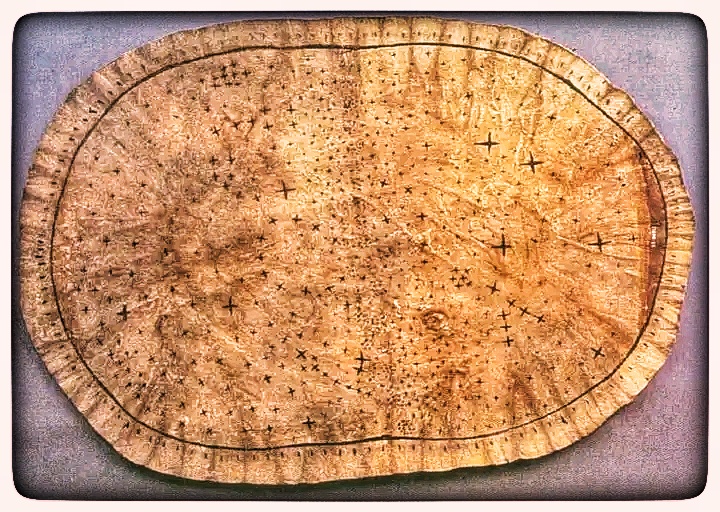
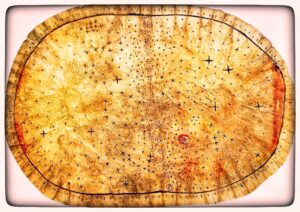
The Big Black Meteoric Star Bundle, a related but distinct bundle held at the Field Museum under catalog number 71898, contained a star chart made from soft leather measuring approximately 56 centimeters by 38 centimeters, decorated with painted stars representing the Skidi cosmological map of the heavens. Murie documented that this chart was kept inside a bag made from a buffalo scalp and had once been used to wrap a meteorite, which the Skidi believed was a fallen star god sent to Earth by Tirawahat. The chart is estimated to be between 100 and 300 years old at the time of its acquisition in 1906, meaning it was likely made between the early 1600s and the early 1800s.
Form and Features
The Morning Star bundle had no fixed visible form that communicated its identity to an outsider. When wrapped and bound it appeared as a hide package, no different in external appearance from other Pawnee bundles. Its identity was known through the oral knowledge of the priest who kept it and through the community’s understanding of which household held which ceremonial responsibility.
What distinguished the Morning Star bundle from other Pawnee bundles was not its exterior but the specific sequence of objects inside and the ceremonies those objects governed. The Pawnee maintained a system of roughly 25 to 30 sacred bundles distributed across Skidi villages, each one tied to a specific star, each governing specific ceremonies, and each kept by a hereditary priestly family. The Morning Star bundle governed the single most dramatic ceremony in the Skidi calendar. The Evening Star bundle, by contrast, governed the annual Spring Awakening ceremony, which marked the start of the agricultural year. The two bundles and the two stars they represented were understood as a matched pair, Morning Star male and eastern, Evening Star female and western, whose mythological union had produced the first human being.
The war club inside the bundle was the most physically distinctive single object. Its use was restricted entirely to the moment of sacrifice, making it an object without parallel function in daily life. Its presence in the bundle served as a constant reminder of the ceremony’s ultimate act.
Function and Use
The Morning Star ceremony was not a seasonal event tied to the annual calendar in the way most Pawnee ceremonies were. It could only begin when a man reported a dream in which Morning Star had appeared to him and commanded that a sacrifice be made. This made the ceremony irregular, occurring in some years and not others. Scholars estimate it happened roughly every few years rather than annually, and the documented historical record confirms multiple years between occurrences.
Once a man reported the dream, he went to the keeper of the Morning Star bundle and received the warrior’s costume stored inside. He then led a war party on a raid against an enemy village with one specific objective: capturing a girl of suitable age, typically between ten and eighteen years old. The raid ended as soon as a girl was taken. No further fighting was the goal. From the moment of her capture, the girl was treated well, fed properly, and kept comfortable. She was not told what was planned for her.
Back at the village, the captured girl was handed to the Morning Star priest, who took responsibility for her care and ritual preparation during the days leading up to the ceremony. She was dressed using items from the Morning Star bundle and anointed with red paint. A special guardian called the Wolf Man brought her to the war lodge each day as the preparatory ceremonies unfolded. A five-day sequence of rituals preceded the final sacrifice, with priests singing through a prescribed body of songs that moved the girl symbolically from the human world into the realm of the gods. Each song corresponded to a tally stick laid down from the bundle’s contents.
On the final morning, as Morning Star rose in the eastern sky, the entire village assembled outside. The girl was taken to a scaffold made of sacred woods and skins, built to represent Evening Star’s garden, the source of all plant and animal life in Skidi cosmology. She was tied spread-eagled to the scaffold. Priests sang the final songs. At the moment of her death, the man who had captured her shot a sacred arrow from the Skull bundle through her heart while another man struck her head with the war club from the Morning Star bundle. The right half of her body had been painted red and the left half black, marking her as the embodiment of Evening Star. Her blood was caught in dried meat held by her captor, then burned as a smoke offering to the gods. Every man and boy in the village then shot an arrow into her body, each one acting symbolically as Morning Star himself.
Anthropologist Ralph Linton, reviewing the evidence in the early 20th century, reported that Pawnee priests performed the ceremony somewhat reluctantly, treating it as an obligation inherited from tradition rather than an act of desire. The blood fertilizing the ground was understood to guarantee the success of that year’s corn harvest and the continuation of the universe as the Skidi understood it.
Cultural Context
The Pawnee are a Caddoan-speaking people who had lived along the Loup, Platte, and Republican rivers in present-day Nebraska for at least 700 years before European contact, with oral tradition asserting a much longer presence. Their population before contact was estimated at more than 60,000 across the four bands: the Skidi, the Chaui, the Kitkahaki, and the Pitahawirata. The Skidi, whose name translates as Wolf People, were the most astronomically oriented of the four bands and maintained the most elaborate star-based ceremonial system of any Great Plains people.
Skidi cosmology placed stars at the center of all things. Tirawahat, their creator god whose name translates roughly as the Universe and Everything Inside, was understood to govern through a hierarchy of star gods who planned and executed creation in the eastern sky and carried it out in the west. Morning Star, a red star identified in most sources as Mars though some early accounts cite Venus, was the primary male war god. Evening Star, bright and white in the west, was the primary female deity of life and fertility. Their mythological mating had produced the first human girl, who became the mother of all people. The Morning Star sacrifice reenacted this creation myth, with the captive girl representing Evening Star and the ceremony ensuring that the original creative force remained active in the world.
The earth lodges in which the Skidi lived were built according to cosmological principles, with the four central posts representing the four star gods who supported the sky, the east-facing entrance aligned to receive the first light of the spring equinox sun directly onto the altar inside, and the smoke hole acting as an astronomical observation point for timing ceremonies by tracking the appearance of specific star groups.
The first sustained European contact with the Pawnee came through Spanish explorers in the 16th century and French traders in the early 18th century. American acquisition of Pawnee territory followed the Louisiana Purchase of 1803. Smallpox epidemics in 1831 and 1838 killed large portions of the population. By 1860 fewer than 4,000 Pawnee remained. The United States government pressured the Pawnee into signing a series of land cession treaties, with the last Nebraska lands sold in 1874. The Pawnee were relocated to Indian Territory in Oklahoma in 1874 to 1875 under conditions so harsh that many died on the journey. By 1900 the population had fallen below 600.
Internal opposition to the Morning Star ceremony had been building among Pawnee leaders for decades before it ended. Around 1817, Petalesharo, the son of Skidi chief Knife Chief, physically intervened to rescue a Comanche girl moments before her sacrifice, cutting her from the scaffold, placing her on a horse, and leading her away while the assembled community hesitated to stop him. In 1821 Petalesharo traveled to Washington D.C. as part of a delegation meeting President James Monroe, where female students at a local seminary presented him with a silver medal honoring his act of opposition to the ceremony. The medal was excavated in 1883 from a burial site in Howard County, Nebraska. In 1827 Indian Agent John Dougherty successfully negotiated the cancellation of a ceremony that had already begun, though a warrior shot the Cheyenne girl intended as the captive during the attempt to lead her to safety, and the sacrifice was carried out anyway by the assembled community over her dying body. The last ceremony was performed in 1838. The United States government subsequently suppressed the practice, and the Skidi themselves were already moving away from it.
Discovery and Preservation
George A. Dorsey, curator of anthropology at the Field Museum of Natural History, conducted fieldwork among the Pawnee in Oklahoma between 1900 and 1906, working closely with James R. Murie, a mixed-heritage Skidi Pawnee whose mother was Pawnee and whose father was an American soldier. Murie was a fluent Pawnee speaker who had participated in the final phase of Pawnee ceremonial life before full disruption and was the only person capable of providing the level of ceremonial detail that the documentation required. Together, Dorsey and Murie collected approximately 400 ethnographic objects from Pawnee community members and delivered them to the Field Museum in 1906, where they were catalogued under the Pawnee collection including the Big Black Meteoric Star Bundle under number 71898. Murie continued his documentation work under the direction of Clark Wissler at the American Museum of Natural History between 1914 and 1920, completing a comprehensive manuscript on Pawnee ceremonialism that was published posthumously in 1981 by the University of Nebraska Press as Ceremonies of the Pawnee, edited by Douglas R. Parks. This remains the single most complete account of Pawnee bundle ceremonies including the Morning Star ritual.
Von Del Chamberlain, an astronomer who directed the Albert Einstein Planetarium at the National Air and Space Museum in Washington D.C., published When Stars Came Down to Earth: Cosmology of the Skidi Pawnee Indians of North America in 1982, the first full ethnoastronomical study of any Native North American people. Chamberlain’s analysis of the Skidi star chart held at the Field Museum identified multiple constellation correspondences between the painted star groups on the chart and known astronomical configurations, demonstrating that the Skidi had maintained observational knowledge sophisticated enough to track planet positions, track seasonal star risings, and orient ceremonial architecture by celestial alignment over multiple generations.
The Pawnee Nation of Oklahoma created its Cultural Resource Division in 2016, which houses its NAGPRA program, language program, Tribal Historic Preservation Office, and Pawnee Nation Museum at 657 Harrison Street in Pawnee, Oklahoma. Marti Only A Chief serves as the Nation’s NAGPRA coordinator and has been actively engaged in consultations with institutions holding Pawnee ceremonial material since the passage of revised NAGPRA regulations that took effect in January 2024. These regulations require institutions to obtain tribal consent before displaying or conducting research on certain categories of objects, including sacred items. The Pawnee Nation has outstanding consultations with multiple institutions including the Field Museum and the American Museum of Natural History regarding bundle materials collected during the early 20th century fieldwork period.
The Field Museum’s Pawnee Earth Lodge exhibit, a full-scale interior reconstruction of a Skidi Pawnee earth lodge, has been a permanent feature of the museum’s North American Indian halls and provides the primary public educational context for the bundle collection held in storage. The Field Museum operates a Repatriation Program that consults with descendant communities, and Pawnee representatives have visited the collections on multiple occasions. No public announcement of a completed bundle repatriation from the Field Museum to the Pawnee Nation had been made as of early 2026.
Why It Matters
The Pawnee Morning Star bundle documents a ceremonial system that integrated astronomy, agriculture, cosmology, and ritual sacrifice into a single coherent framework, one of the most structurally complex religious systems documented on the North American Plains. The Skidi star chart held at the Field Museum is among the oldest surviving Native North American astronomical records, demonstrating observational and cosmological knowledge developed independently of Western astronomy across at least two centuries of documented use. The internal debate within the Pawnee community over the Morning Star sacrifice, evidenced by Petalesharo’s intervention in 1817 and the actions of multiple chiefs in subsequent years, challenges the assumption that indigenous communities held their ceremonial traditions without critical reflection, and shows instead that the Pawnee were actively negotiating the ethics and strategic costs of the ceremony long before external pressure made abolition a political necessity. The ongoing NAGPRA consultations between the Pawnee Nation and major American institutions over Skidi bundle materials collected in the early 20th century represent one of the most substantive active repatriation processes in the Plains region, shaped by the 2024 regulatory changes that for the first time require institutional consent from tribes before research on sacred objects can proceed.
https://wikiflo.com/blackfoot-medicine-bundle/
[…] Pawnee Morning Star Bundle: The Most Powerful Ancient Sacrifice Ritual […]