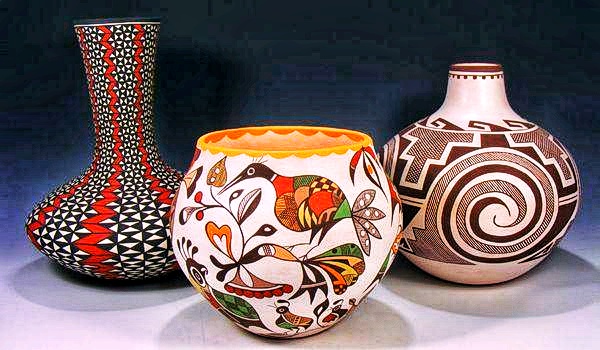
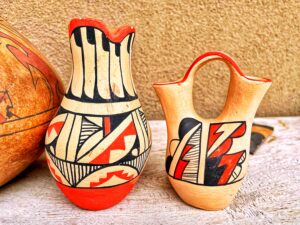
Pueblo Pottery consists of hand-coiled earthenware vessels produced at the San Ildefonso Pueblo in northern New Mexico, approximately 32 kilometers northwest of Santa Fe, constitute the defining body of work created by Maria Po’ve’ka Montoya Martinez (circa 1887 to July 20, 1980) and her collaborators across a career spanning more than seven decades. Representative pieces range in size from small bowls measuring approximately 8.3 centimeters tall and 15.2 centimeters in diameter to large jars reaching 40 centimeters in height and 49.5 centimeters in width, with forms including ollas, seed jars, plates, and bowls. The vessels are composed of locally gathered earthenware clay tempered with volcanic ash or powdered pottery sherds, fired in open-air pit kilns to temperatures between approximately 426 and 760 degrees Celsius before being smothered in a carbon-rich reduction atmosphere.
The black-on-black style, combining a polished glossy background with matte painted decoration on the same blackened surface, was developed through experimentation by Maria and her husband Julian Martinez (1879 to 1943) between approximately 1917 and 1921, inspired by prehistoric ceramic fragments excavated at Bandelier National Monument in 1908 by archaeologist Edgar Lee Hewett, founder and director of the Museum of New Mexico in Santa Fe. The earliest documented public exhibition of this pottery style occurred at the New Mexico Museum of Art in July 1920. Major institutional holdings include the Smithsonian American Art Museum and Renwick Gallery, the Metropolitan Museum of Art (accession number 2002.490), the Brooklyn Museum, the Denver Art Museum, the de Young Museum in San Francisco, the Penn Museum in Philadelphia (eight vessels signed “Marie” or “Marie and Julian”), the Museum of Indian Arts and Culture in Santa Fe (catalog number 49249/12 for a black-on-black plate measuring 35 centimeters in diameter), the Heard Museum in Phoenix, the Millicent Rogers Museum in Taos, the National Museum of the American Indian, and the Sainsbury Centre in Norwich, United Kingdom. Individual pieces have sold at auction for as much as $225,000.
Pueblo Pottery Material and Craftsmanship
Martinez gathered clay locally, in the vicinity of the San Ildefonso Pueblo, typically once per year in October when dry conditions made collection practical. The raw clay was stored in an adobe structure maintaining a stable temperature until needed. Before forming, the clay was mixed with temper consisting of either volcanic ash found near the pueblo or finely ground sherds from broken pottery. This temper reduced shrinkage during drying and firing and reinforced the structural integrity of the finished vessel. Water was added to achieve a workable consistency, and the mixture was kneaded by hand on a cloth-covered table before shaping began.
Martinez formed all vessels by hand using the ancient Pueblo coiling method, without a potter’s wheel. She built walls upward from a base by layering ropes of clay, then scraped and smoothed both interior and exterior surfaces with a tool made from a gourd. Her ability to achieve exceptionally thin, uniformly symmetrical walls was widely noted among contemporaries and contributed to her early regional reputation. The scraping and sanding stage removed surface irregularities and prepared the vessel for slip application.
An iron-bearing clay slip was applied to the dried but unfired vessel in multiple coats. This required continuous attention because the slip could not be allowed to dry before polishing was completed, as uneven drying produced streaks on the surface. Martinez polished the slip-covered surface with smooth creek stones, some passed down through generations and valued as heirloom tools. This burnishing process, the most time-consuming stage of production, compressed and aligned clay particles at the surface, creating the high-gloss finish characteristic of her work.
Julian Martinez applied decorative designs over the polished surface using a second clay slip mixed with beeweed plant extract or pulverized iron ore, applied with brushes made from yucca leaves. The painted slip, when fired, produced a matte surface in contrast to the glossy polished background, creating the distinctive two-tone visual effect within the same monochromatic black palette. Julian drew primarily on traditional Pueblo motifs including the Avanyu water serpent, feathers, rain clouds, geometric bands, and designs adapted from rock art and ancient ceramic fragments observed at archaeological sites and in museum display cases.
Form and Features
The primary vessel forms produced by Martinez and her collaborators included ollas, rounded water jars with a slightly flattened rim and marked shoulder angle; seed jars, low-profile spherical forms with small openings; plates and shallow bowls; and taller cylindrical jars. The de Young Museum holds a black-on-black jar measuring 17.8 centimeters tall and 22.9 centimeters in diameter, while the Heard Museum collection includes a black-on-black jar with gunmetal finish from 1968 measuring 26.7 centimeters tall and 24.8 centimeters wide, and a larger black-on-black jar from 1964 measuring approximately 40 centimeters tall and 49.5 centimeters wide.
The visual distinction of the ware derives entirely from surface treatment rather than applied pigment or glaze. Both the polished background and the painted decoration consist of the same iron-bearing clay material, but the difference in surface compression between burnished and painted areas produces different light-reflective properties after firing. The polished areas reflect light directly, appearing glossy and lustrous. The painted matte areas scatter light diffusely, appearing flat and dark by contrast. This differentiation remains stable because it results from physical surface structure fused permanently during firing rather than from chemical coatings applied afterward.
Signatures on the underside of vessels provide a chronological record of collaborations across Martinez’s career. Early undecorated pieces were signed “Marie.” Decorated pieces made with Julian from approximately 1925 to 1943 were signed “Marie and Julian.” After Julian’s death in 1943, works produced with daughter-in-law Santana Martinez were signed “Marie and Santana” through approximately 1956. Pieces made with son Popovi Da from 1956 until his death in 1971 were signed “Maria/Popovi.” These dated pieces, with Popovi Da adding month and year beginning in 1959, are among the most precisely documented in the body of work. Plain unsigned or self-signed pieces from the 1950s appear as “Maria Poveka,” using her Tewa given name meaning pond lily or water lily.
Function and Use
Traditional Pueblo pottery at San Ildefonso served utilitarian household purposes including food storage, cooking, and liquid containment prior to the arrival of the railroad at Santa Fe in 1880. The railroad introduced manufactured metal and ceramic goods that displaced functional pottery from daily Pueblo life. By the late 19th century, the remaining pottery production at San Ildefonso was oriented primarily toward the curio trade, with potters making small, easily transportable pieces for sale to tourists.
The black-on-black ware developed by Martinez and Julian did not serve utilitarian functions. The reduction firing that produced the black color prevented complete ceramic vitrification, resulting in a vessel that was less hard and not fully watertight compared to traditionally fired red wares. The pottery therefore could not be used for cooking or liquid storage. Its function was exclusively aesthetic and commercial, purchased by collectors, museums, and the general public as decorative objects and artworks. This reorientation of Pueblo pottery from functional vessel to art object was a deliberate outcome of the broader effort by Santa Fe cultural institutions to elevate and preserve Indigenous ceramic traditions.
Martinez demonstrated pottery-making techniques publicly at multiple world expositions including the Louisiana Purchase Exhibition in St. Louis in 1904, the Panama-California Exposition in San Diego in 1915, the Chicago World’s Fair in 1934, and the Golden Gate International Exposition in San Francisco in 1939. She also demonstrated at the Palace of the Governors in Santa Fe beginning in 1911 and sold work at the Santa Fe Indian Market established in 1922. These demonstrations increased public awareness of Pueblo ceramic traditions and created direct commercial relationships between Martinez and non-Native collectors.
Cultural Context
San Ildefonso Pueblo is a Tewa-speaking community established approximately around 1300 CE in the Rio Grande Valley of northern New Mexico. Pottery-making at San Ildefonso was a communal and traditionally female activity, with different stages of production often shared among family members and neighbors. Women typically formed and polished vessels while men contributed painted decoration. This division of labor reflected longstanding Pueblo social organization and persisted throughout Martinez’s career, with each collaborative partnership following the same general structure of Martinez forming the vessel and a male collaborator applying decoration.
The black-on-black style revived and refined by Martinez and Julian drew on a tradition of highly burnished black pottery that had been produced at nearby Santa Clara Pueblo since at least the 17th century, as well as on prehistoric ceramic traditions documented by archaeological fragments from Ancestral Pueblo sites. Hewett’s 1908 excavation at Bandelier National Monument recovered shards of ancient black-on-black biscuit ware that he sought to have recreated in full-scale form for museum display. Martinez was identified as the most skilled available potter for this commission, known specifically for her ability to produce thin-walled vessels quickly and consistently.
The formal establishment of the Santa Fe Indian Market in 1922 and the Museum of New Mexico’s concurrent fund for purchasing high-quality Pueblo pottery created institutional incentives for potters to produce fewer but better-quality pieces at higher price points. Martinez’s signed pottery, which she was encouraged to mark by museum staff and collectors beginning in the early 1920s, made her the first Pueblo potter to sign works individually, a practice that imported conventions of fine art attribution into a tradition that had been communal and anonymous. This shift had lasting consequences for how Pueblo pottery was marketed, valued, and collected throughout the 20th century.
By 1922, the black-on-black technique had been shared by Martinez with virtually all active potters at San Ildefonso Pueblo, transforming the community’s economic base. Martinez taught the firing technique to other potters within San Ildefonso and at neighboring pueblos as part of a deliberate effort to distribute economic benefit across the community rather than maintain exclusive commercial advantage.
Discovery and Preservation
The development of the black-on-black ware was not a single discovery but a prolonged experimental process spanning approximately a decade. Initial work between Maria and Julian to recreate ancient black pottery for Hewett produced undecorated vessels around 1913 that Martinez herself considered of insufficient quality. She concealed these early pieces. Further encouragement from visitors who purchased her existing black pottery in the mid-1910s prompted continued refinement.
The critical technical breakthrough involved the firing sequence. Maria and Julian determined that smothering a wood and cow chip fire with dry powdered horse manure at the correct moment of the firing cycle cut off oxygen supply while retaining heat, producing a carbon-rich reduction atmosphere that turned the entire clay body and surface black. The fire burned for approximately one hour reaching temperatures possibly approaching 760 degrees Celsius, after which the smothering process required approximately three more hours before the kiln cooled sufficiently to unload. The two-tone matte-on-glossy visual effect emerged from the differential burnishing of the surface before firing, not from any post-firing treatment, meaning the complete visual character of the piece was determined and fixed during a single firing.
The first documented exhibition of the black-on-black style occurred in July 1920 at the New Mexico Museum of Art. By the mid-1920s Martinez’s work appeared in museum collections, and publications by Hewett and others distributed awareness of her pottery beyond New Mexico. The Museum of New Mexico purchased her pieces for its collection and Hewett encouraged collectors and visiting scholars to acquire examples. Alice Marriott published a biographical account, “Maria: The Potter of San Ildefonso,” in 1948, and Susan Peterson produced a detailed technical study, “The Living Tradition of Maria Martinez,” in 1977. Richard Spivey’s “Maria” provided additional biographical documentation.
Martinez received the Craftsmanship Medal from the American Institute of Architects in 1954, honorary doctorates from the University of Colorado and the University of New Mexico, and the initial National Endowment for the Arts grant to fund a Martinez pottery workshop in 1973. Her portrait was created by American sculptor Malvina Hoffman. She was invited to the White House on four occasions. In 1978, the Smithsonian Institution’s Renwick Gallery presented a major solo exhibition of her work. The Heard Museum in Phoenix mounted an exhibition titled “Maria and Modernism” in 2024, with an accompanying scholarly catalogue, examining her relationship to American Modernist movements. Martinez’s great-granddaughter Barbara Gonzalez and other family members continue producing San Ildefonso pottery, maintaining a lineage of ceramic practice that extends across five generations.
Why It Matters
The black-on-black pottery of Maria Martinez represents a technical innovation within ancient Pueblo ceramic traditions that transformed the economic and cultural circumstances of San Ildefonso Pueblo during a period of significant disruption to Indigenous material practices in the American Southwest. The ware demonstrates how reduction firing and differential surface burnishing can produce complex visual effects within a single-material, single-firing process without the use of glazes, pigments, or any post-firing treatment. Martinez’s decision to share her techniques openly rather than maintain commercial exclusivity preserved and distributed the ceramic tradition across an entire community. The practice of signing individual pieces introduced fine art market conventions into Pueblo pottery for the first time, fundamentally altering how Native American ceramics were valued, collected, and institutionally preserved throughout the 20th century. The body of work documents the intersection of Indigenous artistic tradition, early 20th-century anthropological preservation efforts, and the emergence of a commercial market for Native American fine art in the American Southwest.
https://wikiflo.com/pawnee-morning-star-bundle/
[…] Pueblo Pottery: The Most Beautiful Black-on-Black Native American Art […]
[…] […]