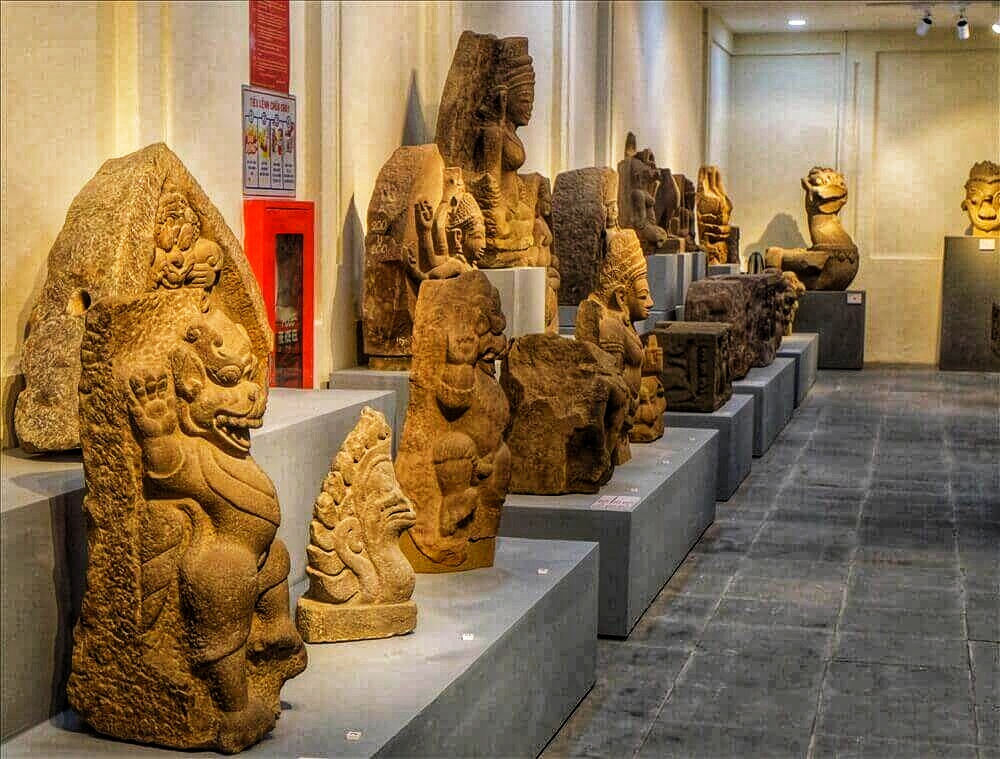
Champa Sculptures produced by the Champa Kingdom between the 5th and 15th centuries CE form the primary collection of the Museum of Cham Sculpture, located at No. 02, 2 Thang 9 Street, Hai Chau District, Da Nang City, central Vietnam, on the west bank of the Han River. The museum holds the largest collection of Champa sculptural art in the world, currently displaying more than 400 artifacts in sandstone, terracotta, and bronze across a total museum area of 6,673 square meters, with approximately 2,000 square meters dedicated to exhibition space. The collection spans ten centuries of artistic production from workshops attached to the major religious centers of the Champa Kingdom, including My Son Sanctuary in Quang Nam Province, the ancient royal capital of Tra Kieu known in Sanskrit as Simhapura, the Buddhist center of Dong Duong, and the late-period site of Thap Mam in Binh Dinh Province. Four objects in the collection carry designation as national treasures of Vietnam. The Tra Kieu Pedestal, carved in sandstone between the 7th and 8th centuries CE, measures 190 centimeters by 190 centimeters wide and 54 centimeters tall. The My Son E1 Altar, also sandstone and also dated to the 7th to 8th centuries CE, consists of 16 stone blocks of which 14 remain. The Tara Bodhisattva statue, cast in bronze and dated to the late 9th to early 10th century CE, stands 129.3 centimeters tall and is the largest Cham bronze sculpture ever found. The Dong Duong Altar, sandstone, dated to the late 9th century, consists of 24 stone blocks and received national treasure designation in 2018. Three additional objects, an Apsara dancer relief from Tra Kieu dated to the 10th century, a Brahma birth relief from My Son dated to the 7th to 8th centuries, and a Shiva statue from My Son tower C1 dated to the 8th century, received national treasure designation in 2024, bringing the museum’s total national treasures to seven. The museum was formally opened in 1919 and is recognized as a first-class national museum by Vietnam’s Ministry of Culture, Sports and Tourism, a designation it received in 2011. It is the oldest museum in Da Nang and one of the first museums built in Vietnam under French colonial administration.
Material and Craftsmanship of Champa Sculptures
Champa sculptors worked primarily in sandstone, which was quarried from sources across central Vietnam and carved by specialized workshops attached to individual temples and royal patronage networks. Sandstone was the dominant material because it was widely available across the region, could be carved with iron tools to a high level of surface detail, and was structurally suited to both freestanding sculpture in the round and to architectural relief work integrated into the brick temple towers for which Champa architecture is known. Temple towers at sites like My Son and Dong Duong were built of fired brick, and sandstone was used specifically for sculptural elements including lintels, pediments, corner pieces, and devotional images placed within the tower interiors, because brick does not hold fine surface detail.
Surface finishing on sandstone sculptures varied by period and workshop. Early pieces from the My Son E1 style, dated to the second half of the 7th century, display relatively flat, schematic relief with emphasis on linear contour and symbolic content over naturalistic modeling. Later pieces from the Tra Kieu and Dong Duong periods show a fuller command of three-dimensional volume, with figures emerging more completely from background planes and displaying greater attention to muscular anatomy, fabric drape, and expressive gesture.
Bronze casting was practiced alongside sandstone carving but produced fewer surviving works due to the vulnerability of metal objects to melting, looting, and reuse across the centuries of Champa’s decline. The Tara Bodhisattva statue is solid bronze rather than hollow cast, a technically demanding approach requiring greater quantities of metal and more controlled casting conditions than shell casting. The statue bears gemstone inlays in the eyes and forehead, a detail that indicates the level of patronage and resources available at the Dong Duong Buddhist center at the height of its activity in the late 9th century. When it was discovered in 1978, both hands had been broken off by villagers who believed the object was made of precious metal. The lotus flower held in one hand and the conch shell held in the other were removed and retained privately, with only the main figure transferred to the museum.
Terracotta was used for smaller votive objects, architectural decorations, and ornamental pieces throughout the Champa period, and a representative selection of terracotta objects is held within the museum collection alongside the dominant sandstone and bronze holdings.
Form and Features
The museum organizes its collection into galleries grouped by excavation site rather than by chronology, reflecting the scholarly convention through which Champa sculptural styles are identified by their site of origin. The four principal galleries are My Son, Tra Kieu, Dong Duong, and Thap Mam.
The My Son Gallery holds works from Champa’s most sacred temple complex, active from the 4th through the 13th centuries CE, and represents the period considered the classical phase of Cham sculptural art. The My Son E1 Altar, a national treasure, is the defining object of this gallery. It was originally a pedestal supporting a large lingam as the primary cult image of Shiva in the central temple of the My Son E1 complex. Its four exterior surfaces are carved in low relief with scenes depicting the lives of Hindu ascetics in forest settings, including figures playing musical instruments, meditating, preaching to animals, and receiving massages. The scenes are interpreted as representations of life on Mount Meru, the cosmic mountain of Hindu cosmology. A separate pediment also held at the museum from the My Son E1 tower depicts the Dawning of the Lotus Era, showing Brahma emerging from a lotus growing from Vishnu’s navel at the moment of cosmic creation.
The Tra Kieu Gallery holds works from the ancient royal capital of Champa, active primarily between the 4th and 8th centuries. The Tra Kieu Pedestal, its central national treasure, is carved on all four vertical sides with narrative reliefs depicting episodes from the Ramayana epic, making it one of only three known Champa pedestals with narrative content. The reliefs show scenes including the wedding procession of Rama and Sita, with apsara dancers and gandharva musicians rendered with particular attention to posture, jewelry, and emotional expression. At each corner of the pedestal, a crouching leonine figure serves as a load-bearing atlas supporting the structure above.
The Dong Duong Gallery holds works from the site that served as the primary Buddhist center of the Champa Kingdom in the late 9th and early 10th centuries. The sculptural style of this period is markedly different from the Hindu works of My Son and Tra Kieu, favoring broader, more frontal figures with square faces, full lips, and strong brow ridges. The Tara Bodhisattva, the gallery’s central object, stands with both palms facing outward at the hips in a gesture of reassurance and generosity, with the body rendered in a pose of composed frontality characteristic of the Dong Duong style.
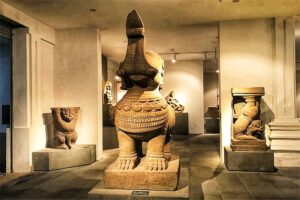
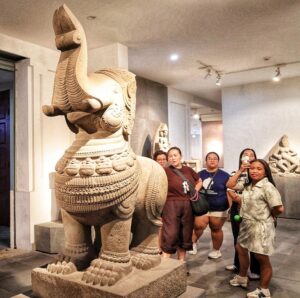
The Thap Mam Gallery holds works from Binh Dinh Province representing the later phase of Champa art from the 11th through 14th centuries. Approximately 58 metric tons of stone sculptures and architectural fragments were recovered from the Thap Mam site during a 1934 excavation. The Thap Mam style is characterized by technically proficient but formulaic work, with highly standardized figural types and decorative programs that lack the individual vitality of the earlier periods. Among the significant Thap Mam pieces is a Gajasimha, a mythological hybrid creature with the head of an elephant and the body of a lion, recognized as a national treasure and transferred to the museum in 1935.
Additional notable works distributed across the collection include a Garuda devouring a Naga, a Brahma riding a swan, Dvarapala guardian figures typically measuring between 1.5 and 2 meters tall, and relief panels depicting polo players and wrestlers that document secular court activities alongside the dominant religious themes.
Function and Use
Champa sculptures were produced as integral components of a temple system organized around Hindu and Buddhist devotional practice. The primary cult image at any Cham temple was the lingam, the abstract phallic symbol of Shiva, placed on a yoni base and positioned at the center of the temple’s inner sanctuary. The pedestals held at the museum were the structural bases on which these lingams stood, making them the most sacred architectural and sculptural elements of their respective temples. Surrounding the central lingam, the temple interior held secondary images of Shiva in anthropomorphic form, of his consort Uma or Parvati, of Ganesha, of Brahma, of Vishnu, and of the various protective guardian figures whose role was to prevent malevolent forces from entering the sacred space.
The large Dvarapala guardian figures, examples of which appear throughout the museum’s galleries, stood at temple entrances facing outward toward approaching visitors. They were typically armed and displayed fierce expressions intended to ward off spiritual threats. Their placement defined the boundary between the ordinary world outside the temple and the divine space within.
The apsara figures carved in relief on temple walls and on altars served both devotional and cosmological functions. As celestial beings inhabiting the divine realm, their presence on temple surfaces indicated that the building physically embodied a divine palace. Their portrayal in dance postures referenced the celestial performances described in Hindu cosmological literature as constant features of divine court life.
During the height of Champa’s prosperity in the 9th and 10th centuries, the Dong Duong Buddhist center received royal patronage from King Indravarman II, who founded a Mahayana Buddhist monastery there in 875 CE, the date recorded in a stone inscription found at the site that also provides the first known documentary reference to the Tara Bodhisattva statue. The Tara image functioned as the primary Buddhist devotional figure at this center, receiving offerings and ritual attention as a manifestation of the bodhisattva of compassion within the Mahayana tradition.
Cultural Context
Champa was an Indianized maritime kingdom that controlled the central and southern coastline of present-day Vietnam from approximately 192 CE until its final dissolution in 1832. Chinese chronicles of the 2nd century CE record the founding of the kingdom of Lin-Yi in the region, the name under which Champa first appears in written history. At its territorial peak, the kingdom extended from the Ngang Pass in present-day Quang Binh Province in the north to the Dong Nai River delta in Binh Thuan Province in the south, a coastal strip of approximately 1,400 kilometers. The kingdom derived its wealth from maritime trade along routes connecting China, the Indian subcontinent, the Malay Archipelago, and the Middle East, with ports at Hoi An and Da Nang serving as major commercial nodes.
The adoption of Hinduism, primarily Shaivism, and later Mahayana Buddhism by Champa’s ruling elite was part of a broader process of Indianization visible across Southeast Asia from the 1st century CE onward, through which courts from Vietnam to Indonesia adopted Indian religious, administrative, and artistic frameworks as instruments of royal legitimacy. Champa’s geographic position directly on the maritime trade route ensured sustained contact with Indian merchants, Brahmin priests, and Buddhist monks over several centuries. A Cham stone inscription dated to the 4th century CE is the oldest Sanskrit inscription found in mainland Southeast Asia.
The relationship between Champa and its neighbors was characterized by alternating periods of trade, diplomacy, and warfare. Conflicts with the Vietnamese Dai Viet kingdom to the north beginning in the 10th century progressively reduced Champa’s territory. The Viet capture of the Cham capital Vijaya in Binh Dinh Province in 1471 under Vietnamese Emperor Le Thanh Tong effectively ended Champa as a major political entity, though reduced Cham principalities survived in southern Vietnam under Vietnamese suzerainty until 1832. Today the Cham people are one of Vietnam’s 54 recognized ethnic minorities, with communities concentrated primarily in Ninh Thuan and Binh Thuan Provinces, maintaining their language, the Cham script, traditional weaving, pottery, and distinctive religious practices that blend Hinduism, Islam, and indigenous traditions. Champa Sculptures remain the most complete record of this lost civilization.
Discovery and Preservation
The process of collecting Champa sculptures into what became the museum began in 1891 when Charles Lemire, the French envoy at Tourane, the colonial name for Da Nang, collected sculptures from Tra Kieu and Khuong My temples and brought them to a public garden near the Han River that was informally called the Garden of Tourane. Lemire’s initial collection numbered approximately 50 pieces. Henri Parmentier, a French architect and archaeologist who joined the École Française d’Extrême-Orient in 1900 and headed its archaeological department from 1904 to 1932, became the central figure in building the collection and campaigning for a purpose-built museum to replace the open-air garden storage. In 1902, Parmentier formally proposed the construction of a museum building. The project was approved after Charles Gravelle, director of the French Indochina Bank, visited the sculpture garden in 1913 and wrote to the Governor-General of French Indochina requesting funding. Construction began in 1915. The first building, designed by French architects Delaval and Auclair following suggestions from Parmentier to incorporate Cham architectural motifs into a predominantly French colonial structure, opened on May 10, 1919. The museum was established specifically to house and protect Champa Sculptures. Parmentier published the museum’s first catalog the same year. The museum was initially named the Musée Henri Parmentier in his honor.
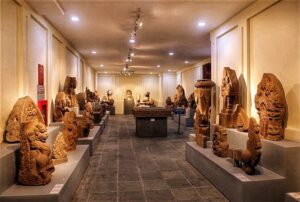
The museum expanded twice in subsequent decades. The first expansion in the mid-1930s added two new galleries to accommodate objects collected in the 1920s and 1930s, including the large sandstone assemblage from the Thap Mam site excavated in 1934. A second major renovation and expansion was completed in 2016 by Da Nang City, connecting all buildings into a single continuous visitor circuit and adding new facilities including an education center, auditorium, inscriptions gallery, pottery gallery, music gallery, and thematic rooms devoted to Cham festivals and traditional crafts still practiced by Cham communities in Ninh Thuan Province today.
The Tara Bodhisattva statue’s recovery in 1978 followed an accidental discovery by villagers digging soil for brick-making in Dong Duong village, Quang Nam. The statue had been referenced in a 9th-century inscription at the site but had escaped EFEO excavations beginning in 1902. When found, villagers removed both hands believing the figure to be precious metal, a common misidentification of bronze. The main figure was transferred to the museum. After decades of requests, the two detached hand pieces, the lotus and the conch, were eventually recovered and reattached during a restoration program, with a formal unveiling of the fully restored statue in recent years.
In 2012, the museum held 3 of the 30 objects designated in the first round of Vietnam’s National Treasure program, the highest proportion held by any single institution in that initial designation. By 2024 the museum’s national treasure holdings had grown to seven objects. Selected national treasures from the museum have traveled to France and the United States for temporary exhibitions, with the loan arrangements explicitly framed as exchanges supporting conservation and heritage promotion programs.
Why It Matters
The Museum of Cham Sculpture in Da Nang holds the only comprehensive collection in the world documenting the full arc of sculptural production across ten centuries of the Champa Kingdom, from the earliest stable period of Cham art defined by the My Son E1 style in the 7th century through the late standardized production of the Thap Mam period in the 14th century. The collection preserves the primary visual record of Hindu and Buddhist religious practice as it was translated through a distinctly Cham cultural lens across a kingdom whose own written records were largely destroyed during centuries of warfare and political collapse. The Tra Kieu Pedestal is the most complete visual evidence connecting Champa’s royal capital to the Ramayana narrative tradition and to the artistic conventions of the broader Indianized world of early Southeast Asia. The Tara Bodhisattva represents the single most significant surviving object of Mahayana Buddhist practice in Champa, a tradition that was dominant for less than a century before Shaivism reasserted primacy, making the statue a rare and precisely datable marker of a specific religious moment in the kingdom’s history. The continued presence of Cham descendants as a living ethnic minority in Vietnam, maintaining traditions directly descended from those depicted in the museum’s objects, means the collection functions simultaneously as historical archive and as active cultural reference for a community whose ancestors made everything it contains. Champa Sculptures represent an irreplaceable legacy of Southeast Asian artistic heritage.
https://wikiflo.com/epic-of-gilgamesh-tablets/
[…] https://wikiflo.com/the-remarkable-champa-sculptures-of-vietnam-5th-to-15th-century-collection/ […]